Real Touch flowers can look impressive in product photos yet disappointing in person. A fast quality check helps me separate genuinely premium stems from flowers relying mainly on marketing labels.
To quickly evaluate Real Touch flower quality, I check six things first: botanical shape, petal feel and recovery, natural color variation, surface shine, stem flexibility, and construction quality. A strong flower should look convincing from several feet away, remain detailed up close, feel appropriate to the real species, and show no obvious glue, seams, exposed wire, or rigid plastic parts.
I do not judge quality simply because a supplier calls something Real Touch, premium, or luxury. Real Touch flowers can be made from several different materials, including polyurethane, synthetic-rubber or latex-type coatings, silicone-like polymers, coated synthetic fabric, plastics, and internal wire. Different manufacturers may even use different names for similar materials.
What Should I Check First When Evaluating a Real Touch Flower?
The first inspection should take less than a minute. I begin with the complete flower rather than immediately squeezing a petal.
My quickest first-pass test is to examine the flower’s silhouette, color, surface finish, center, leaves, and stem before touching it. If the bloom has incorrect proportions, neon color, obvious shine, a crude plastic center, or a perfectly symmetrical shape, softness alone will not make it premium.
Start With the Botanical Shape
I ask one simple question:
Does this actually look like the flower it claims to represent?
A rose should have believable layers from the center outward.
A peony should have substantial depth and different petal sizes.
A tulip should have a recognizable cup shape.
An orchid should reproduce the distinctive center and petal arrangement of the real flower.
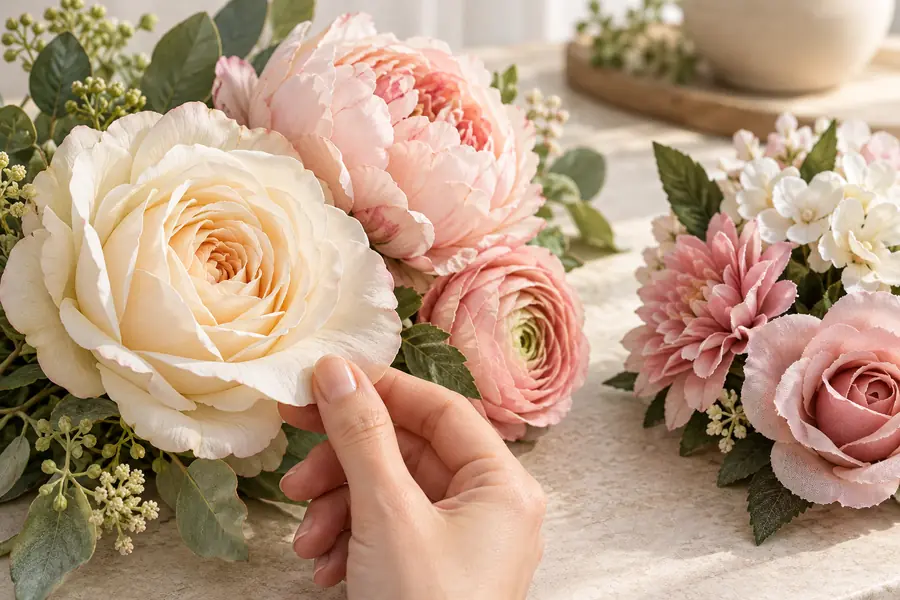
High-quality artificial flowers usually include layered petals, subtle irregularity, and depth rather than a shallow, mechanically repeated shape. Current artificial-flower quality guidance similarly identifies natural petal shapes, asymmetry, and multiple levels of openness as important realism signals.
I look for:
- Different petal sizes
- Slight variations in petal angles
- Natural bloom depth
- Correct proportions between bloom and stem
- Believable buds when included
- Species-appropriate leaf shapes
- Natural flower-center construction
If the basic geometry is wrong, I usually reject the sample immediately.
Check the Color Before the Texture
Color is one of the fastest quality filters.
Designer Melissa Reynolds’ 2026 advice on realistic faux florals puts color at the top of the inspection list and specifically warns against unnatural neon greens. Muted, botanical colors generally appear more convincing.
I do not expect a flower to be one perfectly flat shade.
A convincing white rose may contain:
cream, ivory, pale green, and warmer tones near the center.
A blush peony may have a deeper center.
Leaves may contain several related greens.
Recent 2026 quality guides also identify subtle tonal shifts and natural gradients as important differences between stronger and cheaper artificial flowers.
Flat color makes a flower feel printed.
Layered color makes it feel botanical.
Look for Excessive Shine
I move the flower under natural or strong indoor light.
If the petals reflect a hard, uniform highlight like polished plastic, I become cautious.
Real flowers can have sheen, but the reflection normally varies with the species, surface texture, veins, and petal curvature.
Current designer guidance identifies excessive gloss as one of the clearest giveaways in faux flowers. Better flowers tend to use matte or naturally reflective surfaces.
This test takes only seconds and eliminates many weak products immediately.
How Can I Test Real Touch Petal Quality in Seconds?
After the visual check, I test the petal physically.
A good Real Touch petal should feel flexible, have appropriate thickness, compress or bend without immediately creasing, and return reasonably close to its original shape. I do not expect every flower to feel equally soft because roses, tulips, orchids, peonies, and calla lilies naturally have different structures. The tactile quality should match the botanical reference.
Use the Gentle Pinch Test
I gently press the petal between my fingers.
I look for:
- Soft resistance
- Flexibility
- No cracking
- No obvious permanent crease
- Reasonable recovery
Some current Real Touch guidance describes premium petals as soft and flexible while still retaining their form.
I avoid aggressively folding or stretching a sample unless I am conducting a formal durability test because not every realistic petal is designed for extreme deformation.
The goal is not to discover whether the flower is indestructible.
The goal is to see whether normal handling feels botanical rather than brittle.
Match the Feel to the Species
This is important.
A high-quality artificial tulip may feel slightly substantial or waxy.
A rose petal may feel thinner.
A peony may require both softness and enough structure to support many layers.
An orchid may benefit from a more molded surface.
Real Touch manufacturing references explain that different flowers use different polymers and construction methods precisely because no single material reproduces every flower equally well. Coated fabric is used for some roses and peonies, while polyurethane or silicone-like materials may be selected for other flower structures.
So I do not use:
softest flower wins
as my quality standard.
I use:
most botanically appropriate feel wins.
Check Petal Edges
Edges reveal manufacturing quality quickly.
I inspect for:
- Fraying
- Thick molded ridges
- Uneven cutting
- Visible fabric fibers
- Paint buildup
- Cracks
- Flash from molding
A premium flower should not lose the illusion at its perimeter.
The edges are particularly important in roses, peonies, poppies, and tulips because they are often visible in close-up photography.
How Do I Evaluate the Stem, Leaves, and Construction?
A premium bloom attached to a cheap stem is not a premium Real Touch flower.
I check whether the stem bends naturally and holds position, whether leaves have believable veins and colors, and whether connections are discreet. Visible glue, exposed wire, rigid glossy stems, crude plastic calyxes, identical leaves, or obvious molding seams are warning signs.
Bend the Stem Gently
I want a flower stem to be adjustable.
Real flowers rarely grow perfectly vertical.
Premium artificial stems commonly include internal wire so designers can create:
- Gentle curves
- Outward-facing blooms
- Drooping tulips
- Asymmetrical bouquets
- Different stem heights
Current Real Touch guidance specifically recommends bending the stem during evaluation because flexibility makes natural arranging easier.
I bend the stem slightly and release it.
A good stem should hold a usable position without:
snapping, kinking badly, or springing back into an unnaturally straight line.
Inspect the Leaves
I look at leaves almost as carefully as flowers.
Low-quality foliage often reveals an otherwise convincing artificial bloom.
I check:
- Vein detail
- Edge shape
- Leaf thickness
- Several green tones
- Natural surface finish
- Variation in direction
- Clean attachment points
Recent quality guidance consistently identifies visible leaf texture, flexible stems, and color variation as important realism features.
Bright glossy leaves attached to a beautiful Real Touch rose can ruin the whole effect.
Examine the Calyx and Flower Center
Many buyers focus only on petals.
I look underneath the bloom.
That is where shortcuts often appear.
I inspect:
- Calyx shape
- Connection to the stem
- Flower center
- Stamens
- Adhesive
- Mold seams
Open flowers such as anemones, orchids, daisies, and lilies need especially detailed centers.
A poorly molded center becomes obvious even when the outer petals look excellent.
Search for Visible Glue
Visible adhesive is one of my quickest rejection criteria for premium work.
A little hidden construction adhesive is normal.
Large clear or yellow glue beads are not.
I check:
behind petals, around leaves, at the calyx, and near branch connections.
For wedding bouquets and luxury arrangements, these areas may appear in photographs.
How Can I Quickly Test Whether Real Touch Flowers Will Photograph Well?
Photography is one of the best quality tests because cameras expose problems that softer showroom lighting can hide.
I photograph the flower in daylight and under indoor lighting, first from normal viewing distance and then close-up. I look for unwanted glare, flat color, visible seams, obvious fabric weave, crude flower centers, and unnatural symmetry. A high-quality Real Touch flower should remain convincing when the camera moves closer.
Use Window Light
I place the flower beside a window.
Natural light reveals:
- Plastic shine
- Petal translucency
- Surface texture
- Color gradients
- Stem color
Recent Real Touch guidance also describes how premium polymer petals can respond to light differently from basic fabric flowers, with better products producing a softer, more natural visual response.
Take a Close-Up Photo
This is particularly useful for wedding professionals.
A bouquet may look excellent from six feet away but reveal:
visible seams, unfinished petal edges, glue, or flat printing
in macro photography.
A 2026 wedding-flower quality guide specifically recommends close-up photographic performance as a useful way to distinguish stronger stems from cheaper ones.
My practical rule is simple:
If the flower will appear in bridal portraits, detail photographs, product photography, luxury retail, or high-end hospitality arrangements, I perform the camera test before approving it.
Compare It With a Real Flower
When possible, I place the artificial flower beside a fresh example.
I compare:
- Petal thickness
- Scale
- Center depth
- Leaf size
- Color
- Stem proportion
- Natural shine
I do not expect the artificial flower to become indistinguishable at one inch.
I want it to remain believable at the distance relevant to the project.
How Should Professional Buyers Evaluate Samples Before Bulk Ordering?
A good individual stem is only the first stage of quality control.
For professional purchasing, I evaluate multiple samples from the same SKU and check batch consistency, packing recovery, stem strength, color matching, construction quality, and photography performance. One perfect showroom sample does not prove that 500 production stems will arrive at the same quality level.
Compare Multiple Stems
I place three or more samples side by side.
I compare:
- Bloom diameter
- Color
- Stem length
- Leaf count
- Petal placement
- Surface finish
- Flower-center alignment
- Calyx construction
I want consistency without unnatural cloning.
That sounds contradictory, but it is an important distinction.
The manufacturing quality should remain consistent.
The botanical details can include slight natural variation.
Test Packing Recovery
Artificial flowers are often compressed during shipping.
I reshape the flower and ask:
Does it recover easily?
Do petals retain severe folds?
Does the stem straighten?
Do leaves become permanently distorted?
A product that looks excellent before packing but poor after normal shipping is difficult to use commercially.
Check Material Claims
I also verify what the supplier means by Real Touch.
Real Touch flowers can use synthetic fabric coated with polymers, silicone-like materials, PVC-related systems, polyurethane, or other formulations. Manufacturing terminology is not always consistent between factories.
For substantial orders, I ask:
- What is the petal material?
- Is there a fabric core?
- Is the coating latex-type, PU, or another polymer?
- What are the leaves made from?
- Does the stem contain internal wire?
- Are material specifications consistent across production?
This information does not replace sample evaluation.
It helps explain why the sample performs the way it does.
My insights: How to Quickly Evaluate Real Touch Flower Quality
After comparing current 2026 designer guidance, Real Touch material information, and artificial-flower quality criteria, I think the most effective evaluation method is not a complicated laboratory process.
To quickly evaluate Real Touch flower quality, I use a six-part test: shape, color, touch, light, stem, and finish. The flower should have botanically accurate proportions, layered color, appropriate petal flexibility, natural light response, a shapeable stem, and clean construction. If it fails several of these checks, a “Real Touch” label does not make it premium.
My First Insight: I Can Reject Weak Flowers Before Touching Them
My first few seconds are visual.
I ask:
Does the flower shape look right?
Is the green too bright?
Are the petals excessively shiny?
Is the arrangement perfectly symmetrical?
Do I see obvious plastic?
Current designer advice supports this approach, particularly the emphasis on realistic color, controlled shine, and natural imperfection.
If the visual design already fails, I do not need a complicated material analysis.
My Second Insight: Touch Should Confirm Realism, Not Create It
A soft flower is not automatically realistic.
This is one of the biggest mistakes I see in Real Touch evaluation.
Manufacturers can make a petal extremely soft.
But if the:
shape, color, scale, center, leaves, and stem
are wrong, softness does not rescue it.
Material guides also make clear that Real Touch products use different formulations depending on the flower being reproduced.
So touch is one part of a system.
My Third Insight: The Best Quick Test Is Multi-Distance Inspection
I evaluate the flower from three distances.
Across the room: Does the silhouette look botanical?
At arm’s length: Do the color and proportions look natural?
Close-up: Do the petals, center, leaves, and construction remain convincing?
This method quickly reveals whether the flower works only as distant decoration or can also survive close inspection.
A current Real Touch supplier guide similarly recommends evaluating the complete flower both close up and from a distance rather than relying on softness alone.
My Fourth Insight: Photography Should Be Part of Quality Control
For weddings, hotels, retail displays, and interior projects, photography matters.
A flower may spend years appearing in:
wedding portraits, hotel social media, restaurant photography, retail campaigns, or interior-design images.
I therefore treat the camera test as part of professional quality control.
Strong artificial flowers should not suddenly develop:
harsh glare, obvious texture, flat colors, or visible seams
under a phone camera.
My Fifth Insight: The Stem Is a Fast Indicator of Overall Manufacturing Quality
I have found that better flower heads are usually paired with better stems.
A manufacturer that pays attention to:
wire flexibility, leaf attachment, stem texture, and clean joints
is often paying attention to the entire product.
Conversely, an expensive-looking bloom attached to a rigid bright-green plastic stem is a warning sign.
So when I need to evaluate a sample very quickly, I always bend the stem.
My Sixth Insight: Batch Quality Matters More Than One Perfect Sample
This becomes important for professional buyers.
One beautiful flower is easy to approve.
Five hundred consistent flowers are harder to manufacture.
For bulk procurement, I care about:
- Color consistency
- Bloom-size tolerance
- Stable coatings
- Reliable stem strength
- Packaging recovery
- Repeatable assembly
That is what turns a beautiful product into a usable commercial product.
My 60-Second Real Touch Quality Check
When I have only one minute, I use this sequence:
| Time | Test | What I look for |
|---|---|---|
| 0–10 sec | Shape | Correct botanical silhouette |
| 10–20 sec | Color | Gradients and natural greens |
| 20–30 sec | Surface | No excessive plastic shine |
| 30–40 sec | Touch | Flexible petal with good recovery |
| 40–50 sec | Stem | Bendable and proportional |
| 50–60 sec | Construction | Clean joints, leaves, center, and no obvious glue |
If the flower passes all six, I move to more detailed testing.
My Professional Five-Minute Check
For samples I may purchase in quantity, I add:
- Photograph the flower beside a window.
- Photograph a close-up of the center and petals.
- Inspect the reverse side.
- Bend and reposition the stem.
- Compare several stems from the same SKU.
- Check recovery after packing.
- Review the material specification.
That process gives me far more useful information than trusting the product title.
My Final View
When someone asks me “How to quickly evaluate Real Touch flower quality”, I recommend starting with the flower itself rather than the label.
First, look at the silhouette.
Then inspect the color.
Check the shine.
Touch a petal.
Bend the stem.
Turn the flower over.
Finally, photograph it.
Those steps expose most quality problems remarkably quickly.
The best Real Touch flower should remain believable at several levels.
From a distance, it should look like a real botanical form.
At normal viewing range, its colors and proportions should make sense.
Close up, the flower center, leaf veins, petal edges, and stem connections should still look carefully made.
When touched, the material should feel appropriate to the real species rather than simply rubbery or soft.
And when reshaped, the stem should give a designer enough control to create natural movement.
Most importantly, I remember that Real Touch is not one standardized material or guaranteed quality level. Manufacturers use different polymers and construction methods, and the same marketing term can cover very different products.
For professional sourcing, the fastest reliable rule is therefore:
verify the flower with your eyes, hands, and camera before trusting the label.
Conclusion
Quickly judge Real Touch flowers by shape, color, shine, petal recovery, stem flexibility, and construction. A premium label matters far less than convincing botanical performance.