
A modern home can feel flat when every surface is soft and neutral. Wrought iron adds dark contrast, craftsmanship, texture, and architectural character without overwhelming the room.
I use wrought iron in modern homes through statement lighting, furniture, mirrors and wall decor, architectural details, and smaller functional accents. The most elegant results come from using iron selectively and balancing its visual weight with warm wood, stone, linen, plaster, glass, ceramics, and greenery rather than filling the room with matching metal pieces.
Wrought iron also fits surprisingly well with current design. Interiors in 2026 are moving toward lived-in character, craftsmanship, tactile materials, vintage influence, and objects that feel personal rather than perfectly coordinated. Vogue identifies authenticity and the human touch as central themes in current interiors, while warm minimalism is combining simple forms with richer natural materials and texture.
1. Use Wrought Iron Lighting as a Statement Feature
Lighting is one of the easiest ways for me to introduce wrought iron without making the room feel themed. A single dark fixture can provide enough contrast to change the character of the entire space.
I use wrought iron chandeliers, pendants, wall sconces, and lamps when I want to add structure above eye level. For modern interiors, I prefer clean forged curves, simple frames, or sculptural shapes rather than oversized chandeliers covered in repetitive scrollwork. One strong iron fixture usually creates a more elegant result than several matching pieces.
Why Iron Lighting Works So Well
Lighting naturally draws attention.
A chandelier sits above the dining table.
A pendant defines the kitchen island.
A wall sconce creates rhythm in a hallway.
Because these objects already have a practical purpose, the metal does not feel like decoration added simply to fill space.
The iron becomes part of the architecture.
I especially like dark iron lighting against lighter materials.
A black or aged iron chandelier can stand out beautifully against:
- Warm white plaster
- Pale oak
- Limestone
- Cream linen
- Natural brick
- Soft neutral paint
The contrast creates definition without requiring another strong color.
Current interiors are also moving toward pieces that show a visible human touch rather than highly uniform, mass-produced decoration. Vogue’s 2026 trend reporting highlights a renewed interest in lived-in interiors, organic materials, and craftsmanship.
That makes forged-looking lighting particularly useful.
I Keep the Shape Appropriate to the Room
I choose the fixture according to the architecture.
For a contemporary dining room, I might use a linear iron pendant with a restrained shape.
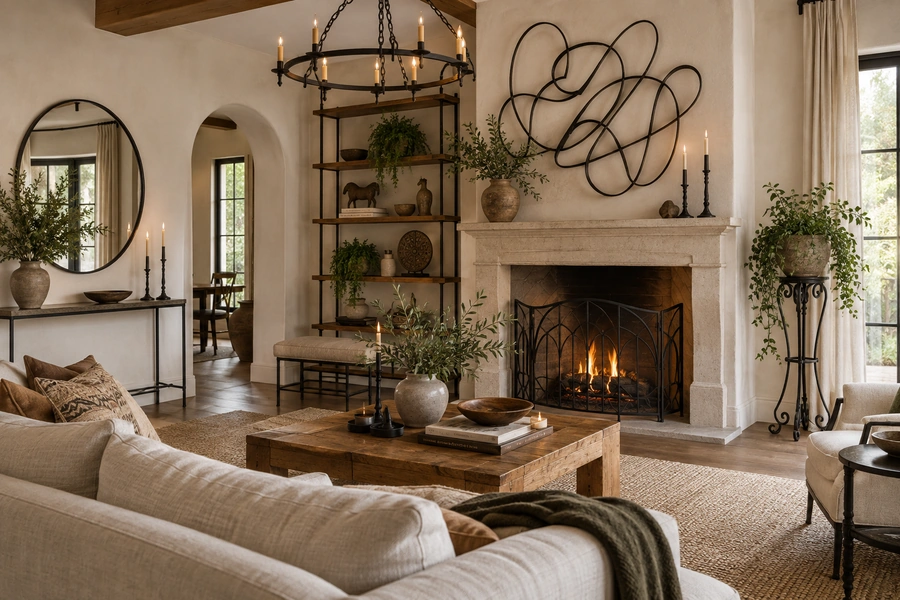
For a Spanish-style house, I can use a larger chandelier with curved forged arms.
For a warm minimalist room, I prefer a simpler iron fixture and let texture come from the wood, fabric, and stone around it.
The iron does not have to be complicated to be interesting.
In fact, the fewer decorative elements the fixture contains, the more attention I pay to proportion and silhouette.
I Avoid Matching Every Light Fixture
I do not automatically use an iron chandelier, iron sconces, iron table lamps, and iron floor lamps in the same room.
That can make the design feel too coordinated.
Instead, I may combine:
| Main fixture | Supporting material |
|---|---|
| Iron chandelier | Ceramic table lamps |
| Iron pendant | Aged brass sconces |
| Iron sconces | Linen-shaded floor lamp |
| Iron floor lamp | Glass or ceramic table lamp |
This creates layers.
The room still has a clear metal accent, but it does not feel like a furniture showroom.
2. Add Wrought Iron Furniture for Structure and Contrast
Wrought iron furniture can look surprisingly light when I choose open frames and combine the metal with warmer surfaces.
I use wrought iron in coffee tables, side tables, console tables, stools, benches, desks, and dining-table bases. I usually pair iron with wood, stone, marble, glass, leather, or upholstery. This combination gives me the strong visual lines of metal while keeping the room warm enough for everyday living.
I Prefer Mixed-Material Furniture
One of the easiest mistakes with iron furniture is choosing pieces that feel too visually heavy.
A large all-black table with thick legs can dominate a small living room.
An iron frame with a stone or glass top behaves differently.
The open frame allows light to move through it.
The contrasting material softens the metal.
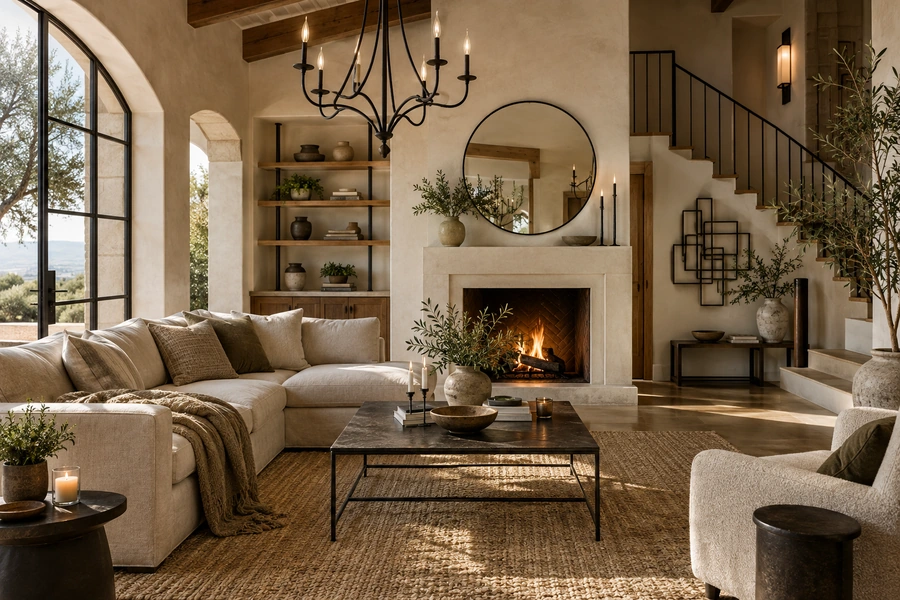
Warm minimalism provides a useful example. Homes & Gardens’ coverage of the 2026 trend includes a wrought iron coffee table within a room built from neutral tones, soft upholstery, and tactile natural materials. The iron works because it adds definition rather than becoming the entire design language.
That is the balance I try to create.
My Favorite Material Combinations
| Wrought iron piece | Material pairing | Result |
|---|---|---|
| Coffee table | Limestone or marble | Architectural and refined |
| Console | Warm oak | Balanced and natural |
| Side table | Glass | Light and open |
| Bench | Linen upholstery | Softer and more comfortable |
| Stool | Leather | Warm and collected |
| Dining base | Wood tabletop | Strong but welcoming |
I often use only one significant iron furniture piece in a room.
A wrought iron console can be enough.
If I already have a dark iron coffee table, I may choose wood or upholstered side tables rather than repeating the same material.
Iron Can Help a Neutral Room Feel More Finished
Neutral interiors can become visually soft.
Cream sofa.
Beige rug.
Pale wood.
Linen curtains.
Stone table.
All of these materials may be beautiful, but I sometimes need one darker line to give the room structure.
Iron does that efficiently.
A slim dark table leg or console frame can define the space without introducing a new color palette.
This is one reason wrought iron works so well with warm minimalism. The style keeps simplicity but avoids the coldness associated with older minimalist interiors by layering texture, earthy colors, and natural materials.
Iron becomes the contrast rather than the dominant material.
3. Decorate With Wrought Iron Mirrors and Wall Art
Wrought iron does not need to occupy floor space. A mirror or wall installation can add depth and architectural character while keeping the room open.
I use wrought iron mirrors, decorative grilles, botanical wall panels, geometric designs, and vintage architectural fragments when I want more texture on a wall. For modern living, I prefer one substantial piece with a clear silhouette instead of several small matching iron decorations. This keeps the material sophisticated rather than themed.
Wrought Iron Mirrors Can Bridge Old and New
A mirror is one of the easiest wrought iron pieces to incorporate because it is both practical and decorative.
I can choose a thin black iron frame for a modern room.
I can use an arched frame in a Mediterranean interior.
I can choose hand-forged curves for a Spanish-style home.
Wrought iron is currently appearing again within the broader revival of Spanish farmhouse interiors. Homes & Gardens describes the 2026 version of the look as lighter than the heavy Tuscan interiors associated with the early 2000s, while still using touches such as wrought iron, woven textures, and artisanal finishes.
That distinction is important.
I do not recreate the older look with dark furniture, heavy leather, terracotta everywhere, and large matching iron scrollwork.
Instead, I use one iron mirror against a lighter wall and surround it with warmer, quieter materials.
Wall Art Benefits From Negative Space
Open iron wall decor has an advantage over solid art.
The wall remains visible through it.
That empty space becomes part of the composition.
I may use:
a botanical iron panel above a console, a geometric grille above a fireplace, or an antique architectural fragment on an otherwise simple wall.
Because light passes through the design, shadows can change during the day.
That gives the iron more dimension than a flat printed piece.
I Choose One Focal Element
I usually avoid placing an iron mirror next to an iron wall panel and above an iron console filled with iron candleholders.
Each individual piece may look good.
Together, they can become a theme.
Current interiors are moving in the opposite direction. Better Homes & Gardens’ 2026 coverage describes matching décor sets as increasingly dated and favors interiors that mix textures, vintage pieces, and more individual objects.
So I let one wall element be the focal point.
Then I use ceramics, books, wood, glass, flowers, or greenery around it.
4. Make Wrought Iron Part of the Architecture
The most timeless use of wrought iron may be the one that becomes part of the house itself.
I use wrought iron for stair railings, balusters, room dividers, gates, fireplace screens, and built-in architectural details when I want the metal to feel permanent rather than decorative. Simple vertical lines work well in contemporary homes, while restrained forged curves can complement Spanish, Mediterranean, traditional, and European-inspired architecture.
Railings Can Become Functional Sculpture
A stair railing already needs to exist.
That makes it a natural place to introduce metal.
I can use a simple black iron railing with warm wood steps.
The wood softens the metal.
The iron creates definition.
For a more traditional home, I can add a controlled amount of curved ornament.
The key word for me is controlled.
I do not need every baluster to contain a large decorative scroll.
A few repeated details can create enough character.
I Match the Iron to the Architecture
I think wrought iron looks best when it has a relationship with the building.
A highly decorative railing may feel appropriate in a Spanish Revival house.
The same railing may feel forced inside a very restrained modern home.
For a contemporary interior, I often use:
- Straight vertical balusters
- Thin iron frames
- Simple curved handrails
- Repeated geometric patterns
For a more traditional interior, I may add:
- Gentle scrolls
- Forged leaves
- Decorative collars
- More visible handmade texture
The material remains the same.
The form changes.
Fireplace Screens Are an Easy Architectural Addition
If changing the railing is too large a project, a fireplace screen offers a simpler way to introduce architectural iron.
A black iron screen can create contrast against limestone, brick, plaster, or tile.
I prefer a simpler screen when the fireplace surround is already decorative.
If the fireplace itself is very plain, I can choose a screen with more character.
This keeps the visual hierarchy clear.
5. Use Smaller Wrought Iron Details to Tie the Home Together
A home does not need a large chandelier or custom staircase to benefit from wrought iron. Smaller functional details can repeat the material throughout the house without overwhelming it.
I use wrought iron through shelf brackets, plant stands, candleholders, hooks, hardware, small side tables, decorative bowls, and sculptural objects. These accents work best when I repeat the metal in small amounts and combine it with natural materials. I avoid buying complete matching sets because variation makes the interior feel more personal and contemporary.
Small Iron Details Can Create Rhythm
Imagine a kitchen with oak shelves supported by black iron brackets.
A nearby pendant contains another dark metal detail.
Across the room, an iron-framed stool repeats the color once more.
Those elements create continuity.
They do not have to be identical.
That is important because current design is becoming more comfortable with mixed metals and layered materials rather than requiring every finish to match perfectly. Better Homes & Gardens’ 2026 design reporting specifically identifies all-one-metal schemes and matching décor sets as dated compared with more layered combinations.
I therefore feel comfortable combining iron with:
- Aged brass
- Bronze
- Chrome
- Stainless steel
- Copper
The finishes should relate to the room, but they do not need to match.
Plant Stands Are Particularly Effective
I like wrought iron plant stands because they combine a rigid material with something organic.
Dark metal and green foliage naturally balance each other.
The plant softens the iron.
The iron gives the plant structure and height.
I can use a plant stand in:
a living room corner, sunroom, kitchen, entryway, or covered patio.
Terracotta pots work especially well because their warm color offsets the darker metal.
This relationship between iron and organic materials also appears in current outdoor styling. Homes & Gardens’ 2026 coverage of Sharon Stone’s patio highlights the combination of wrought iron with woven furniture and natural textures as a way to create a character-rich space rather than using metal alone.
The same principle works indoors.
I Choose Decorative Objects With Character
For smaller accessories, I prefer one object with an interesting shape rather than several generic pieces.
A hand-forged candleholder may be enough.
An aged iron bowl can sit beside ceramic objects.
A sculptural iron object can provide contrast on a wood console.
Current interiors are increasingly focused on personal storytelling rather than standardized decorative formulas. Architectural Digest’s 2026 styling coverage describes a move away from stripped-down, impersonal rooms toward spaces that show signs of life and individual character.
I think wrought iron works best in that context.
I want the piece to feel found, crafted, or intentionally selected.
How Do I Make Wrought Iron Look Modern Rather Than Outdated?
Wrought iron itself is not what usually makes a room feel old. The problem is often excessive ornament, dark matching furniture, or repeating the same scroll pattern throughout the house.
I make wrought iron look modern by using fewer pieces, choosing cleaner silhouettes, mixing it with warm natural materials, and avoiding complete sets. I also use aged, bronze, charcoal, or softened black finishes when pure black feels too strong. The goal is contrast and craftsmanship, not creating a room where every decorative element announces the same metal.
I Avoid Recreating the Heavy Tuscan Look
Wrought iron became strongly associated with certain late-1990s and early-2000s interiors.
These rooms often used dark wood, heavy leather, faux-aged walls, terracotta, and large amounts of decorative iron.
The current Spanish farmhouse revival is taking a lighter approach. Homes & Gardens notes that the contemporary version softens those older Tuscan associations with woven materials, lighter textiles, and more restrained artisanal details.
That gives me a useful rule.
I can keep the iron.
I simply change the context.
I Pair Hard Metal With Softer Materials
Iron becomes much more inviting when I combine it with materials that feel warm to the hand.
| Hard wrought iron element | Material that softens it |
|---|---|
| Iron chandelier | Linen curtains |
| Iron coffee table | Wool rug |
| Iron railing | Oak handrail |
| Iron mirror | Plaster wall |
| Iron console | Ceramic lamp |
| Iron plant stand | Terracotta and greenery |
| Iron candleholder | Natural wood table |
This is why warm minimalism works so well with iron.
I do not need to hide the metal.
I just make sure it is not the only strong texture in the room.
My insights: 5 Stunning Ways to Use Wrought Iron in Your Home: Elegant Design Solutions for Modern Living
The most useful lesson I take from current interiors is that wrought iron works best when I stop treating it as an old decorative style and start treating it as a versatile design material.
The five strongest ways I use wrought iron in a modern home are statement lighting, mixed-material furniture, mirrors and wall decor, architectural details, and smaller functional accents. These applications allow iron to add contrast, craftsmanship, depth, and structure without making the room feel heavy. I keep the result elegant by combining iron with warmer materials and using it selectively.
My First Insight: Wrought Iron Works Best as Contrast
I rarely want an entire room made visually darker by iron.
I want the material to create definition.
This is why a slim black coffee table works so well in a pale living room.
The iron creates a boundary.
The surrounding upholstery and natural materials keep the room comfortable.
I use the same idea with lighting, mirrors, and railings.
Iron acts almost like a dark pencil line within the composition.
My Second Insight: Function Makes Iron Feel Timeless
The iron pieces I trust most over time usually have a practical purpose.
A railing provides safety.
A table provides a surface.
A chandelier provides light.
A mirror reflects the room.
A bracket supports a shelf.
When iron has a functional reason to exist, it is less dependent on decorative trends.
I think this is one reason architectural iron has remained relevant through many different design periods.
My Third Insight: Craftsmanship Matters More Than Ornament
I do not judge wrought iron by how complicated the scrollwork is.
A simple forged curve can be more beautiful than twenty machine-repeated decorations.
Current 2026 interiors strongly favor authenticity and the visible human touch. Vogue describes current design as moving toward lived-in spaces, organic materials, and objects that feel personal rather than algorithmically perfect.
Wrought iron fits this direction when its craftsmanship is visible.
Hammered surfaces, slight variations, hand-forged curves, and aged finishes can add character.
I still want clean workmanship.
Handmade should not mean careless.
My Fourth Insight: Modern Wrought Iron Needs Warmth Around It
This is probably the easiest way to make wrought iron work in a contemporary home.
I do not combine every iron piece with another hard black object.
I combine it with:
wood, stone, wool, linen, clay, plaster, greenery, and warm lighting.
Warm minimalism shows why this approach works. The current style keeps clean lines while replacing the coldness of earlier minimalism with earthy colors and tactile natural materials.
Iron gives the softness structure.
The soft materials keep the iron from feeling harsh.
My Fifth Insight: Fewer Wrought Iron Pieces Usually Look More Elegant
I think restraint is the biggest difference between a modern wrought iron interior and a dated one.
If I have a strong wrought iron chandelier, I do not automatically need an ornate iron mirror.
If I have a beautiful iron staircase, I may not need decorative iron wall plaques.
If I use an iron coffee table, I can use wood or upholstered side tables.
This gives each piece enough visual space.
It also fits the broader 2026 move away from matching sets and toward layered rooms that feel collected over time.
My Simple Wrought Iron Design Formula
| Design goal | Wrought iron solution | Material I pair with it |
|---|---|---|
| Create a focal point | Chandelier or pendant | Linen and wood |
| Add structure | Coffee or console table | Stone or glass |
| Fill a wall | Mirror or grille | Plaster or painted wall |
| Add architecture | Railing or fireplace screen | Wood, brick, or stone |
| Repeat the material subtly | Brackets, stands, hooks | Ceramics and greenery |
I use this as a starting point rather than a strict decorating rule.
Every room needs a slightly different balance.
My Final Approach
When I want to introduce wrought iron into a modern home, I first ask what the room is missing.
If it needs height and drama, I consider lighting.
If it needs stronger structure at furniture level, I use an iron table.
If the wall needs depth, I choose a mirror or sculptural panel.
If I am renovating, I consider architectural iron such as a railing or fireplace screen.
If the room only needs a small amount of dark contrast, I use brackets, a plant stand, or a handmade object.
Then I stop and look at the room again.
I do not keep adding wrought iron simply because the first piece worked.
That restraint is what allows the material to feel elegant.
In 2026, interiors are increasingly moving toward authenticity, craftsmanship, warm minimalism, mixed materials, and homes that look genuinely lived in rather than perfectly coordinated. Wrought iron can fit all of those directions when I use it as one expressive material within a layered interior rather than as a complete decorating theme.
Conclusion
I use wrought iron most effectively through lighting, furniture, wall decor, architectural details, and small accents, balancing its strong lines with warm materials, craftsmanship, and thoughtful restraint.