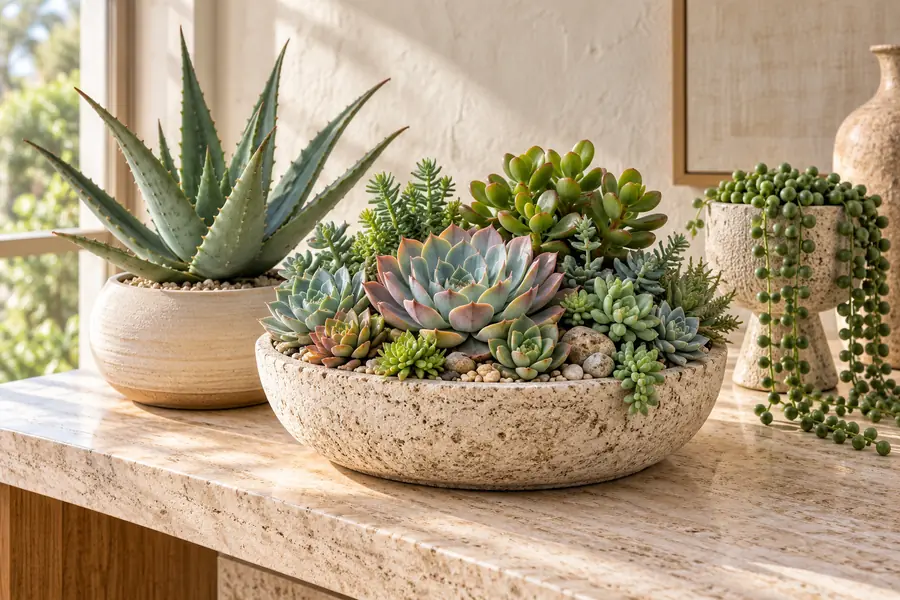

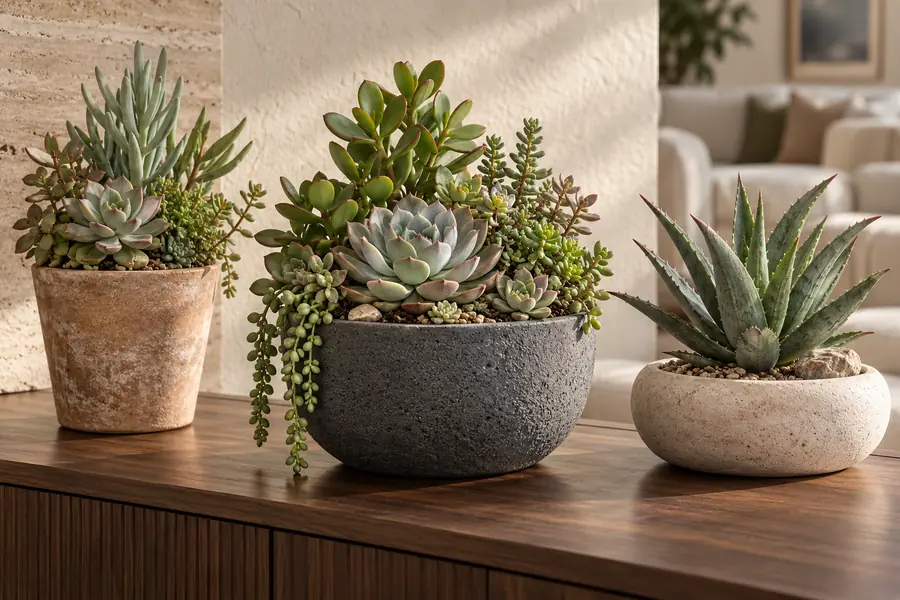
Faux succulents seem simple, yet poorly made versions can look more artificial than almost any other fake plant. Glossy leaves, flat color, identical rosettes, and cheap pots quickly give them away.
The best faux succulents for 2026 include the CB2 Potted Faux Succulent for a polished ready-made display, Afloral’s 16.5-inch potted succulent for natural terracotta styling, Nearly Natural’s faux aloe for sculptural realism, Threshold’s Succulent Capsule for value, and premium sedum, jade, agave, or trailing succulents when you want to build a custom arrangement.
The best faux succulents combine realistic species shape, leaf thickness, natural finish, color variation, appropriate scale, convincing planters, and suitable viewing distance—not brand name.
What Are the Best Faux Succulents to Buy in 2026?
Different succulents work better for different placements, so I would shop by use case rather than looking for one universal winner.
| Pick | Best for | Why I like it |
|---|---|---|
| CB2 14" Potted Faux Succulent | Best overall premium pick | Finished stoneware pot and polished presentation |
| Afloral 16.5" Potted Succulent | Best natural-material arrangement | Real terracotta pot and three succulent clusters |
| Nearly Natural 9" Aloe | Best faux aloe | Thick variegated leaves and sculptural form |
| Threshold Succulent Capsule | Best value arrangement | Mixed succulents, cement container, rock filler |
| Afloral UV-Treated Sedum | Best indoor/covered outdoor pick | UV-treated foliage and aged clay pot |
| Primrue 10.5" Faux Succulent | Best soft-touch value pick | PU/polyester construction and compact scale |
| Afloral Artificial Jade | Best DIY option | Easy to combine with your own planter |
| Pure Garden 3-Piece Set | Best multi-room set | Three small arrangements in faux-stone pots |
1. CB2 14-Inch Potted Faux Succulent — Best Overall
If I wanted one finished faux succulent that required almost no styling, CB2 would be near the top of my list.
The CB2 Potted Faux Succulent works because the plant and planter are designed as one decorative object. The foliage sits in a textured white stoneware vessel, and the overall 14-inch scale is substantial enough for a coffee table, console, shelf, or office without becoming oversized.
CB2 currently lists the plant as a plastic-and-wire artificial succulent in a textured stoneware container, while Forbes Vetted highlights the product’s realistic detailing and irregularities as reasons it stands out among faux succulents.
Why It Works
The planter is important.
Many artificial succulents arrive in tiny lightweight pots that immediately expose them as inexpensive décor.
A heavier-looking stoneware container creates visual credibility before anyone even studies the foliage.
The plant also has enough volume to function as a standalone arrangement rather than a tiny decorative filler.
Best for: Coffee tables, reception desks, bedside tables, office shelves, and modern interiors.
2. Afloral 16.5-Inch Potted Artificial Succulent — Best Natural-Material Arrangement
Afloral’s current potted arrangement is one of my favorite choices when the container matters as much as the foliage.
This arrangement combines three large artificial succulent clusters with an actual terracotta clay pot. That use of real terracotta gives the display natural surface variation and weight that many fully synthetic succulent arrangements lack.
Afloral currently specifies a 16.5-inch height, 14.75-inch width, three succulent clusters, and a material mix including plastic, poly foam, wire, and terracotta. Its current product page also carries strong customer feedback for the pot quality and overall appearance.
Why Real Materials Help
Artificial greenery often looks more convincing when it is paired with something genuinely natural.
Real terracotta provides:
warm color,
small imperfections,
mineral texture,
and believable visual weight.
That surrounding authenticity can make the synthetic leaves feel less obvious.
Best for: Sideboards, large shelves, coffee tables, home offices, and warm natural interiors.
3. Nearly Natural 9-Inch Aloe Succulent — Best Faux Aloe
Aloe is one of the easiest succulent types to reproduce successfully.
Nearly Natural’s 9-inch artificial aloe uses thick variegated leaves and darker pointed edges, giving it more botanical variation than a basic uniformly green plastic succulent. Its compact rosette shape also makes it useful where a mixed arrangement would feel too busy.
Current retail specifications describe the plant as nine inches tall with thick foliage, variegated green coloring, and spiky colored tips.
Why Aloe Often Looks Convincing
Real aloe already has a fairly rigid structure.
That works in favor of artificial materials.
A faux fern can look suspicious when every frond is stiff.
Aloe is naturally:
firm,
upright,
and architectural.
Artificial construction therefore fights the real plant less.
Best for: Desks, bathrooms, shelving, bedrooms, and Southwestern-inspired interiors.
4. Threshold Succulent Capsule — Best Value Arrangement
Budget faux plants often save money in the wrong place: the planter.
This one does better.
Threshold’s Succulent Capsule combines several artificial succulent forms with a cement container and rock filler. The mixed shapes create more natural variation than an arrangement made from identical rosettes, while the finished container means it can be displayed immediately.
Current Target product information describes the arrangement as mixed realistic-looking succulents housed in a textured cement container with rock filler. The current shopping data also shows strong customer ratings.
Why It Is Good Value
You are getting the whole composition:
foliage,
top dressing,
and planter.
That matters because buying a cheap fake succulent and then replacing its container can quickly erase the original savings.
Best for: Bookshelves, bathrooms, home offices, side tables, and inexpensive room refreshes.
5. Afloral UV-Treated Artificial Sedum — Best for Covered Outdoor Spaces
Most faux succulents should be treated as indoor décor unless the manufacturer says otherwise.
Afloral’s 16.5-inch UV-treated sedum is one of the more useful current choices when you need faux succulent greenery for a covered porch or another protected outdoor area. It arrives in an aged clay pot and is specifically marketed for indoor and covered outdoor use.
Afloral states that the plant is UV treated but also warns that greater sun exposure can accelerate fading. The product uses mostly plastic foliage with wire, foam, and a clay-style pot.
That distinction is important.
UV treated does not mean permanently fade-proof.
For long-term exterior use, sunlight intensity, heat, moisture, and exposure still matter.
Best for: Covered porches, sheltered balconies, entry tables, and sunrooms.
6. Primrue 10.5-Inch Faux Succulent — Best Compact Soft-Touch Value
For a smaller decorative plant, material choice becomes increasingly noticeable because people view it more closely.
This Primrue succulent is interesting because its current specifications use a combination of polyurethane and polyester rather than describing the foliage simply as conventional rigid plastic. At 10.5 inches tall, it is large enough for a shelf or desk without requiring floor space.
The current listing describes the plant as a low-maintenance faux succulent made from polyurethane and polyester materials, with a compact 10.5-by-6-inch footprint.
I would consider it where people will see the plant from normal desk or shelf distance.
Best for: Offices, desks, narrow shelves, bedside tables, and small apartments.
7. Afloral Artificial Jade — Best for DIY Styling
Sometimes the best faux succulent is not sold as a finished arrangement.
Afloral’s artificial jade is a useful choice when you already have a good planter and want to control the final styling yourself. Jade’s naturally fleshy, relatively simple leaves make it a forgiving species to reproduce artificially.
The current Afloral listing sells the seven-inch artificial jade as loose greenery intended to be styled in a container of the buyer’s choice.
Why DIY Can Look Better
Preassembled artificial arrangements often repeat the same spacing and shape.
When you build your own, you can:
adjust height,
change direction,
combine species,
and choose better containers.
The result can look much less mass-produced.
Best for: Custom ceramic pots, terrariums, wedding décor, centerpieces, and DIY arrangements.
8. Pure Garden 3-Piece Artificial Succulent Set — Best Multi-Room Value
If the goal is to distribute a little greenery across several small spaces, a set can make more sense than one larger plant.
Pure Garden’s three-piece faux succulent set offers several small artificial plants in faux-stone containers, making it useful for desks, bathrooms, shelving, or separate rooms.
Current product data shows strong customer ratings and three assorted-size arrangements designed to mimic real succulents while requiring no plant care.
I would not use all three directly beside one another.
Separating them makes each arrangement feel more intentional and reduces the obvious “matching set” effect.
Best for: Multiple shelves, office desks, guest rooms, bathrooms, and budget decorating.
What Makes the Best Faux Succulents Look Real?
Artificial succulents are most convincing when the manufacturer reproduces the characteristics that make real succulents distinctive.
The most realistic faux succulents have thick dimensional leaves, subtle tonal variation, matte or softly waxy surfaces, believable centers, species-appropriate shapes, and correctly scaled containers. Excessive gloss, paper-thin leaves, one flat shade of green, repeated molds, and visible foam are the most obvious giveaways.
Real Simple’s broader fake-plant guidance recommends paying attention to size, materials, realistic foliage, and the relationship between the plant and its container. Its styling guidance also recommends adding natural materials such as moss or soil-like coverings and introducing imperfections rather than making faux plants perfectly uniform.
Leaf Thickness Comes First
Succulents store water in fleshy leaves.
That means thin foliage is immediately suspicious.
A realistic echeveria should appear layered and substantial.
Aloe should feel thick and upright.
Jade should have rounded fleshy leaves.
Agave should look firm and architectural.
Matte Does Not Mean Completely Dull
Many real succulents have waxy surfaces.
The goal is not to eliminate every reflection.
The goal is to avoid the hard, uniform shine associated with inexpensive molded plastic.
Color Variation Is Crucial
Real succulents can contain:
blue-green,
gray-green,
pink,
red,
purple,
cream,
and yellow-green
within a single plant.
Subtle variation makes artificial foliage much more convincing.
Are Real Touch Faux Succulents Better?
Sometimes—but “Real Touch” should not be treated as a universal quality guarantee.
Real Touch materials can improve close-up realism by giving foliage a softer or more flexible surface, but molding, pigmentation, leaf thickness, seams, and botanical accuracy still determine whether the finished succulent looks convincing. A well-designed conventional molded succulent can look better than a poorly shaped product carrying a premium material label.
This is particularly important for online shopping.
Do not stop at:
“Real Touch.”
Look at:
close-up photography,
leaf edges,
center construction,
and side views.
The plant still has to resemble the species it claims to reproduce.
Which Faux Succulent Types Usually Look Best?
Some species adapt better to artificial manufacturing than others.
| Succulent type | Why it works well artificially |
|---|---|
| Aloe | Naturally rigid, thick leaves |
| Agave | Strong architectural form |
| Jade | Simple fleshy leaves |
| Sedum | Dense texture hides attachment points |
| Echeveria | Sculptural rosette can work with quality molding |
| String of pearls | Cascading silhouette reads well from distance |
| Haworthia | Compact geometry suits molded materials |
Agave and Aloe Are Particularly Safe Choices
Both naturally have firm structural leaves.
That means artificial rigidity is not automatically a giveaway.
Echeveria Requires Better Surface Quality
Echeveria can look beautiful when manufacturers reproduce:
leaf thickness,
powdery color,
and soft gradients.
Cheap versions often look like plastic flowers because every leaf is thin, identical, and perfectly spaced.
How Do You Make Faux Succulents Look More Realistic?
Even a good product can benefit from better styling.
The easiest way to improve faux succulents is to pair them with believable natural-looking containers and top dressing. Terracotta, matte ceramic, cement, stoneware, gravel, and coarse mineral textures usually work better than tiny glossy plastic pots.
Real Simple’s current advice on making artificial plants look real also recommends introducing natural elements and imperfect styling rather than leaving faux plants in their factory presentation.
For succulents specifically, I would focus on four visual layers:
Plant: believable foliage.
Planter: correct scale.
Surface: gravel or realistic top dressing.
Placement: somewhere a real succulent could plausibly receive light.
A fake succulent does not need sunlight.
But placing one beside a bright window often makes the visual story more believable.
Are Cheap Faux Succulents Worth Buying?
They can be.
Inexpensive faux succulents can work very well on shelves, in bathrooms, or in areas viewed from several feet away. Premium products become more worthwhile when the plant sits on a coffee table, reception desk, dining table, or another location where people see the foliage closely.
This is why I use viewing distance as a purchasing rule.
| Viewing distance | What matters most |
|---|---|
| Under 2 feet | Texture, seams, leaf thickness |
| 2–5 feet | Color, planter, proportions |
| 5+ feet | Overall silhouette and scale |
A high shelf does not necessarily need expensive Real Touch foliage.
A wedding centerpiece does.
How Do Faux Succulents Compare With Living Succulents?
Faux plants solve different problems.
Artificial succulents require no watering, drainage, sunlight, soil, or plant-care knowledge. Living succulents provide actual growth and natural variation but still need appropriate light and watering. Faux versions are particularly useful in windowless offices, dark bathrooms, vacation homes, inaccessible shelves, and commercial interiors where consistency matters.
Artificial does not mean maintenance-free in the literal sense.
Dust still accumulates.
CB2 recommends cleaning its faux succulent with a soft dry cloth, which is typical of many decorative artificial plants.
A dusty fake succulent can look less convincing than an inexpensive clean one.
My insights: What Are the Best Faux Succulents
After comparing current 2026 products, editorial recommendations, manufacturer specifications, materials, planters, and different use cases, I think the best faux succulent depends less on brand prestige than on where it will be seen.
What Are the Best Faux Succulents? For a polished finished display, I would choose the CB2 14-inch Potted Faux Succulent. For a more natural terracotta look, Afloral’s 16.5-inch arrangement is excellent. Nearly Natural’s aloe works well as a single sculptural plant, Threshold offers strong budget value, and loose jade or sedum stems are better when you want to build a custom arrangement.
My First Insight: Succulents Are One of the Best Categories to Buy Artificial
Their natural biology helps.
Many real succulents are already:
firm,
geometric,
and slow-moving.
Artificial materials can imitate those qualities more easily than they can reproduce a delicate fern or translucent flower petal.
That makes faux aloe, agave, jade, and sedum particularly forgiving.
My Second Insight: The Planter Can Matter Almost as Much as the Plant
Compare two identical artificial succulents.
Put one in:
a tiny plastic nursery pot.
Put the other in:
real terracotta with gravel.
The second usually looks more convincing immediately.
That is one reason I rate Afloral’s terracotta arrangement and CB2’s stoneware succulent highly: the container is already part of the finished design.
My Third Insight: More Plants Do Not Automatically Create More Realism
A dense arrangement containing eight identical rosettes can look less natural than three well-chosen forms.
I prefer controlled variety.
For example:
one aloe,
one echeveria,
one sedum cluster.
Their shapes differ, but the colors can relate.
My Fourth Insight: Real Touch Matters Most at Close Range
If someone can touch the plant, tactile quality becomes valuable.
If the succulent sits eight feet away on a shelf, tactile realism has almost no design value.
Spend according to where the plant will live.
My Fifth Insight: Outdoor Faux Succulents Are a Separate Category
Indoor artificial plants should not automatically be moved outdoors.
Afloral’s UV-treated sedum is explicitly intended for indoor and covered outdoor settings, yet even the manufacturer notes that stronger sun exposure accelerates fading.
For outdoor use, I would prioritize:
UV suitability,
weather exposure,
stability,
and replacement expectations
before close-up realism.
My Sixth Insight: Budget Faux Succulents Can Be Excellent Styling Tools
Threshold is a good example.
Its plant is not competing on premium tactile materials.
It competes by delivering:
mixed forms,
a cement-style container,
rock filler,
and useful scale.
That complete composition can matter more than an expensive loose stem placed badly.
My Seventh Insight: I Would Buy Fewer, Better Succulents
Artificial greenery starts looking artificial when it appears everywhere.
Instead of six small fake succulents scattered around a room, I would often use:
one substantial mixed arrangement
and
one smaller sculptural plant.
The greenery becomes intentional instead of repetitive.
My 2026 Shortlist
Best overall: CB2 Potted Faux Succulent
Best natural-material arrangement: Afloral Potted Artificial Succulent
Best faux aloe: Nearly Natural Aloe Succulent
Best budget arrangement: Threshold Succulent Capsule
Best covered-outdoor option: Afloral UV-Treated Sedum
Best compact value: Primrue Faux Succulent
Best DIY option: Afloral Artificial Jade
Best multi-room set: Pure Garden 3-Piece Succulent Set
My Final View
The best faux succulents do not succeed because they contain the most leaves or use the most impressive marketing terminology.
They succeed because they imitate the things people subconsciously expect from real succulents:
thick leaves, muted surfaces, dimensional shapes, subtle color variation, believable centers, and appropriate pots.
For the most polished ready-made option, I would start with CB2’s Potted Faux Succulent, which is also the current succulent recommendation in Forbes Vetted’s broader best-fake-plant guide.
For a warmer, more natural presentation, Afloral’s terracotta-potted arrangement is particularly strong.
For budget-conscious decorating, Threshold’s Succulent Capsule provides a convincing finished composition without requiring a separate planter.
Ultimately, I would choose according to viewing distance, planter quality, species, placement, and intended use rather than trying to find one artificial succulent that is universally best.
Conclusion
The best faux succulents combine realistic leaf thickness, muted texture, natural color variation, and quality containers. Buy according to viewing distance and placement—not simply price or leaf count.