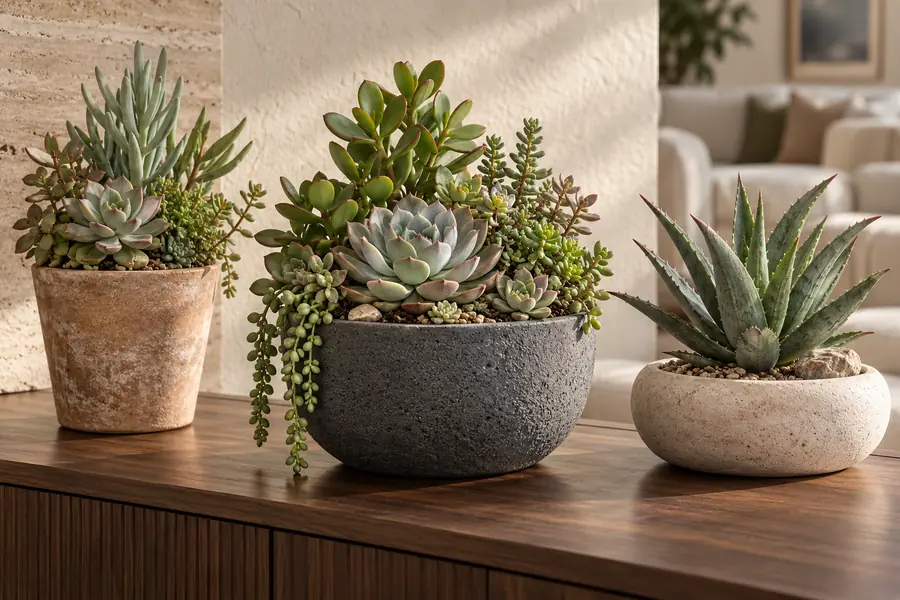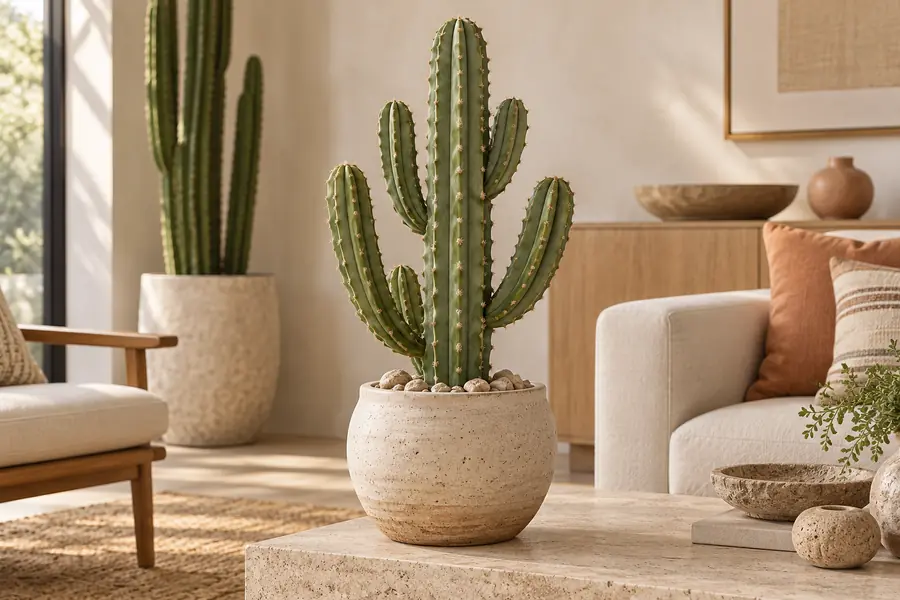

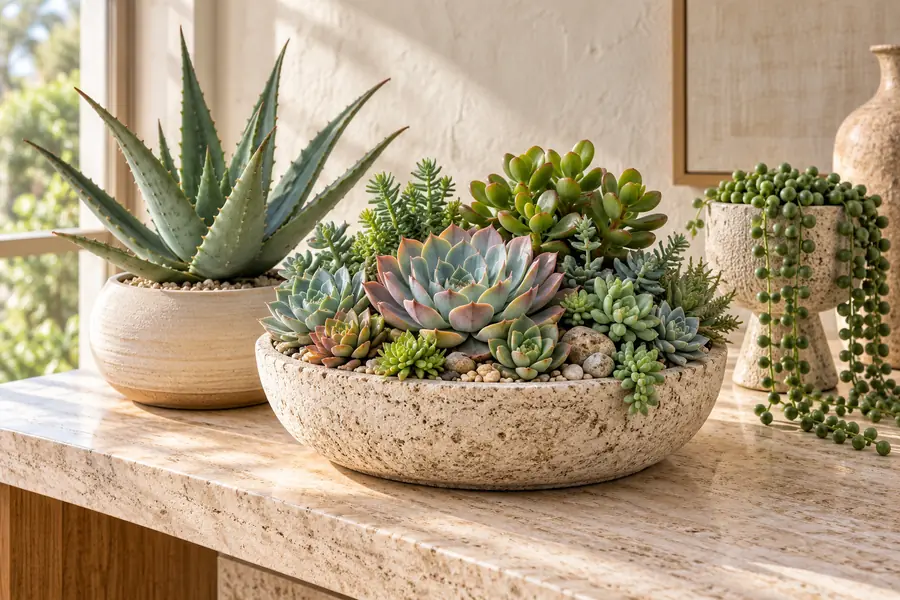
Succulents seem easy to reproduce, yet cheap versions often look unmistakably plastic. Excessive shine, identical leaves, flat green coloring, and unrealistic pots quickly reveal the illusion.
The most realistic fake succulents available in 2026 include Afloral’s potted succulent arrangement and Real Touch sedum, Nearly Natural’s 9-inch aloe succulent, Threshold’s Succulent Capsule, realistic faux agave plants from House of Silk Flowers, and high-quality string-of-pearls or jade stems. The best examples use thick textured leaves, subtle color variation, realistic growth patterns, and properly scaled planters.
Realistic artificial succulents depend on viewing distance, texture, scale, and placement. Their sculptural leaves work well in molded materials, but glossy finishes reduce realism significantly.
Which Fake Succulents Look the Most Realistic in 2026?
There is no universal laboratory ranking for faux-succulent realism, so I would compare current products by botanical shape, materials, coloration, scale, planter quality, and how much styling is required.
| Pick | Best for | Why it stands out |
|---|---|---|
| Afloral Potted Artificial Succulent Plant | Best overall arrangement | Large clusters, color variation, terracotta pot |
| Afloral Real Touch Sedum Pick | Best tactile realism | Soft-touch finish and green-gray color |
| Nearly Natural 9" Aloe Succulent | Best aloe | Thick variegated leaves and colored tips |
| Threshold 8" Succulent Capsule | Best ready-made budget arrangement | Mixed plants, cement planter, rock filler |
| House of Silk Flowers Faux Agave | Best architectural succulent | Thick leaves and strong 360-degree form |
| Afloral String of Pearls | Best trailing succulent | 33 cascading vines and root-ball construction |
| Afloral Artificial Jade | Best DIY potting option | Simple fleshy-leaf structure |
| Afloral Artificial Agave | Best small agave | Soft-textured molded foliage |
1. Afloral Potted Artificial Succulent Plant — Best Overall
For a complete tabletop arrangement, Afloral currently has one of the strongest combinations of plant detail and finished presentation.
The 16.5-inch Afloral potted arrangement uses three large succulent clusters in a real terracotta clay pot. Its mix of plastic, poly foam, wire, and other materials creates more variation than a single molded plant, while the substantial container keeps the composition from looking like a cheap desk accessory.
Afloral currently lists the arrangement at 16.5 inches tall by 14.75 inches wide. Customer reviews on the current product page repeatedly praise the color detail, substantial pot, and ability to pass visually as a real plant.
Why I like it:
The leaves are large enough to show dimensional detail.
The arrangement uses several forms rather than repeating one identical rosette.
And the terracotta pot adds genuine material texture around the synthetic foliage.
That final point is important. Real materials surrounding artificial greenery often improve the whole illusion.
Best for: Coffee tables, consoles, office reception areas, sideboards, and large shelves.
2. Afloral Real Touch Sedum Pick — Best for Close-Up Texture
When the plant will be viewed closely, surface feel matters more.
Afloral’s Real Touch Sedum Pick is one of the more interesting options for custom succulent arrangements because it is specifically designed to reproduce both the appearance and tactile quality of sedum. Its muted green-gray color is also more convincing than the bright uniform green common in inexpensive faux plants.
The current 7.5-inch pick is made primarily from PVC with paint and wire and is marketed as a Real Touch product. Afloral recommends combining several picks with other succulent forms for custom arrangements.
I would use this for:
- Small mixed planters
- Wedding arrangements
- Centerpieces
- Close-up shelf décor
The disadvantage is that one pick is not a finished plant.
You need to design the arrangement yourself.
That is also its strength: you can mix several species and avoid the repetitive appearance of preassembled mass-market succulent bowls.
3. Nearly Natural 9-Inch Aloe Succulent — Best Faux Aloe
Aloe is one of the easier succulent forms to reproduce because the eye reads the entire spiky silhouette before inspecting tiny details.
Nearly Natural’s 9-inch artificial aloe is a strong realistic option because it combines thick leaves, variegated green coloration, and darker pointed edges rather than using one uniform plastic tone.
The current model measures approximately 9 inches high and 12 inches wide. Nearly Natural describes it as an indoor decorative plant with thick variegated leaves and colored tips; its current product page also includes a buyer review specifically praising its realistic appearance.
Why Aloe Works Well as a Faux Plant
Real aloe has:
thick leaves,
a relatively simple radial form,
and naturally firm structure.
Artificial materials can reproduce those features effectively.
The species does not require delicate stems or translucent petals, so manufacturers can focus on:
shape,
edge coloration,
and surface texture.
Best for: Desks, bathroom shelving, bookcases, and Southwestern-inspired rooms.
4. Threshold 8-Inch Succulent Capsule — Best Ready-Made Budget Arrangement
A budget faux succulent often fails at the planter.
Threshold avoids much of that problem by selling the plant as a complete tabletop object.
The Threshold Succulent Capsule combines several artificial succulent forms with a textured cement container and rock filler. The variety of leaf shapes makes the arrangement more convincing than a group of identical rosettes, while the heavy-looking planter creates a finished appearance straight from the box.
Target currently lists the arrangement as 8 inches high and 11.8 inches wide, with plastic greenery, a cement container, and rock filler. It has a strong current rating, and recent verified reviews repeatedly comment on the plants’ realistic appearance.
The main limitation is material.
It is still plastic foliage.
From very close range, premium Real Touch products may look more convincing.
But at normal bookshelf or console distance, the complete composition is strong.
Best for: Bookcases, bathrooms, consoles, coffee tables, and budget decorating.
5. House of Silk Flowers Faux Agave — Best Architectural Succulent
Agave is an excellent choice when you want a plant to behave almost like sculpture.
The House of Silk Flowers faux agave sold through Corrigan Studio is one of the most convincing larger-format succulent styles because its thick leaves spread in a strong 360-degree rosette. Realistic color variation and dimensional foliage reduce the flat, repetitive look common in cheaper artificial agaves.
Current Wayfair listings offer the design in several sizes, including approximately 13-inch and 20-inch versions. The product is handcrafted and designed for viewing from all sides.
Why Agave Is a Good Faux Species
Real agaves naturally have:
stiff leaves,
architectural symmetry,
and minimal movement.
Those are characteristics that artificial materials can imitate without looking unnatural.
In fact, a rigid faux agave can sometimes look more convincing than a rigid faux fern, because rigidity belongs to the real plant.
Best for: Modern interiors, large consoles, floor planters, offices, and minimalist spaces.
6. Afloral String of Pearls — Best Trailing Faux Succulent
Most faux-succulent lists focus entirely on rosettes.
A trailing plant adds useful variation.
Afloral’s faux String of Pearls is one of the more convincing choices for shelves because its 33 hanging vines vary in length and emerge from a root-ball-style base. That irregular cascading structure is more believable than a handful of perfectly identical plastic strands.
The current drop-in plant measures approximately 17 inches tall and 18 inches wide and uses plastic, wire, and paper construction. Its product page currently carries favorable reviews for realism at both close and normal viewing distances.
Because it is sold as a drop-in rather than a finished potted plant, you can pair it with:
- Aged terracotta
- Matte ceramic
- Stoneware
- Hanging planters
That flexibility helps create a more customized final look.
Best for: Shelves, kitchen cabinets, hanging pots, and high bookcases.
7. Afloral Artificial Jade — Best for DIY Arrangements
Jade is another succulent that translates well into artificial form.
Faux jade works because the real plant already has simple, fleshy oval leaves and sturdy stems. A good artificial version does not need complex botanical detail; it mainly needs believable leaf thickness, color, and branching.
Afloral’s current 7-inch artificial jade bush is specifically designed as a lifelike loose plant that can be placed into a container of your choice.
I would choose this type of product if I already own a good planter.
A cheap factory pot often reduces realism more than the plant itself.
8. Afloral Artificial Agave — Best Small Sculptural Pick
For smaller custom arrangements, Afloral’s 6-inch agave is another strong option.
This compact agave uses polyethylene, PVC, wire, and dye to create thick radiating leaves with a softer surface than many inexpensive rigid-plastic succulents.
Afloral currently describes the foliage as having a soft, lifelike texture and recommends using it in custom pots or Southwest-inspired arrangements.
Because the plant is only around six inches tall, close-up quality matters.
I would pair it with a simple:
terracotta,
concrete,
or matte stoneware
planter rather than anything overly decorative.
What Makes a Fake Succulent Look Real?
Succulent realism comes from a different set of details than artificial trees.
The best fake succulents have thick three-dimensional leaves, matte or waxy surfaces, gradual color transitions, believable edge coloration, irregular leaf spacing, accurate botanical proportions, and convincing soil or planter materials. Glossy plastic, identical leaves, neon greens, and perfectly repeated rosettes are the biggest warning signs.
Real Simple’s broader fake-plant buying guidance similarly recommends looking for matte rather than overly shiny foliage, natural-looking textures, realistic stems, and planters appropriate to the plant and room.
1. Look for Leaf Thickness
This may be the single most important feature.
Real succulents store water in thick leaves.
A paper-thin fake echeveria cannot convincingly imitate that.
When comparing products, view side-profile photos.
The leaves should appear:
fleshy,
rounded,
or appropriately rigid
depending on the species.
2. Avoid One Flat Shade of Green
Living succulents often contain complex color.
An echeveria might combine:
blue-green,
gray,
pink,
and purple.
Aloe may have:
dark tips,
variegation,
or small tonal changes.
Sedum can shift from:
green
to yellow-green
to gray-green.
Subtle gradients create realism.
3. Species-Appropriate Shine Matters
A fake succulent does not need to be completely matte.
Some living succulent leaves have a soft waxy surface.
What looks wrong is hard plastic gloss.
I prefer a finish that reflects light softly rather than producing bright highlights.
4. Check the Center of Rosettes
Cheap echeveria often reveals its construction at the center.
The leaves may meet around:
a visible plastic peg,
an unnatural hole,
or a perfectly circular molded joint.
Premium products hide that transition much more effectively.
5. Look at the Undersides
Retail photos concentrate on the best angle.
But succulent leaves often expose their undersides.
I inspect:
- Mold seams
- Paint coverage
- Attachment points
- Wire
- Color consistency
The plant needs to work from more than one viewing angle.
Which Succulent Types Are Easiest to Reproduce Realistically?
Some species are naturally better candidates for artificial manufacturing.
Agave, aloe, jade, sedum, echeveria, and string-of-pearls forms are among the strongest faux-succulent categories because their thick leaves, strong silhouettes, and relatively simple botanical structures translate well into molded synthetic materials.
Agave
Probably the easiest.
Its rigid architecture works naturally with molded materials.
Aloe
Also highly forgiving.
Good versions use thick leaves with colored tips and slight variegation.
Echeveria
Potentially very realistic, but manufacturers need to reproduce the powdery color and fleshy layered rosette correctly.
Sedum
Excellent for mixing.
Small sedum elements break up arrangements and introduce texture.
Afloral’s current sedum products include both Real Touch picks and fully wired bushes designed for custom arrangements.
Jade
Simple thick leaves make the species forgiving, although stems need to look believable.
String of Pearls
Works especially well from slightly greater viewing distances where the overall cascading silhouette is more important than each individual bead.
How Should You Style Artificial Succulents So They Look Real?
Buying the plant is only half of the result.
To make fake succulents look realistic, use a planter appropriate to their scale, conceal factory foam, add natural-looking gravel or mineral top dressing, vary plant heights and species, avoid perfect symmetry, and place the arrangement where a real succulent could plausibly receive bright light.
Upgrade the Pot
Succulents look particularly convincing in:
- Terracotta
- Unglazed ceramic
- Concrete
- Stoneware
- Matte pottery
These materials naturally fit desert and succulent planting.
Hide Foam Completely
Visible foam instantly reveals an artificial arrangement.
Cover it with:
gravel,
coarse sand,
small stones,
or a mineral top dressing.
The filler should look dry and natural.
Do Not Use Perfectly Identical Plants
A bowl containing five identical fake echeverias can look manufactured.
Instead, mix:
one tall aloe,
one rosette,
low sedum,
and perhaps one trailing form.
Different forms create a more botanical composition.
Place Succulents Near Plausible Light
They do not require sunlight.
But real succulents usually do.
Placing artificial succulents on:
bright shelves,
windowside tables,
or sunny-looking consoles
helps the visual story make sense.
Keep Them Clean
Dust is particularly visible in rosette centers and between agave leaves.
Use a soft brush, microfiber cloth, or care method appropriate to the specific product.
Are Expensive Fake Succulents Worth It?
Not always.
Premium artificial succulents are most worthwhile when the plant will be viewed closely or used as a permanent focal point. For a high shelf or distant arrangement, shape and color may matter more than Real Touch material. The smartest strategy is to spend according to viewing distance.
This is consistent with The Spruce’s broader fake-plant testing: its testers emphasized how plants appear in actual rooms rather than demanding perfect close-up replication from every product.
Spend More When:
- The plant sits on a coffee table.
- It is part of a wedding centerpiece.
- Guests can touch it.
- It appears in product photography.
- It is used in luxury commercial interiors.
Spend Less When:
- It sits on a high shelf.
- It is part of a larger mixed arrangement.
- It is viewed from several feet away.
- The planter and room styling do most of the visual work.
Planter Quality Can Matter More Than a Small Foliage Upgrade
A $30 faux succulent in excellent pottery may look more convincing than a $70 plant left in a cheap plastic nursery container.
That is why Threshold’s cement planter and Afloral’s terracotta arrangement stand out: the finished container already supports the illusion.
My insights: What Are the Most Realistic Fake Succulents Available
After comparing current 2026 retail products, materials, customer feedback, and broader artificial-plant testing, I think fake succulents are one of the easiest artificial plant categories to get right—but also one of the easiest to ruin with poor surface finish.
What Are the Most Realistic Fake Succulents Available? My strongest overall choices are Afloral’s potted mixed succulent and Real Touch sedum for close-up realism, Nearly Natural’s aloe for a single sculptural plant, Threshold’s Succulent Capsule for affordable ready-made décor, and high-quality faux agave for architectural impact. The best choice depends primarily on viewing distance and intended scale.
My First Insight: Texture Matters More Than Leaf Count
With artificial trees, canopy volume can matter.
With succulents, it matters much less.
One exceptionally realistic aloe can look better than a bowl packed with 20 cheap rosettes.
The eye focuses on:
surface,
thickness,
and silhouette.
I would buy fewer, better forms.
My Second Insight: Succulents Reward Matte Materials
Cheap artificial plants often fail because their leaves are too shiny.
This is especially damaging to succulents.
Many real succulents have:
powdery,
waxy,
or softly textured
surfaces.
A bright glossy finish immediately breaks the illusion.
That is why Real Touch sedum and softly textured agave products are particularly interesting for close-up applications.
My Third Insight: Agave May Be the Safest Artificial Succulent
If someone asked me which species is easiest to fake convincingly, I would probably choose agave.
Its real structure is already:
rigid,
sculptural,
and symmetrical.
Those traits work with molded plastic rather than fighting against it.
Current House of Silk Flowers agave designs use thick leaves and color variation specifically to create that architectural appearance.
My Fourth Insight: Mixed Arrangements Need Controlled Variety
More species are not automatically better.
A realistic succulent bowl might contain:
three or four forms.
A chaotic bowl of ten unrelated plastic plants can look like craft-store décor.
I would repeat colors while changing shapes.
For example:
gray-green echeveria
+
deep-green aloe
+
small sedum
+
one trailing element.
That creates variation without visual confusion.
My Fifth Insight: Real Materials Help Artificial Plants
This is one of the easiest realism tricks.
Use artificial greenery with:
real terracotta,
real stone,
real gravel,
or real ceramic.
Afloral’s potted arrangement benefits from this approach because the synthetic plant sits in an actual terracotta clay container.
The eye sees enough authentic texture that the composition feels less synthetic overall.
My Sixth Insight: Budget Options Can Be Very Convincing at Normal Distance
The Threshold Succulent Capsule is a good example.
It is not a Real Touch botanical product.
Yet its mixed plant forms, cement container, and rock filler create a convincing finished object, and current Target reviews repeatedly praise its realism.
This reinforces an important rule:
realism is the whole composition, not merely the polymer used for the leaves.
My Seventh Insight: The Best Product for a Shelf Is Not the Best Product for a Centerpiece
Viewing distance should control your choice.
| Placement | What matters most |
|---|---|
| Coffee table | Texture and leaf detail |
| Desk | Surface finish and planter |
| Bookshelf | Silhouette and color |
| High shelf | Overall shape |
| Wedding centerpiece | Close-up botanical accuracy |
| Reception desk | Finish from several angles |
| Large arrangement | Species variation and scale |
This prevents overspending.
My Current 2026 Shortlist
Best overall arrangement: Afloral Potted Artificial Succulent Plant
Best Real Touch option: Afloral Real Touch Sedum Pick
Best aloe: Nearly Natural 9-Inch Aloe
Best budget arrangement: Threshold Succulent Capsule
Best architectural option: House of Silk Flowers Faux Agave
Best trailing option: Afloral String of Pearls
Best DIY foliage: Afloral Artificial Jade
Best small sculptural option: Afloral Artificial Agave
My Final View
If realism is the priority, I would not buy artificial succulents by counting how many plants come in the package.
I would inspect:
leaf thickness, surface shine, color variation, center construction, plant scale, and planter quality.
The most convincing options imitate how succulent tissue actually looks.
Aloe should feel thick.
Agave should feel architectural.
Sedum should have subtle clustered texture.
Echeveria should have layered rosettes with gentle color transitions.
Jade should have fleshy leaves and believable branching.
If those botanical characteristics are right, artificial succulents can be among the most convincing faux plants in a room.
If they are wrong, even an expensive arrangement can still look like molded plastic.
Conclusion
The most realistic fake succulents combine thick dimensional leaves, subtle color, natural texture, believable planters, and correct species proportions. For realism, choose fewer high-quality plants rather than more inexpensive plastic foliage.