
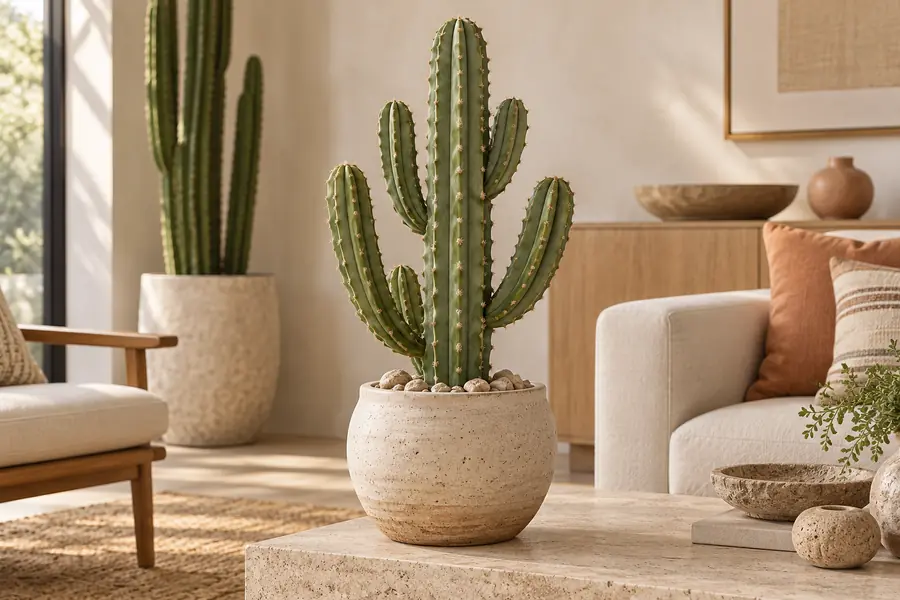
Artificial cacti should be easy décor, but finding one that does not look like shiny molded plastic can be surprisingly difficult. Texture, proportion, color, pot quality, and scale make a major difference.
The Sill Artificial Cactus is my best all-around choice for most interiors because its 25-inch scale is versatile, its sculptural shape works in many rooms, and buyers can pair it with a finished planter instead of relying on a tiny nursery pot. For a much larger statement, the AllModern Faux Cactus is a stronger choice, while a UV-resistant Primrue cactus makes more sense for outdoor-oriented applications.
The best artificial cactus depends on realism, finish, proportion, planter quality, stability, viewing distance, placement, indoor or outdoor use, and overall spatial fit and scale.
What Are the Best Artificial Cactus Plants Available in 2026?
My current shortlist looks like this:
| Pick | Best for | Approximate size |
|---|---|---|
| The Sill Artificial Cactus | Best overall | 25 in. |
| AllModern Faux Cactus Succulent | Best statement cactus | Up to 80 in. |
| Primrue UV-Resistant Artificial Cactus | Best outdoor-oriented option | 60 in. |
| Nearly Natural Artificial Cactus | Best oversized floor cactus | 6.5 ft. |
| Afloral Potted Pencil Cactus | Best tabletop/shelf option | 18.5 in. |
| Vickerman Artificial Cactus | Best mid-size alternative | Around 46 in. |
| Mainstays Artificial Cactus | Best inexpensive tabletop option | 12 in. |
I would not rank these only by realism because scale changes what “realistic” means.
A tabletop cactus will be inspected from inches away.
A six-foot statement cactus is normally judged from across the room.
That difference should affect how much you pay for surface detail.
1. The Sill Artificial Cactus — Best Overall
For most residential interiors, this is the artificial cactus I would start with.
The Sill Artificial Cactus is the most balanced choice because it is large enough to create noticeable botanical form without becoming difficult to place. At approximately 25 inches tall and 9 inches wide, it works on a low cabinet, plant stand, large console, or directly beside smaller furniture.
The Sill currently sells the cactus directly and offers it either on a basic base or paired with several ceramic or porcelain planter styles. The company recommends cleaning it with a soft dry cloth and keeping it out of direct sunlight.
That planter choice matters more than it may sound.
One of the biggest problems with artificial cacti is the base.
A realistic cactus can immediately look cheap when it appears to grow from:
a tiny plastic pot,
visible foam,
or an undersized black container.
The Sill makes it easier to create a complete composition rather than buying the plant and solving the pot problem later.
Why I Rank It First
I like the scale.
At 25 inches, it is large enough to have presence but small enough to work in:
- Apartments
- Bedrooms
- Offices
- Living rooms
- Entry consoles
- Home libraries
Forbes Vetted also chose it as its cactus recommendation, describing it as a realistic faux option with non-sharp spines and a sculptural silhouette.
Main Drawback
It is an indoor decorative product rather than my first choice for harsh outdoor exposure.
The Sill specifically advises keeping it out of direct sunlight.
Best for: Most indoor homes, offices, shelves, and medium-scale botanical styling.
2. AllModern Faux Cactus Succulent in Pot — Best Statement Cactus
If I wanted the cactus itself to become a major design feature, I would move up dramatically in scale.
The AllModern Faux Cactus Succulent is one of the strongest statement choices because the collection has been offered in approximately 34-, 57-, and 80-inch sizes. Its plastic-and-silk construction forms a prickly-pear-like silhouette with broad pads, a branching trunk, and small floral details.
The 80-inch version has recently carried a 4.8-star rating from well over 100 customer reviews, and Wayfair identifies the product as one of its verified faux plants.
Architectural Digest also selected an AllModern faux cactus as the cactus pick in its guide to lifelike artificial plants, describing it as a large, textured option suitable for styling in an upgraded pot.
Why Scale Helps
A large cactus functions differently from a normal fake houseplant.
It becomes closer to sculpture.
The viewer notices:
the outline,
branch arrangement,
height,
and relationship to the furniture
before examining small surface details.
That can actually help realism.
The Factory Pot Is the Weak Point
Customer feedback on the AllModern product frequently praises realism, but at least some buyers have found the included pot visually too small for the plant’s scale.
I agree with that concern conceptually.
An 80-inch cactus should feel physically grounded.
I would place the original weighted base inside a larger:
terracotta planter,
stone-effect pot,
or textured ceramic container.
Then I would conceal the inner pot using gravel or another dry-looking top dressing.
Main Drawback
Large versions are expensive and much more demanding spatially than the average artificial plant.
Availability can also vary by size.
Best for: Tall living-room corners, restaurants, large offices, Southwest-inspired interiors, and statement spaces.
3. Primrue 60-Inch UV-Resistant Artificial Cactus — Best Outdoor-Oriented Pick
Outdoor artificial plants need a different buying standard.
For buyers who specifically need a cactus marketed for both indoor and outdoor décor, the 60-inch Primrue UV-resistant artificial cactus is one of the more compelling current choices. It combines statement scale with an explicitly UV-resistant positioning and a heavier base than many decorative indoor cacti.
The current listing describes it as approximately 60 inches tall and 11.7 pounds, with raised rib details and artificial spines. It is marketed for indoor and outdoor locations and has accumulated strong current buyer ratings. Primrue 60-inch UV-Resistant Artificial Cactus
Why Outdoor Rating Matters
One of the most common mistakes with artificial plants is assuming:
plastic = outdoor-safe.
It does not.
Sunlight can cause:
- Fading
- Brittleness
- Color shift
- Surface deterioration
Adhesives and internal materials can also age differently outdoors.
If exterior use is important, I prefer a product that is specifically marketed for outdoor exposure rather than moving an indoor faux cactus onto a patio and hoping for the best.
UV-Resistant Does Not Mean Permanent
Even an outdoor artificial cactus will age.
The actual service life depends on:
sun exposure,
temperature,
rain,
wind,
material formulation,
and climate.
I would not interpret “UV resistant” as “will never fade.”
Main Drawback
A large outdoor cactus still needs a stable planter and protection against tipping in wind.
Best for: Covered patios, porches, commercial entrances, balconies, and buyers specifically seeking exterior-oriented artificial greenery.
4. Nearly Natural 6.5-Foot Artificial Cactus — Best Oversized Floor Cactus
This is for a completely different scale of room.
Nearly Natural’s 6.5-foot Artificial Cactus is the strongest option on my list for buyers who want a very tall desert silhouette. At 78 inches high but only around 16 inches wide, it creates substantial vertical impact without consuming the width of a large artificial tree.
Nearly Natural currently lists the product at 6.5 feet tall, 16 inches wide, and 10 inches deep. The company says it contains several thick green stems with artificial spines and comes in a nursery-style planter. It also specifically states that this model is not intended for outdoor use.
Why a Tall Cactus Can Work Better Than a Tree
Artificial trees often spread widely.
A tall cactus grows visually upward.
That makes this category useful in:
narrow corners,
between windows,
beside tall cabinetry,
or next to architectural openings.
The silhouette also works well in minimalist rooms because it creates form without a huge canopy of foliage.
Expect to Upgrade the Pot
The manufacturer’s imagery may show styled containers, but the company notes that the decorative planter shown is inspirational and that the plant itself arrives with a nursery planter.
At this scale, I consider a larger finished pot essential.
Main Drawback
It is expensive, and this is unquestionably a specialist statement piece rather than an all-purpose faux plant.
Best for: Large residential rooms, hospitality, Southwestern interiors, and narrow spaces needing dramatic vertical height.
5. Afloral Artificial Potted Pencil Cactus — Best for Shelves and Desks
Not everyone needs a giant saguaro.
Afloral’s Artificial Potted Pencil Cactus is a compact 18.5-inch choice that works well where a large cactus would be overwhelming. Its slender branching form provides botanical movement while the included terracotta pot gives it a more finished appearance than many small artificial plants.
The current Afloral listing describes it as a premade artificial pencil cactus in a terracotta clay pot, designed for desks, shelves, and other smaller interior areas. Afloral Artificial Potted Pencil Cactus
Why Pencil Cactus Is a Smart Faux Species
Some plants are easier to reproduce convincingly than others.
A pencil cactus has:
slender stems,
limited surface complexity,
and relatively simple branching.
That means the artificial version does not need to reproduce hundreds of delicate leaves.
For close-range faux plants, simplicity can be an advantage.
Main Drawback
It does not deliver the classic saguaro silhouette many people imagine when searching for an artificial cactus.
Best for: Shelves, desks, consoles, bedrooms, and smaller rooms.
6. Vickerman Artificial Cactus — Best Mid-Size Alternative
A mid-size cactus can be easier to integrate than either a tabletop succulent or a six-foot statement plant.
Vickerman’s artificial cactus range is worth considering when you want a floor plant around three to four feet tall. Current retail listings include models in this range, and buyer feedback frequently emphasizes convincing appearance.
One current 46-inch Vickerman listing is sold as a green artificial cactus in a black plastic planter, while recent verified buyers of the line describe the plants as realistic enough to be mistaken for living cacti.
This is a useful middle ground.
It can fill:
an empty corner,
a landing,
an office,
or the end of a console
without dominating the architecture.
Main Drawback
As with many mid-priced artificial floor plants, the basic planter may need upgrading.
Best for: Buyers who want statement scale without buying a five- or six-foot cactus.
7. Mainstays 12-Inch Artificial Cactus — Best Budget Tabletop Pick
At the inexpensive end, expectations should change.
A budget faux cactus does not need to fool someone from six inches away. It needs to create convincing color, proportion, and shape at normal tabletop viewing distance while arriving in a container that does not immediately look disposable.
The current Mainstays 12-inch artificial cactus is sold in a ribbed brown ceramic pot and has accumulated solid buyer ratings at a budget price point. Mainstays 12-Inch Artificial Cactus
The ceramic container is important.
For an inexpensive artificial plant, upgrading the pot can cost almost as much as the plant itself.
Starting with a usable planter improves the total value.
Main Drawback
At close range, inexpensive materials usually cannot reproduce the subtle matte texture of a real cactus as successfully as premium versions.
Best for: Desks, dorms, small shelves, bathrooms, and inexpensive decorating.
What Makes an Artificial Cactus Look Real?
Cacti are simple in shape, but that simplicity makes mistakes surprisingly visible.
The most realistic artificial cactus has a matte or softly textured surface, subtle green variation, believable ribs or pads, correctly scaled artificial spines, irregular branching, and a stable pot. Excessive shine, uniform neon green, obvious mold seams, perfectly identical branches, and undersized planters are the biggest giveaways.
1. Surface Texture Matters Most
A living cactus is not usually glossy like hard molded plastic.
The skin often has:
subtle texture,
fine color variation,
and a soft waxy appearance.
I therefore prefer faux cacti with:
EVA,
PU-like surfaces,
soft-touch materials,
or carefully textured molded plastic
over highly reflective plastic.
2. Look for Color Variation
Real cactus flesh is not one flat green.
Different areas may appear:
blue-green,
olive,
yellow-green,
or slightly gray.
Small tonal changes create much more realism than extremely saturated green.
3. Spines Should Match the Scale
Artificial spines create a difficult balance.
Too large and they look decorative.
Too small and they disappear.
Some homeowners may actually prefer soft or non-sharp simulated spines for practical reasons, particularly around children or high-traffic locations.
Forbes specifically notes the non-sharp spine design on The Sill’s faux cactus as part of its appeal.
4. The Pot Must Look Heavy Enough
A five-foot cactus in a tiny six-inch container feels physically impossible even when the plant itself looks excellent.
For floor cacti, I nearly always consider:
planter scale,
visual weight,
and base concealment.
5. Avoid Perfect Repetition
A real cactus does not usually branch with exact mathematical symmetry.
Slight differences in:
height,
orientation,
and shape
help enormously.
Is EVA Better Than Plastic for an Artificial Cactus?
Not automatically, but it can be useful.
EVA and softer polymer materials can create a less rigid, less reflective surface than inexpensive hard plastic, which can help imitate fleshy cactus tissue. However, molding quality, pigmentation, construction, and species accuracy matter more than the material name alone.
Some current artificial cactus products specifically emphasize EVA construction because it can provide a softer, more tactile surface.
But I would never buy solely because a product says “EVA.”
A poorly molded EVA cactus can still look artificial.
A carefully textured plastic cactus can look excellent.
The full object matters.
Should You Buy a Tall or Small Artificial Cactus?
Choose according to the room rather than the product photograph.
Small artificial cacti work best on desks, shelves, and consoles, while 30- to 50-inch models suit empty corners and plant stands. Five- to seven-foot cacti function more like sculptural furniture and need enough architectural space around them to look intentional.
My practical scale guide is:
| Location | Useful cactus size |
|---|---|
| Desk | 6–15 in. |
| Bookshelf | 8–20 in. |
| Console | 15–30 in. |
| Small floor corner | 24–40 in. |
| Living-room statement | 40–65 in. |
| Large architectural space | 65+ in. |
Scale is one of the easiest ways to make even a good artificial cactus look wrong.
A small cactus gets lost in a large double-height room.
A six-foot cactus overwhelms a narrow table.
Can Artificial Cactus Plants Be Used Outdoors?
Only when the product is suitable for exterior exposure.
Do not assume every faux cactus is outdoor-safe. For patios or gardens, look for explicit outdoor or UV-resistant specifications. Indoor models can fade or deteriorate when exposed to strong sunlight and weather, and some manufacturers specifically tell buyers to keep their artificial plants out of direct sun.
For example, The Sill tells owners of its artificial cactus to keep it out of direct sunlight, while Nearly Natural explicitly says its 6.5-foot cactus is not for outdoor use.
By contrast, current Primrue options are specifically marketed as UV-resistant products for indoor and outdoor décor. Primrue 60-inch UV-Resistant Artificial Cactus
That distinction should influence the purchase.
How Do You Make a Fake Cactus Look More Realistic?
A few styling changes can improve even a moderately priced cactus.
Place the cactus in a larger proportionate planter, hide the factory pot, use gravel or stone as a top dressing, position it where a real cactus could plausibly receive light, keep the surface clean, and avoid surrounding it with too many other artificial desert plants.
Upgrade the Planter
This is my first step.
Good combinations include:
- Terracotta
- Matte ceramic
- Sand-colored stone
- Textured concrete
- Woven outer baskets
Use Gravel Carefully
Cacti naturally suggest dry planting media.
A small layer of neutral gravel can visually connect the cactus to its planter.
Avoid obviously polished decorative stones if the goal is botanical realism.
Place It Near Light
The artificial cactus does not need sun.
But people expect a cactus to live near:
windows,
glass doors,
or bright rooms.
That visual logic helps the illusion.
Keep It Dust-Free
Dust collects particularly visibly on artificial ribs and spines.
Use the care method recommended for the specific material.
The Sill recommends a soft dry cloth for its model.
Is an Expensive Artificial Cactus Worth It?
Sometimes.
A premium artificial cactus is worth paying for when it is large, highly visible, viewed at close range, or expected to remain in the room for many years. For a small plant on a distant shelf, the difference between a $25 and $150 product may provide little practical design value.
I spend according to viewing distance.
For a hotel lobby or main living-room corner, I care about:
surface texture,
scale,
pot stability,
shape,
and long-term appearance.
For a high bookshelf, I care primarily about:
silhouette
and
color.
The smartest purchase is not always the most expensive one.
My insights: What Is the Best Artificial Cactus Available
After comparing current 2026 products, direct manufacturer specifications, current consumer feedback, and editorial recommendations from Forbes Vetted and Architectural Digest, I think the answer depends mainly on scale.
What Is the Best Artificial Cactus Available? For most homes, my choice is The Sill Artificial Cactus because its 25-inch size, finished planter options, non-sharp sculptural form, and manageable proportions make it unusually versatile. For a dramatic floor display, I prefer the larger AllModern cactus; for outdoor-oriented use, I would choose a model specifically marketed as UV resistant rather than an indoor faux cactus.
My First Insight: Cactus Is One of the Better Plant Types to Reproduce Artificially
Cacti have one major advantage over delicate artificial flowers.
They do not require the manufacturer to reproduce:
hundreds of thin leaves,
transparent petals,
or highly complex branching.
The strongest faux cactus products focus on:
form,
texture,
ribs,
spines,
and color.
That makes convincing replication easier.
My Second Insight: Matte Texture Matters More Than Maximum Detail
A cactus can have hundreds of molded spines and still look fake if the main surface shines like plastic.
I would rather have:
slightly simplified detail
with
excellent texture
than
extreme detail on a glossy surface.
That is why close-up photos in normal daylight are valuable when shopping online.
My Third Insight: Bigger Is Not Automatically More Realistic
Large artificial plants create impact.
But they also expose proportion problems.
A six-foot cactus needs:
a believable trunk or stem width,
a substantial pot,
and enough surrounding room.
Otherwise it can resemble stage scenery.
The Nearly Natural 6.5-foot model works best when the room itself supports that scale.
My Fourth Insight: The Pot Can Change the Ranking
Many artificial-plant comparisons focus completely on foliage.
For cactus, I think the planter matters almost as much.
A realistic cactus in a tiny black shipping pot looks unfinished.
A moderately priced cactus in a correctly scaled terracotta or stone planter can look significantly more expensive.
My Fifth Insight: Indoor and Outdoor Should Be Separate Categories
I would never select an outdoor artificial cactus based only on how realistic it looks indoors.
Outdoor use requires another layer of questions:
- Is it UV resistant?
- Is it explicitly intended for exterior use?
- Is the base heavy enough?
- Can wind move it?
- Will water collect in the planter?
- What does the warranty say about outdoor exposure?
This is why my best overall indoor pick and my outdoor-oriented pick are different products.
My Sixth Insight: The Best Cactus Depends on Viewing Distance
For a tabletop cactus, people see:
texture,
mold seams,
spines,
and artificial soil.
For a tall cactus across the room, they mainly see:
shape,
scale,
and color.
This should determine where you spend money.
My Current Ranking
| Category | My pick |
|---|---|
| Best overall | The Sill Artificial Cactus |
| Best statement | AllModern Faux Cactus Succulent |
| Best outdoor-oriented | Primrue UV-Resistant Artificial Cactus |
| Best oversized | Nearly Natural 6.5-Foot Cactus |
| Best tabletop | Afloral Pencil Cactus |
| Best mid-size | Vickerman Artificial Cactus |
| Best budget | Mainstays 12-Inch Artificial Cactus |
My Final View
If I were buying one artificial cactus for an average home today, I would choose The Sill Artificial Cactus.
It is large enough to look intentional.
It does not require a huge room.
The planter system allows the base to feel finished.
Its non-sharp artificial spines make it more practical than a real cactus in high-traffic interiors.
And its form has already been recognized in current editorial artificial-plant recommendations.
If I were furnishing a larger room and wanted the cactus to function as sculpture, I would move to the AllModern Faux Cactus Succulent. Architectural Digest has featured an AllModern faux cactus among its recommended lifelike plants, and current retail feedback on the large collection repeatedly emphasizes realism.
For outdoor use, however, I would change priorities completely and buy an explicitly UV-resistant outdoor model.
That is the central buying lesson:
Do not search for the most realistic artificial cactus in isolation. Search for the most realistic cactus that is the correct size, material, planter, and exposure rating for the place where you will actually use it.
Conclusion
The best artificial cactus depends on size and placement. The Sill is my best all-around indoor choice, while AllModern excels at statement scale and UV-resistant models make more sense outdoors.