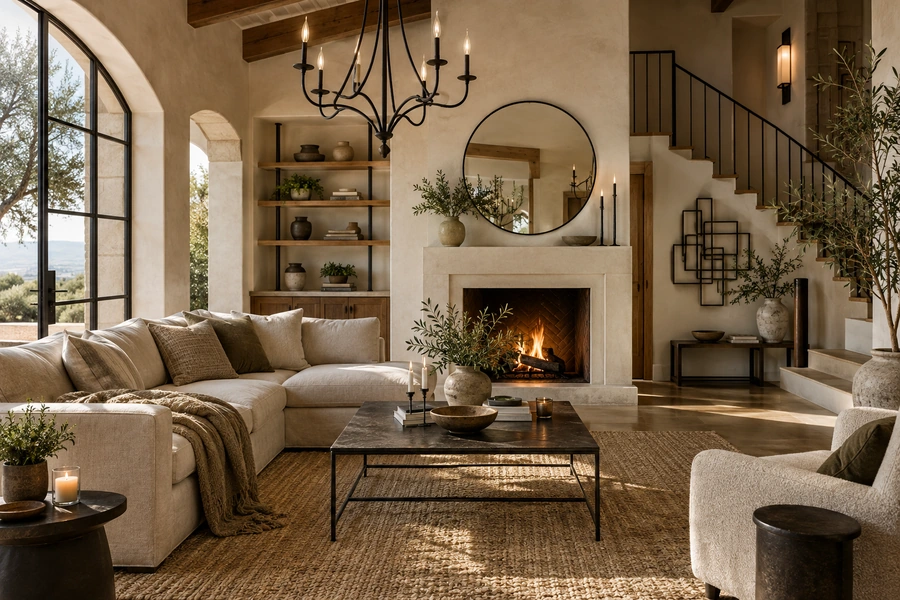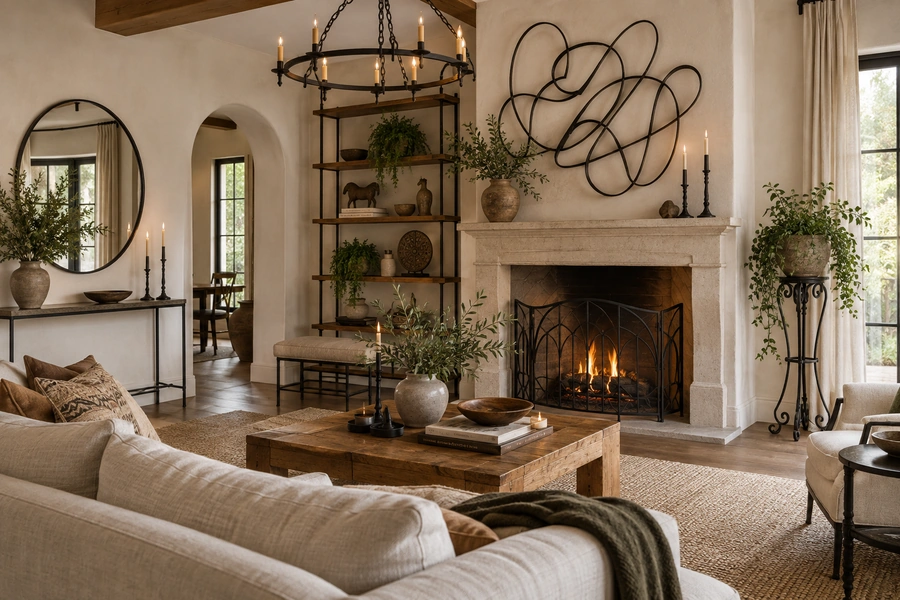

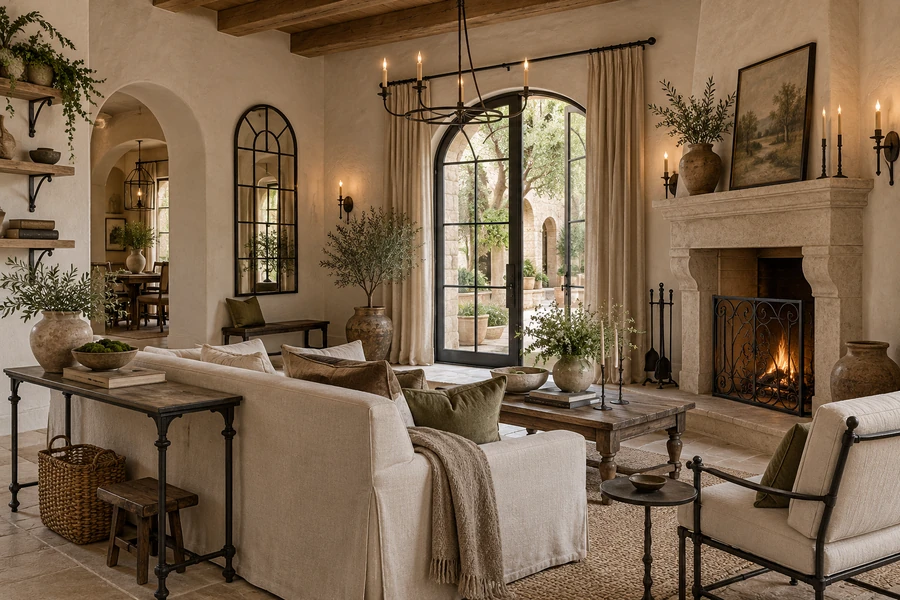
Old-World interiors can feel rich and timeless, but too much ornate metal quickly turns warmth into a heavy theme. The right wrought iron pieces create character without excess.
The best wrought iron products for Old-World style include chandeliers, wall sconces, console tables, mirrors, candle holders, fireplace screens, stair railings, door grilles, curtain hardware, shelf brackets, planter stands, and garden furniture. Choose restrained forms, aged finishes, and handcrafted details, then balance the dark metal with wood, plaster, stone, linen, and warm neutral colors.
That approach fits the wider 2026 move toward rooms that feel collected rather than perfectly matched. Vintage décor, aged metals, natural stone, warm woods, and pieces with visible craftsmanship are becoming more important as homeowners move away from generic gray-and-beige interiors.
Is Wrought Iron Decor Still in Style?
Wrought iron still works in contemporary interiors, but its most fashionable form is lighter, more selective, and less ornate than the heavy Mediterranean décor associated with earlier decades.
Yes, wrought iron remains in style, especially as vintage and Old-World influences return in 2026. The strongest applications use iron as an architectural or handcrafted accent rather than covering every room in scrollwork. Matte black, charcoal, aged bronze, and hand-forged textures pair especially well with stone, warm timber, plaster, linen, and terracotta.
Current 2026 design coverage shows renewed interest in vintage pieces, craftsmanship, aged metals, natural materials, and interiors that look accumulated over time rather than purchased as one matching set.
That makes wrought iron particularly relevant because the material naturally suggests:
- Age
- Handcraft
- Structure
- Permanence
- European architecture
- Blacksmithing traditions
- Historical detail
The key is choosing products that contribute character rather than turning the home into a period set.
1. Wrought Iron Chandeliers
A chandelier is one of the fastest ways to establish an Old-World mood.
The strongest designs use:
- Fine curved arms
- Candle-style lights
- Restrained forged details
- Aged black or bronze finishes
- Generous scale
Wrought-iron-style lighting works particularly well above:
- Dining tables
- Kitchen islands
- Entry halls
- Stair landings
Current handcrafted iron retailers still offer iron chandeliers as a central Old-World home category, including traditional beam-and-iron and Gothic-inspired lighting.
For a modern version, avoid very dense clusters of decorative curls.
One sculptural chandelier against a simple plaster ceiling usually looks stronger than several matching iron fixtures.
2. Wrought Iron Wall Sconces
Wall sconces bring historical character without taking up floor space.
They fit naturally beside:
- Fireplaces
- Mirrors
- Beds
- Hallways
- Entry consoles
Vogue’s 2026 coverage of monastic-inspired interiors has also highlighted wrought iron and other aged-metal sconces as effective ways to add historical character to restrained rooms.
Use warm bulbs rather than very cool white lighting.
The iron supplies structure.
The warm light supplies softness.
3. Wrought Iron Console Tables
A narrow console table with an iron base and stone or wood top can give an entryway immediate Old-World character.
The most useful combinations are:
Iron + travertine
Iron + marble
Iron + reclaimed oak
Iron + limestone
A traditional all-iron console can work, but contemporary interiors often benefit from mixing materials.
The stone or wood keeps the furniture from looking visually too dark.
Use the table for:
- Ceramic lamps
- Antique books
- A large mirror
- A simple vase
- One sculptural object
Do not cover every inch with small themed accessories.
4. Wrought Iron Mirrors
A narrow forged-metal mirror frame introduces iron without requiring a large furniture purchase.
Old-World mirrors work particularly well in:
- Entries
- Powder rooms
- Dining rooms
- Bedrooms
- Fireplace walls
Choose:
- Thin dark frames
- Arched tops
- Subtle hand-forged irregularity
- Restrained corner detailing
Avoid overly elaborate grape, leaf, or scroll motifs unless the architecture already supports a strong Mediterranean or Spanish Revival style.
The mirror itself reflects light, which helps balance the darkness of the frame.
5. Wrought Iron Candle Holders
Candle holders are one of the easiest low-commitment ways to introduce the material.
They can sit on:
- Mantels
- Dining tables
- Consoles
- Shelves
- Sideboards
Current 2026 décor coverage continues to feature vintage-style cast-iron and aged-metal candle holders as warm, timeless accents.
Choose sets with slightly different heights rather than identical pieces.
That creates the layered, collected look that is more consistent with current Old-World styling.
6. Wrought Iron Fireplace Screens
A fireplace already carries historical weight.
An iron screen reinforces it.
Look for:
- Fine mesh
- Forged frame
- Simple arch
- Small decorative finials
- Matte dark finish
An oversized scroll pattern may dominate a small room.
A cleaner frame allows:
- Stone
- Brick
- Plaster
- Wood mantel
to remain visually important.
The best fireplace screen looks architectural even when the fire is not lit.
7. Wrought Iron Stair Railings
Railings are one of the strongest architectural uses of iron.
Unlike a decorative accessory, a railing becomes part of the building.
Historic England notes that gates and railings have traditionally used wrought iron, cast iron, and later steel, and emphasizes the importance of regular maintenance for ironwork.
For current interiors, choose:
- Thin vertical balusters
- Small forged variations
- Restrained curves
- Dark matte finishes
Pair them with:
- Oak handrails
- Limestone stairs
- Terracotta
- White plaster
That contrast keeps the staircase lighter.
8. Wrought Iron Door Grilles and Decorative Inserts
Old European and Mediterranean architecture frequently uses metal as part of doors and windows.
A decorative iron grille can bring that feeling into:
- Front doors
- Interior glass doors
- Wine rooms
- Courtyard entrances
An existing design article built specifically around Old-World wrought-iron products also identifies decorative door glass inserts as one way to create Mediterranean character.
For a modern home, choose simplified geometry.
A few curves or vertical forged lines are usually enough.
The grille should enhance the door rather than hide it.
9. Wrought Iron Curtain Rods and Drapery Hardware
Curtain hardware is often ignored, but it can quietly reinforce the architectural style of a room.
Use iron:
- Rods
- Rings
- Brackets
- Finials
- Tiebacks
with:
- Linen curtains
- Cotton drapes
- Velvet
- Natural woven fabrics
A simple forged rod with understated finials looks more timeless than a heavily decorated one.
This is particularly effective in:
- Spanish Revival
- French country
- Mediterranean
- Rustic European interiors
10. Wrought Iron Shelf Brackets and Hooks
Small architectural hardware can deliver more authenticity than large decorative wall art.
Useful pieces include:
- Shelf brackets
- Coat hooks
- Pot racks
- Towel bars
- Kitchen rails
Current artisan iron collections continue to emphasize brackets, kitchen hardware, bathroom accessories, hooks, and other functional pieces as a way to bring traditional craftsmanship into the home.
The advantage is subtlety.
Instead of saying:
“This is an Old-World room.”
the craftsmanship appears in everyday details.
Use iron brackets with:
- Reclaimed wood shelves
- Oak
- Walnut
- Limestone
- Aged timber
11. Wrought Iron Planter Stands and Window Boxes
Iron and plants are a natural Old-World combination.
Use wrought-iron-style:
- Window boxes
- Wall baskets
- Plant stands
- Balcony holders
with:
- Terracotta pots
- Olive trees
- Rosemary
- Ivy
- Geraniums
- Lavender-inspired planting
Traditional product guides frequently include iron planter boxes and plant stands among the most recognizable Old-World applications.
For indoor styling, keep the stand simple and allow the greenery to soften the metal.
For exterior use, check the coating and corrosion resistance before purchase.
12. Wrought Iron Garden Benches, Tables, and Chairs
Iron garden furniture can make a patio feel established rather than newly decorated.
It suits:
- Courtyards
- Gravel gardens
- Mediterranean patios
- Stone terraces
- Covered verandas
Pair it with:
- Linen cushions
- Terracotta pots
- Climbing greenery
- Stone paving
Avoid purchasing every outdoor object in a matching iron collection.
One table set or bench is often enough.
The 12 Products at a Glance
| Product | Best Location | Old-World Effect |
|---|---|---|
| Chandelier | Dining room | Dramatic |
| Wall sconce | Hallway | Architectural |
| Console table | Entry | Refined |
| Mirror | Bedroom/entry | Elegant |
| Candle holder | Mantel | Subtle |
| Fireplace screen | Living room | Historic |
| Stair railing | Staircase | Structural |
| Door grille | Entrance | Mediterranean |
| Curtain hardware | Living/bedroom | Quiet detail |
| Shelf brackets | Kitchen | Crafted |
| Planter stand | Patio | European garden |
| Garden furniture | Courtyard | Established |
What Rooms Are Best for Wrought Iron Home Decor?
Wrought iron can work in almost every part of the home, but it looks best where its dark structure can be balanced by warm, tactile materials.
The best rooms for wrought iron are entryways, dining rooms, kitchens, staircases, living rooms, bedrooms, and outdoor patios. Use one or two significant iron elements per zone, then balance them with wood, plaster, stone, ceramics, linen, leather, or greenery so the metal feels architectural rather than heavy.
Entryway
The entry is one of the strongest locations because Old-World style works well with architectural first impressions.
Try:
- Iron console
- Arched mirror
- Wall sconce
Do not use all three in ornate forms.
Choose one focal piece and let the others stay quiet.
Dining Room
The dining room can handle more drama.
A wrought iron chandelier works especially well over:
- Oak table
- Reclaimed wood
- Travertine
- Limestone
Add:
- Linen chairs
- Ceramic serving pieces
- Vintage rug
The dark iron becomes an outline against warmer surfaces.
Kitchen
Use iron in functional details.
Good choices include:
- Pot rack
- Shelf brackets
- Pendant light
- Cabinet hardware
Old West Iron’s current handcrafted home collection specifically includes kitchen utensils, pot racks, towel bars, and similar functional iron items.
Living Room
Use:
- Fireplace screen
- Iron-and-stone console
- Candle holders
Avoid filling:
- Coffee table
- walls
- fireplace
- side tables
with matching iron décor.
The material is most effective when it interrupts softer finishes.
Bedroom
A fine iron bed can be beautiful.
Pair it with:
- Linen bedding
- Wool rug
- Timber furniture
- Soft plaster walls
Avoid matching:
- Iron bed
- Iron nightstand
- Iron bench
- Iron lamps
One major iron object is enough.
Bathroom
Small iron accessories can add character.
Use:
- Mirror
- Towel bar
- Hooks
Keep moisture exposure in mind.
The coating becomes more important in humid rooms.
Patio and Courtyard
This is where iron can be used most naturally.
Combine it with:
- Stone
- Brick
- Terracotta
- Greenery
- Gravel
The result can feel Mediterranean or European without becoming theatrical.
How Do You Keep Wrought Iron Decor From Looking Heavy or Outdated?
The easiest way to make wrought iron look dated is to use too much of it, especially when every piece contains the same ornate scroll pattern.
Keep wrought iron current by using it selectively, choosing thinner profiles, limiting scrollwork, and pairing dark metal with light natural materials. One iron chandelier, railing, console, or mirror usually creates more impact than a complete matching collection. Old-World style should feel layered and collected, not like a furniture showroom based on one theme.
Use a 20% Iron Rule
Iron should often be the accent rather than the dominant surface.
A useful informal starting point is:
80% softer or natural materials
20% dark structural accents
This is not a technical formula.
It is simply a styling guide.
Balance Dark With Light
Combine black iron with:
- Cream plaster
- Warm white walls
- Linen
- Oak
- Travertine
- Light stone
This prevents dark metal from visually shrinking the room.
Choose Simple Iron for Modern Homes
A modern house can still use Old-World references.
Choose:
- Straight bars
- Thin curves
- Small forged irregularities
- Minimal finials
rather than highly ornamental Renaissance-style patterns.
Let the Material Show Craftsmanship
2026 interiors increasingly favor materials with history, variation, and craftsmanship.
That means one slightly irregular forged bracket may look more current than a perfectly identical set of lightweight stamped-metal decorations.
Mix Old and New
One of the best formulas is:
Old-World material + modern form
For example:
- Iron chandelier + contemporary dining table
- Vintage iron mirror + minimal console
- Forged railing + clean plaster staircase
- Iron sconce + modern artwork
This creates tension.
A room containing only historical references can feel staged.
Avoid the Old Tuscan Formula
The dated version usually combines:
- Heavy iron scrollwork
- Orange-brown walls
- Dark cherry furniture
- Faux-distressed finishes
- Grape motifs
- Matching iron accessories
The new version keeps:
- Iron
- Terracotta
- Stone
- Wood
but removes most of the themed decoration.
Current vs Dated Wrought Iron
| More Current | More Dated |
|---|---|
| Slim railing | Dense scrollwork |
| Matte black | Glossy decorative black |
| Iron + oak | All-dark furniture |
| Iron + stone | Faux-stone everything |
| One statement light | Matching iron lights everywhere |
| Handmade variation | Repeated stamped motifs |
| Simple arch | Heavy decorative curves |
| Collected pieces | Complete themed collection |
Does Wrought Iron Rust Easily Indoors?
Indoor wrought iron generally faces far less corrosion risk than exterior ironwork, but moisture, humidity, damaged coatings, and poor maintenance can still cause rust.
Wrought iron and other ferrous metals can rust when oxygen and moisture reach exposed metal. Indoor pieces normally stay protected when finishes remain intact, but bathrooms, kitchens, conservatories, and coastal homes require more attention. Keep iron clean and dry, inspect chips or scratches, and repair damaged protective finishes before corrosion spreads.
Historic England explains that corrosion can disfigure and weaken architectural metalwork and that protective coatings and ongoing maintenance are central to controlling it.
Check What the Product Is Actually Made From
The term “wrought iron” is used broadly in décor retail.
Traditional architecture includes:
- Wrought iron
- Cast iron
- Steel
Historic England notes that traditional gates and railings may contain different ferrous metals, with steel becoming increasingly common later.
For a decorative indoor product, the exact terminology may not change the look.
For:
- Restoration work
- Exterior railings
- Gates
- Structural elements
the actual material matters much more.
Watch High-Humidity Areas
Take extra care in:
- Bathrooms
- Kitchens
- Enclosed pools
- Coastal homes
- Damp basements
Check:
- Weld joints
- Fixings
- Scratches
- Crevices
Water tends to create problems where it can remain trapped.
Historic England specifically notes that trapped water and coating failure are recurring causes of ironwork corrosion.
Exterior Iron Needs More Maintenance
Outdoor:
- Railings
- Window boxes
- Benches
- Tables
- Gates
receive much greater exposure.
Protective coatings have finite lifespans, and their performance depends on surface preparation, coating type, environmental conditions, and ongoing maintenance.
Simple Maintenance
For ordinary decorative iron:
- Remove loose dust.
- Wipe with an appropriate soft cloth.
- Keep surfaces dry.
- Inspect the finish.
- Check joints.
- Treat scratches before rust grows.
- Follow the manufacturer’s coating instructions.
Avoid applying random oils or coatings to valuable historical pieces.
Historic England warns that some treatments can interfere with later conservation or paint systems.
My Insights: Which 12 Wrought Iron Products Add Old-World Style to Your Home
The most successful wrought iron interiors do not use the most iron. They use the material where craftsmanship and contrast have the greatest visual effect.
The 12 strongest wrought iron products for Old-World style are chandeliers, sconces, console tables, mirrors, candle holders, fireplace screens, stair railings, door grilles, curtain hardware, shelf brackets, planter stands, and garden furniture. In 2026, these pieces look best when they are restrained, tactile, slightly aged, and balanced with warm natural materials.
My First Insight: Lighting Gives the Highest Impact per Piece
One chandelier can transform the character of a dining room without requiring additional themed décor.
That makes lighting one of the safest starting points.
My Second Insight: Architectural Iron Ages Better Than Decorative Iron
A railing or door grille has a reason to exist.
That gives it longevity.
A purely decorative scroll placed randomly on a wall depends much more on trends.
When possible, choose iron that performs a function.
My Third Insight: Small Hardware Can Feel More Authentic Than Large Décor
Forged:
- Hooks
- Brackets
- Handles
- Curtain hardware
can make a house feel considered without becoming obvious.
These details often create a more convincing Old-World effect than large mass-produced wall ornaments.
My Fourth Insight: Iron Needs Warm Materials Beside It
My preferred combinations are:
Iron + oak
Iron + limestone
Iron + travertine
Iron + plaster
Iron + linen
These pairings prevent black metal from looking industrial or harsh.
My Fifth Insight: Old-World Style in 2026 Is About Age, Not Theme
Current design trends increasingly favor interiors that feel accumulated, personal, and rooted in craft.
That means:
- One antique-style mirror
- One handmade table
- One forged light
can create more depth than ten coordinated accessories.
My Sixth Insight: Curves Are Fine—Repetition Is the Problem
Wrought iron does not need to become completely straight and minimalist.
A forged curve can look elegant.
The dated effect appears when:
- Every railing has curls
- Every light has curls
- Every table has curls
- Every mirror has curls
Keep ornament concentrated.
My Seventh Insight: Use Iron at Different Scales
A balanced home might contain:
Large
- Stair railing
Medium
- Dining chandelier
Small
- Two forged shelf brackets
The repetition of material creates continuity without creating a matching set.
My Eighth Insight: Exterior Iron Can Connect the House to the Interior
An iron gate outside can visually relate to:
- Entry chandelier
- Stair railing
- Console hardware
inside.
This creates architectural continuity.
Do not repeat the exact same motif.
Repeat:
- Finish
- Weight
- Craft quality
instead.
My Ninth Insight: Real Craftsmanship Matters More as Interiors Become More Personal
Current 2026 coverage shows homeowners moving toward vintage décor, aged materials, individual expression, and rooms that feel lived in rather than designed for resale.
Hand-forged iron fits that direction because slight variation can make the product look made rather than manufactured.
My Tenth Insight: One Great Iron Piece Is Better Than Twelve Mediocre Ones
Although this article lists 12 product categories, a home does not need all twelve.
Start with the place that needs the strongest identity.
For example:
Dining room: chandelier
Entry: console
Staircase: railing
Patio: garden furniture
Then stop and evaluate the room.
My 12-Product Priority List
| Priority | Product | Why |
|---|---|---|
| 1 | Chandelier | Strong visual impact |
| 2 | Stair railing | Architectural permanence |
| 3 | Wall sconce | Old-World atmosphere |
| 4 | Console table | Easy focal piece |
| 5 | Fireplace screen | Functional character |
| 6 | Door grille | Strong entry detail |
| 7 | Mirror | Easy indoor accent |
| 8 | Shelf brackets | Subtle craftsmanship |
| 9 | Curtain hardware | Quiet continuity |
| 10 | Candle holders | Low-cost introduction |
| 11 | Planter stand | Softened by greenery |
| 12 | Garden furniture | Strong outdoor application |
My Preferred Old-World Formula
For one room, I would use:
- One major wrought iron piece
- One natural stone or warm wood surface
- One soft textile
- One handmade ceramic element
- Plenty of visual space around each piece
For example:
Iron chandelier + oak dining table + linen curtains + ceramic vase + plaster walls
That combination communicates Old-World influence without requiring historical reproduction.
My Final Rule
Do not decorate with wrought iron because you want a room to look “old.”
Use it because you want the room to feel:
- Crafted
- Grounded
- Architectural
- Collected
- Permanent
The best Old-World home is not filled with historical symbols.
It combines a few materials with enough character that the room feels as though it has developed slowly over time.
Conclusion
Use wrought iron selectively. Chandeliers, railings, sconces, consoles, mirrors, hardware, and garden pieces add the strongest Old-World character when balanced with warm wood, stone, plaster, and textiles.