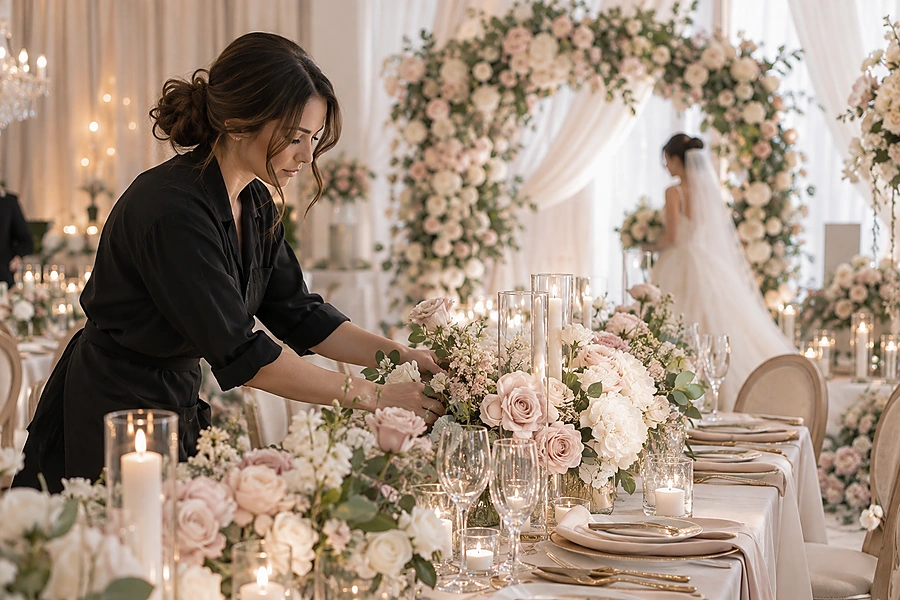

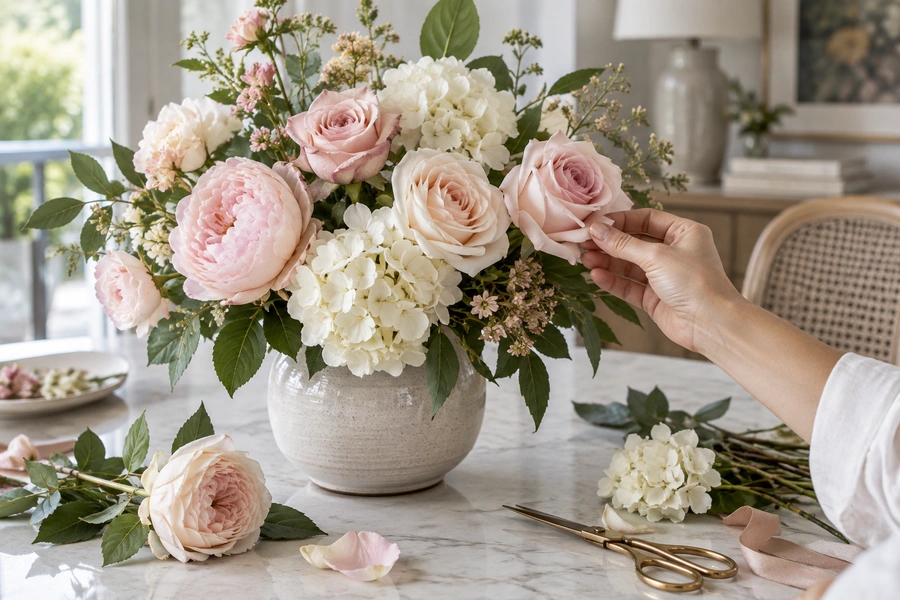
Real touch flowers can feel surprisingly close to fresh petals, but that soft texture does not come from one single material or manufacturing formula.
Real touch flowers are commonly made from polyurethane (PU), latex or synthetic rubber, silicone or similar soft polymers, and polymer-coated synthetic fabric. Their leaves and stems may also contain polyester, polyethylene or other plastics, adhesives, and internal metal wire. “Real touch” describes a realistic look and feel rather than one standardized material.
This distinction matters to me because different materials create different levels of softness, flexibility, durability, and botanical detail. A real touch rose may not be made from the same material as a real touch tulip or orchid.
What Are Real Touch Flower Petals Made Of?
The petals are the most important part of a real touch flower because they create most of the tactile experience. Manufacturers choose materials according to the flower they are trying to reproduce.
Real touch petals are most commonly made from polyurethane, latex or other synthetic rubber compounds, silicone-like polymers, or synthetic fabric coated with a soft polymer. Different flowers require different petal thickness, flexibility, surface texture, and structure, so there is no universal material recipe used for every real touch flower.
Polyurethane (PU)
Polyurethane is one of the materials I most often associate with real touch artificial flowers.
PU can be molded into three-dimensional shapes while still remaining flexible enough to imitate natural petals.
This makes it useful when I need a flower with:
- Defined petal thickness
- Fine surface texture
- Natural curves
- Flexible edges
- Molded veins
- A soft tactile response
Industry material guides identify polyurethane as particularly useful when manufacturers need to reproduce both the density and softness of natural petals.
I may see PU used in flowers such as:
- Peonies
- Gerbera daisies
- Tulips
- Calla lilies
- Roses
- Other sculptural blooms
The exact material formulation varies between factories.
That is important because two products can both be marketed as PU real touch flowers while feeling quite different in the hand.
One may be very soft.
Another may feel firmer.
One may have a matte finish.
Another may feel slightly rubbery.
So I never assume the material name alone tells me the complete quality level.
Latex and Synthetic Rubber
Another common construction uses latex or a similar synthetic rubber material.
Sometimes the latex forms the petal itself.
In other cases, manufacturers apply a soft polymer coating over a synthetic fabric base.
A technical overview of real touch flower manufacturing describes synthetic fabric coated with liquid polymer as one method used to reproduce both the fine texture of a petal and the softer tactile sensation people associate with fresh flowers.
This layered construction makes sense to me.
The fabric provides:
- Structure
- Thinness
- Flexibility
The coating provides:
- Softer touch
- More realistic weight
- Reduced fabric feel
- A more natural surface
For flowers with thin petals, a coated structure can create a very different effect from thick molded plastic.
Silicone and Similar Soft Polymers
Silicone or silicone-like polymers may also be used when the flower needs very fine molding.
Orchids are a good example.
Their petals can contain distinctive:
- Curves
- Ridges
- Veins
- Thickness changes
- Sculptural centers
A molded polymer can reproduce these details more easily than a simple flat fabric petal.
Industry descriptions of real touch flowers specifically mention silicone and similar polymer materials for flowers requiring detailed modeling.
I do not assume every flower described as “silicone flower” uses the exact same silicone formulation.
Factories may use different polymer blends, and terminology can vary.
That is why I prefer actual material specifications when I am sourcing flowers professionally.
Polymer-Coated Synthetic Fabric
This is another important category.
The base may be polyester or another synthetic textile.
The manufacturer then coats one or both sides with a soft polymer.
This creates a flower that combines fabric flexibility with a more realistic surface.
It can also reduce the obvious textile texture that I feel when touching ordinary artificial silk flowers.
| Petal construction | Main benefit |
|---|---|
| Polyurethane | Molded shape and soft texture |
| Latex/synthetic rubber | Flexible, petal-like feel |
| Silicone-like polymer | Detailed molding |
| Polymer-coated fabric | Thin structure with softer surface |
| Polyester fabric | Lightweight and useful for volume |
I do not think one material is automatically better.
The right construction depends on the natural flower being copied.
Are Real Touch Flowers Made of Silicone or Latex?
I often see people describe all real touch flowers as silicone flowers or latex flowers. That is too simple.
Some real touch flowers contain silicone or latex, but those are only two possible materials. Other flowers use polyurethane, synthetic rubber, coated polyester, PVC or other polymer formulations. Manufacturers frequently combine several materials in one stem, so the term “real touch” should not be treated as a synonym for silicone or latex.
“Real Touch” Is a Result, Not a Chemical Name
This is the most useful way I understand the category.
When I see Real Touch, I interpret it as a performance description.
The manufacturer is trying to achieve:
- Lifelike visual appearance
- Softer petals
- More realistic flexibility
- Natural surface texture
- Better close-up detail
- More believable movement
The label does not necessarily tell me exactly how the result was achieved.
One manufacturer may produce a rose from coated fabric.
Another may use molded PU.
Another may use a blend of several polymers.
Current artificial-flower material guides make the same point: real touch is not a standardized chemical formulation.
That is especially important for wholesale buyers.
If I need to know how a flower will behave during shipping, storage, outdoor use, cleaning, or long-term commercial display, I ask more detailed questions.
I Ask Suppliers for the Actual Specification
For a professional order, I may ask:
- What are the petals made from?
- Is the flower PU or coated fabric?
- Does it contain latex?
- What material are the leaves?
- Is there metal wire inside the stem?
- Is the product UV treated?
- Can it tolerate water?
- What cleaning method is recommended?
- Is it intended for indoor or outdoor use?
These questions give me much more useful information than the phrase “real touch” by itself.
One Flower Can Contain Several Materials
I also remember that the flower head is only one part of the finished stem.
A typical real touch artificial flower may contain several materials at once.
| Component | Possible material |
|---|---|
| Petals | PU, latex, silicone-like polymer, coated fabric |
| Leaves | Polyester, PE, plastic, soft polymer |
| Stem covering | Plastic or polymer |
| Stem core | Metal wire |
| Flower center | Molded plastic, fabric, polymer |
| Connections | Adhesive |
| Surface color | Pigments, dyes, coatings |
Real Touch care documentation also notes that artificial flower stems and leaves can contain internal metal wires.
That internal structure allows me to bend and shape stems into more natural positions.
It also means I use proper cutters rather than ordinary scissors when shortening wired stems.
What Is the Difference Between Real Touch and Silk Flowers?
The biggest difference is usually not whether one flower is artificial and the other is real. Both are artificial. The difference is how their petals are constructed and how they feel.
Real touch flowers generally use polyurethane, latex, soft polymer coatings, or similar materials to create tactile realism. Modern silk flowers are usually made from polyester or another synthetic textile rather than genuine silk. Silk flowers can look excellent, but they normally retain a more obvious fabric feel when touched closely.
Modern Silk Flowers Are Usually Polyester
The term silk flower can be misleading.
Historically, silk was used for premium artificial flowers.
Today, most products marketed as silk flowers use synthetic fabric.
Polyester is particularly common.
This material has several advantages.
It is:
- Lightweight
- Flexible
- Easy to dye
- Available in many colors
- Practical for large-scale arrangements
- Usually less expensive than molded real touch petals
That makes high-quality fabric flowers useful for:
- Wedding arches
- Flower walls
- Hanging installations
- Large centerpieces
- Event backdrops
- Large bouquets
Real touch flowers are often stronger when the flower will be viewed very closely.
Real Touch Is Usually Better for Tactile Realism
If someone is going to touch the petals, I usually see more value in real touch construction.
A polyester petal may look excellent in photographs but still feel like fabric.
A good PU or latex-based petal can compress, bend, and recover in a way that feels closer to fresh plant tissue.
Current comparisons between silk and real touch flowers consistently identify tactile realism as the major advantage of real touch products.
That is why I particularly like them for:
- Bridal bouquets
- Table centerpieces
- Hotel arrangements
- Restaurant flowers
- Reception desks
- Product photography
- Close-up displays
I Often Mix Both Materials
I do not think every flower in a premium arrangement needs to be real touch.
A practical arrangement might contain:
Real touch focal flowers
- Roses
- Peonies
- Tulips
- Calla lilies
Premium fabric flowers
- Hydrangeas
- Small filler flowers
- Large background blooms
Molded greenery
- Eucalyptus
- Leaves
- Succulent accents
This gives me realism where people are most likely to notice it while controlling cost and weight.
The overall arrangement can sometimes look more natural because different botanical materials naturally have different textures.
Which Real Touch Flower Material Is Best?
I do not choose the “best” material without first deciding what flower I am trying to imitate and how the arrangement will be used.
There is no single best real touch material for every flower. PU works well when molded softness and petal thickness matter. Latex or polymer-coated fabric can provide thin, flexible petals. Silicone-like materials can reproduce detailed forms. Premium polyester remains useful for lightweight flowers and large arrangements. The best construction matches the natural characteristics of the species.
I Match Material to Flower Structure
Think about a tulip.
Its petals have a smooth, substantial surface.
A molded polymer can reproduce that shape effectively.
Now think about a hydrangea.
It contains many small petals arranged into a large flower head.
Lightweight fabric construction can be more practical.
An orchid has more complex sculptural surfaces.
Detailed molded material can make sense.
A rose requires many overlapping petals and natural curvature.
Coated fabric, PU, or combinations can work depending on the design.
This is why factories do not necessarily use one material across an entire product catalog.
Material Is Only One Part of Quality
I would not buy a flower simply because the supplier says it is polyurethane.
A poorly shaped PU rose can still look unrealistic.
I also inspect:
- Color gradients
- Petal edges
- Flower center
- Veins
- Leaf color
- Stem quality
- Botanical proportions
- Assembly
- Surface shine
A current 2026 artificial-flower buyer guide makes a similar distinction: materials influence realism, but construction and finishing still determine the overall result.
This is particularly important when I am buying flowers for close-up applications.
Can Real Touch Flowers Get Wet or Be Used Outside?
The material affects more than the way a flower feels. It can also influence how I clean and display it.
Some real touch flowers tolerate limited moisture, while others should remain dry. PU, PVC, coated fabric, latex, and other polymers do not all require the same care. I therefore check the manufacturer’s instructions before washing real touch flowers or placing them outdoors. A real touch label alone does not mean a flower is waterproof or UV-resistant.
Different Materials Require Different Cleaning
Real Touch care instructions show how material can change cleaning recommendations.
For example, the manufacturer’s guidance distinguishes between products that can be:
- Cleaned with cold air
- Wiped with a soft damp cloth
- Washed more directly
depending on whether the flower uses polyurethane, PEVA, coated fabric, PVC, or another construction.
This is exactly why I do not use one cleaning method for every artificial flower.
Real Touch Does Not Mean Outdoor-Rated
Soft realistic petals and outdoor durability are two different product goals.
A flower may look and feel exceptionally realistic but fade in strong sunlight.
Another flower may handle outdoor weather well but feel more obviously plastic.
When I need artificial flowers outdoors, I also look for labels such as:
- UV resistant
- UV treated
- Outdoor rated
- Weather resistant
- Water resistant
- Covered outdoor use
I do not infer those qualities from the words real touch.
Material Matters for Long-Term Use
Heat, sunlight, moisture, dust, and storage can all affect polymers differently.
For indoor flowers, I generally:
- Keep them away from unnecessary direct sunlight
- Avoid extreme heat
- Clean them gently
- Store them without crushing petals
- Follow material-specific care instructions
These basic practices help preserve the surface qualities that make real touch flowers feel different from ordinary artificial flowers.
My insights: What Material Are Real Touch Flowers Made Of
The most important conclusion is that there is no single substance called “real touch material.” The category includes several manufacturing systems designed to produce the same basic result: a more convincing artificial flower.
Real touch flowers are commonly made from polyurethane, latex or synthetic rubber, silicone-like polymers, and polymer-coated synthetic fabric. They may also contain polyester, PE or other plastics, adhesives, pigments, and metal wire. I treat “real touch” as a performance category rather than a standardized material specification because different flowers and manufacturers use different formulations.
My First Insight: “Real Touch” Tells Me the Goal, Not the Formula
This is the most important thing I would remember.
The label tells me what the flower is supposed to achieve.
It should look realistic.
It should feel more realistic than ordinary artificial flowers.
It does not necessarily tell me whether the petal is:
- Polyurethane
- Latex
- Silicone
- Coated polyester
- Another polymer blend
That distinction becomes especially important when I buy flowers in bulk.
My Second Insight: Different Flowers Need Different Materials
I do not expect an orchid and a hydrangea to use exactly the same construction.
Their natural structures are too different.
An orchid benefits from detailed molded surfaces.
A peony needs soft layered petals.
A tulip needs smooth, substantial petals.
A hydrangea needs many lightweight individual florets.
The manufacturing material should support those botanical differences.
This is one reason material guides describe different polymers being chosen for different flower types rather than recommending one universal material.
My Third Insight: A Material Name Does Not Guarantee Quality
“PU” can sound premium.
“Silicone” can sound advanced.
“Real touch” can sound realistic.
None of those labels guarantees that the finished flower will look good.
I still inspect the flower itself.
I look at:
| Detail | What I want |
|---|---|
| Petal texture | Soft and appropriate to the species |
| Surface | Matte or naturally reflective |
| Color | Subtle variation |
| Shape | Botanically believable |
| Center | Detailed and realistic |
| Leaves | Natural veins and coloring |
| Stem | Flexible and believable |
| Assembly | Clean connections |
The entire stem needs to work together.
My Fourth Insight: Real Touch and Silk Can Work Together
I do not see these materials as competing categories where one must always replace the other.
Real touch is excellent for close-up focal flowers.
Premium fabric is excellent for lightweight volume.
Plastic or PE foliage can provide durable structure.
A professional arrangement may benefit from all three.
The best material combination depends on:
- Viewing distance
- Budget
- Arrangement size
- Flower variety
- Handling
- Installation location
This is more useful than trying to make every stem from the most expensive material.
My Fifth Insight: Material Specifications Matter Most for Professional Buyers
If I am buying one vase of flowers for my house, touching the petals and checking the appearance may be enough.
If I am buying hundreds or thousands of stems for weddings, hotels, retail, wholesale, or commercial installations, I need more information.
I ask suppliers for:
- Petal material
- Leaf material
- Stem construction
- Internal wire
- UV treatment
- Moisture resistance
- Cleaning method
- Storage recommendations
- Colorfastness information
The term real touch becomes the beginning of the specification rather than the end.
My Final View
When someone asks me “What material are real touch flowers made of?”, I would not answer with only one word such as silicone.
The accurate answer is broader.
Real touch flowers may use polyurethane, latex or synthetic rubber, silicone-like polymers, polymer-coated fabric, polyester, plastic, wire, adhesives, and pigments in different combinations.
The exact formula depends on the flower and manufacturer.
What connects these materials is the purpose.
Manufacturers use them to reproduce the softness, weight, flexibility, veins, curves, and surface texture of fresh flowers more convincingly than many ordinary artificial flowers.
For me, that is the real meaning of real touch.
It is not the name of one raw material.
It is the name of a design objective: making an artificial flower look and feel more like the real botanical flower it represents.
Conclusion
Real touch flowers are commonly made from PU, latex, silicone-like polymers, coated synthetic fabric, plastics, wire, and adhesives; the exact material combination varies by flower and manufacturer.