
A home can feel flat when every surface is soft, pale, and predictable. Wrought iron adds contrast, structure, texture, and handcrafted character without requiring a complete redesign.
I use wrought iron decor through wall art, mirrors, lighting, furniture, stair railings, fireplace screens, shelving, decorative objects, and plant stands. For a current look, I choose fewer statement pieces and combine dark iron with warm wood, natural stone, linen, plaster, ceramics, glass, and greenery instead of filling a room with matching ornate metalwork.
Wrought iron fits particularly well with the direction interiors are taking in 2026. Current design favors craftsmanship, tactile materials, vintage character, sculptural metalwork, and spaces that feel collected instead of perfectly matched. Vogue specifically identifies sculptural, touchable metalwork as part of the year’s design direction.
1. Use Wrought Iron Wall Decor as a Focal Point
An empty wall does not always need another framed print. I can use wrought iron to add depth, shadow, and architectural interest that flat artwork cannot create.
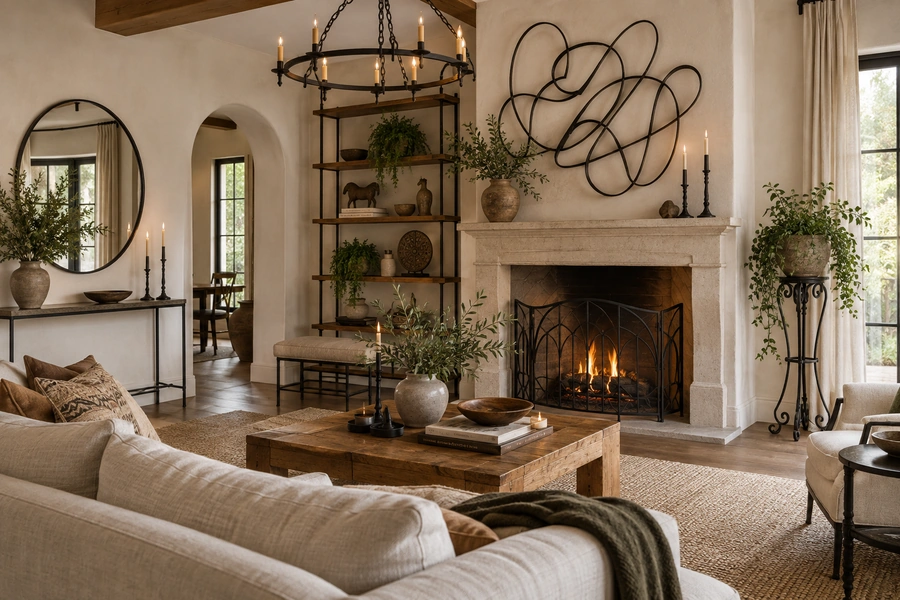
I use wrought iron wall decor when I want a strong focal point without adding more color or fabric to a room. A metal grille, botanical panel, geometric sculpture, medallion, or architectural fragment can work above a console, fireplace, sofa, or sideboard. I usually choose one substantial piece rather than several small matching iron decorations.
I Treat Iron Like Sculpture
One of the qualities I like most about iron wall decor is that it changes as the light changes.
A painting has a flat surface.
Open ironwork has depth.
Light can move through the gaps and create shadows on the wall behind it. That gives the piece more visual movement.
Current wrought iron wall design is also moving beyond traditional scrollwork. Contemporary pieces can use botanical outlines, abstract shapes, geometric patterns, architectural grids, and simple forged curves.
This makes iron much easier to combine with modern interiors.
I might place a large black iron grille against a warm white plaster wall. The contrast is enough to create interest without requiring additional color.
In a more traditional home, I can use an antique railing fragment or decorative panel as wall art. This approach also fits the current preference for interiors that contain collected objects with age and character. Homes & Gardens’ 2026 “found luxury” coverage emphasizes pieces with history and craftsmanship rather than perfectly coordinated furnishings.
I still use restraint.
Large, highly ornate Tuscan-style scroll plaques can make a room feel dated when they are combined with many other dark accessories.
I prefer a simple rule: one strong iron wall piece should look intentional enough that I do not need several smaller ones around it.
2. Frame a Mirror With Wrought Iron
Mirrors already provide practical function, but an iron frame can make them feel more architectural.
I use a wrought iron mirror when I want to introduce metal without adding a heavy piece of furniture. A thin black frame works well in modern interiors, while forged curves or aged iron can suit Mediterranean, Spanish, traditional, rustic, or collected spaces. I especially like iron mirrors in entryways, powder rooms, bedrooms, and above console tables.
I Match the Frame to the Room
The phrase “wrought iron mirror” covers many styles.
One mirror may have a simple narrow black frame.
Another may contain leaves and forged flowers.
Another may use elaborate scrollwork.
The right choice depends on the architecture.
For a contemporary room, I prefer:
a thin rectangular frame, an oval iron mirror, or a restrained arched design.
For a Spanish or Mediterranean interior, I can use more decorative iron because the material already belongs naturally with plaster, tile, wood, and stone.
The current Spanish farmhouse revival also supports this approach. Homes & Gardens’ August 2026 coverage shows wrought iron mirrors among the elements being used to bring Mediterranean character into interiors without recreating the heavy Tuscan look of the early 2000s.
I also think carefully about what the mirror reflects.
If I put an iron-framed mirror opposite a window, I can increase the feeling of light while keeping the dark frame visually balanced.
If I place it above a console, I usually avoid using another highly decorative iron piece directly below it.
For example, an ornate iron mirror can sit above a simple wood console.
A simple iron mirror can sit above a more detailed vintage console.
This balance prevents the room from becoming too themed.
3. Add Wrought Iron Through Lighting
Lighting is one of my favorite places to use wrought iron because it lets the metal function as both decoration and architecture.
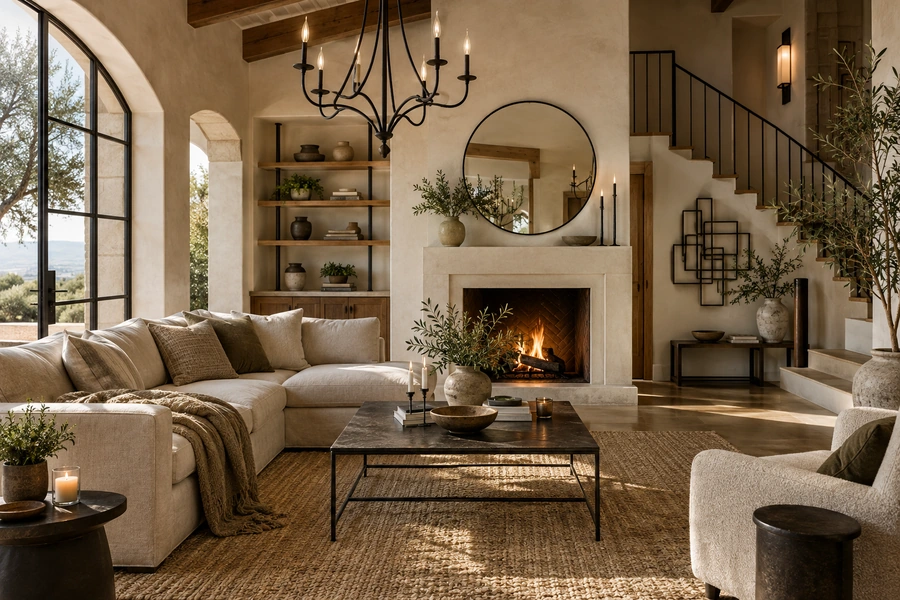
I use wrought iron lighting through chandeliers, pendant lights, wall sconces, and table or floor lamps. For a current interior, I prefer sculptural or simplified iron fixtures instead of extremely heavy multi-scroll designs. The dark metal creates useful contrast against plaster, wood, stone, and soft fabrics while the light itself keeps the material from feeling visually cold.
I Let One Fixture Carry the Metal Story
A chandelier can become the strongest iron element in a room.
I may not need iron wall art, an iron mirror, and iron furniture in the same space.
Instead, I let the light fixture provide the contrast.
This approach works particularly well above:
a dining table, kitchen island, entry table, staircase, or bed.
Architectural Digest provided a current example in a 2026 Paris apartment, where a handcrafted wrought iron pendant hangs above a contemporary resin dining table. The iron works beside tapestry, brass, and other expressive materials rather than forcing the entire room into a traditional style.
That is exactly how I like to use wrought iron now.
I do not ask every object to match.
I want the iron to add another material layer.
Current lighting guidance also favors layered lighting rather than relying on a single overhead fixture. Homes & Gardens’ September 2026 designer guidance recommends combining chandeliers, sconces, floor lamps, and table lamps to create depth and atmosphere.
That gives me several opportunities to repeat iron subtly.
I might use one large iron pendant and two smaller dark sconces, while the table lamps use ceramic or brass.
The repetition connects the room without making everything identical.
4. Bring in a Wrought Iron Table or Furniture Base
I do not need a complete set of iron furniture. One table with an iron structure can give a room enough definition.
I use wrought iron in furniture through console tables, coffee tables, side tables, benches, stools, desks, and dining-table bases. I prefer iron combined with another material such as wood, marble, glass, or stone. The combination gives me the strength and dark lines of metal without making the room feel visually hard or overly industrial.
Iron Works Best for Me in Contrast
A metal table made entirely from heavy black iron can dominate a soft living room.
An iron base with a limestone top feels very different.
So does an iron coffee table with glass.
I like combinations such as:
| Iron element | Material I pair with it | Effect |
|---|---|---|
| Iron console base | Warm wood | Relaxed and grounded |
| Iron coffee table | Stone | Architectural |
| Iron side table | Glass | Light and open |
| Iron dining base | Marble | Refined |
| Iron bench | Linen upholstery | Softer and more comfortable |
| Iron stool | Leather | Warm and collected |
This contrast also fits the current warm-minimalist direction.
Homes & Gardens’ 2026 warm minimalism coverage actually features a wrought iron coffee table within a neutral interior and describes the broader style as combining simple forms with warmer, tactile materials.
I find that useful because it shows why wrought iron does not have to mean “old-fashioned.”
The same material can look completely different depending on what surrounds it.
I also prefer mixed furniture rather than a matching iron set.
One iron console beside a wood cabinet and upholstered chair feels collected.
An iron coffee table, iron end tables, iron console, and iron chairs can easily become repetitive.
The material is strongest when I allow it to provide contrast rather than dominate the room.
5. Use Wrought Iron Railings as Architectural Decor
Some of the best wrought iron decor is not an accessory at all. A stair railing can become one of the most important visual elements in a home.
I use wrought iron railings when I want safety and decoration to work together. Simple vertical balusters can suit contemporary homes, while restrained curves and forged details work well in traditional, Mediterranean, or Spanish-style architecture. I usually keep the pattern lighter than older Tuscan railings so the stairs remain open and the iron does not overpower the surrounding materials.
I Let the Architecture Lead the Pattern
A railing is permanent enough that I do not design it like a temporary trend.
I look at:
the staircase shape, floor material, handrail, ceiling height, wall color, and architecture.
A very elaborate railing may look beautiful in a large Spanish Revival house.
The same railing can overwhelm a small contemporary staircase.
For a modern house, I might use thin vertical black balusters with a warm wood handrail.
The contrast gives the staircase structure without adding too much ornament.
Architectural Digest has shown this type of strategy in a SoHo penthouse where wrought iron railings were used to reference the building’s industrial history while curved forms kept the architecture visually soft.
Current residential examples also continue to use simple black iron railings for architectural contrast. Recent Homes & Gardens coverage of a dramatic entryway, for example, describes black iron railings against cream stairs and light wood as a classic, versatile combination.
I see railings as one of the most timeless places to use iron because the material has a structural reason to be there.
I do not need to explain it as decoration.
It already belongs to the architecture.
That often makes it age better than an ornamental accessory chosen only because it matches a temporary style.
6. Add a Wrought Iron Fireplace Screen
A fireplace naturally creates a focal point, so I do not need a complicated iron piece to attract attention.
I use a wrought iron fireplace screen or fireplace accessories to introduce dark metal at the center of a living room. A simple mesh screen with a forged frame can look clean and architectural, while handmade tools, andirons, or candleholders can add traditional character. I keep the design restrained when the fireplace surround already contains detailed stone, tile, or woodwork.
I Balance Iron With the Fireplace Material
A fireplace may already contain several materials.
I might have:
stone, brick, marble, tile, timber, or plaster.
The iron should support that composition.
Against pale limestone, a black iron screen creates clear contrast.
Against rustic brick, aged iron feels more natural.
Against a minimalist plaster fireplace, I prefer thin dark lines instead of decorative scrollwork.
This is where I think functional wrought iron feels especially convincing.
The object has a reason to exist.
It is not simply another accessory.
The same principle applies to fireplace tools.
A black iron tool set can provide repetition without making me add unnecessary wall decorations.
I can also bring in wrought iron candleholders when the fireplace is not being used. The metal continues the visual theme while the candlelight softens its harder surface.
I am careful not to over-coordinate.
I would not automatically choose an iron screen, matching iron clock, matching sconces, and matching iron log holder.
Current 2026 interiors increasingly favor layered, imperfect combinations rather than fully matched sets. Better Homes & Gardens notes that mixed metals and handcrafted furniture are part of the move toward more soulful and less “matchy” interiors.
That makes the fireplace a good place for one or two strong iron details rather than a complete themed collection.
7. Use Iron Shelves, Brackets, and Storage Details
Wrought iron does not need to be large or dramatic. Small functional details can give a room character without changing the entire style.
I use iron through shelf brackets, open shelving frames, hooks, pot racks, towel bars, cabinet pulls, and small storage pieces. These details work especially well when I pair them with natural wood or stone. They let me repeat the dark iron color around a room in small amounts while keeping the overall interior warm and practical.
Small Iron Details Can Connect a Room
Imagine a kitchen with warm oak cabinets and pale stone.
I may use simple black iron shelf brackets.
Those brackets can visually connect to a dark pendant or window frame without requiring every piece of hardware to match.
In an entryway, I might use an iron hook rail above a wood bench.
In a bathroom, I can use a dark metal towel rail beside a wood vanity.
In a pantry, an iron shelving frame can create a stronger architectural line.
Current wrought iron décor collections still include brackets, shelving, hooks, vessels, storage, and other functional accessories, showing how broad the material’s interior use has become.
I especially like this method when someone wants to experiment with wrought iron but does not want to buy a large piece of furniture.
It is easy to introduce.
It is also easy to control.
The biggest styling mistake I avoid is turning every visible fitting black simply because I started using iron.
I am comfortable mixing metal finishes.
A kitchen can contain black iron shelves, aged brass cabinet hardware, and stainless steel appliances when the colors repeat with enough intention.
The 2026 ASID trend outlook describes metal finishes as becoming more expressive and sculptural, while Better Homes & Gardens notes that mixed metals are adding depth to current interiors.
That gives me more freedom than older decorating rules that required every metal in a room to match exactly.
8. Style Wrought Iron Candleholders and Sculptural Objects
Small wrought iron decor can add texture without taking over a room, but I choose it much more carefully than I would have years ago.
I use wrought iron candleholders, bowls, clocks, sculptures, decorative stands, and small forged objects as accents rather than filler. I prefer pieces with an unusual shape, handmade texture, or visible craftsmanship. One sculptural object on a console usually looks more current to me than a collection of matching iron accessories spread across every surface.
I Choose Objects That Have Presence
Small décor can create clutter quickly.
This is especially true with dark metal because every piece creates a strong line.
I therefore look for objects that can stand alone.
A pair of tall forged candleholders may be enough for a dining table.
One abstract iron sculpture can sit on a console beside books and ceramics.
A handmade iron bowl can provide contrast on a pale stone table.
I also mix these objects with softer materials.
For example, I might combine:
an iron candleholder, a ceramic vessel, a stack of books, and a loose branch.
The metal brings structure.
The ceramics bring softness.
The books bring color.
The branch creates an organic shape.
This type of material layering fits the current design interest in tactile, collected interiors. Vogue’s 2026 trend report emphasizes craftsmanship and sculptural metalwork, while current Homes & Gardens coverage describes texture as increasingly central to warm, comfortable rooms.
I also like aged finishes.
I do not need every iron object to have perfectly smooth black paint.
A subtle patina can make a handmade piece feel more natural.
What I avoid is artificial distressing that looks too deliberate.
I want the piece to feel like an object with character, not an accessory manufactured to imitate age.
9. Combine Wrought Iron With Plants and Greenery
Wrought iron can feel visually hard when I use it alone. Plants are one of the easiest ways for me to soften that quality.
I use wrought iron plant stands, planter frames, wall trellises, decorative baskets, and console tables with greenery. The contrast between dark structured metal and loose foliage works particularly well in living rooms, sunrooms, entryways, kitchens, and covered patios. I choose simple iron forms so the plant remains the main visual focus.
Greenery Softens the Metal Naturally
I like this combination because the materials do opposite things.
Iron is dark, hard, and structured.
Leaves are irregular, soft, and organic.
Together they create balance.
A tall plant on a slender iron stand gains height without needing a massive pot.
A trailing plant can soften an iron wall trellis.
Artificial or fresh branches can sit on an iron console.
A small collection of terracotta pots can sit on a simple forged plant rack.
I can use either living or high-quality artificial greenery depending on the light and maintenance needs of the space.
The key is that I do not hide the iron completely.
I let some of the dark framework remain visible.
That gives the composition structure.
I also like to combine iron with terracotta because the warm orange-brown color prevents the black metal from feeling cold.
This relationship between wrought iron, terracotta, and greenery is especially strong in Mediterranean-inspired spaces. Current 2026 coverage of European bistro and Spanish farmhouse styling continues to combine iron with natural materials and plants rather than using the metal alone.
For a modern room, I keep the stand simple.
For a traditional home, I may allow a few forged curves.
Either way, the plant should remain the star.
How Do I Keep Wrought Iron Decor From Looking Outdated?
The difference between timeless wrought iron and dated wrought iron usually has less to do with the material than with how much of it I use.
I keep wrought iron decor current by choosing cleaner forms, using it selectively, mixing it with warm natural materials, and avoiding complete matching sets. I also mix iron with other metal finishes instead of repeating black metal everywhere. Heavy Tuscan scrollwork can feel dated, while sculptural iron, vintage pieces, architectural details, and simpler handcrafted forms fit current interiors well.
The 2026 design direction supports this more selective approach.
Vogue identifies sculptural metalwork as part of the move toward tactile interiors. Homes & Gardens shows wrought iron working in warm minimalism and “found luxury,” where craftsmanship, history, and collected objects matter more than perfectly matched décor.
I usually follow three simple principles.
First, I let iron create contrast.
Second, I surround it with warmer materials.
Third, I stop before it becomes a theme.
This means one wrought iron mirror may be enough in an entryway.
One iron table may be enough in a living room.
One railing may provide all the dark metal a staircase needs.
The result feels much more natural than repeating the same scroll pattern from room to room.
My insights: 9 Ways To Use Wrought Iron Decor In Your Home
After looking at how wrought iron appears in current interiors, I think its strongest quality is versatility. I can use it as architecture, furniture, lighting, art, or a small functional detail.
The nine most useful ways I use wrought iron decor at home are wall art, mirrors, lighting, furniture, stair railings, fireplace accessories, shelving and storage, sculptural objects, and plant displays. The material feels most current when I use fewer pieces, choose good craftsmanship, and balance its dark structure with warmer natural materials rather than decorating an entire room around matching iron.
I Treat Iron as a Material, Not a Theme
This is the main idea I use when decorating with wrought iron.
I do not think:
“I need a wrought iron room.”
I think:
“This room needs structure.”
Or:
“This wall needs depth.”
Or:
“This pale space needs a darker line.”
That changes the way I select pieces.
A wrought iron pendant may solve the problem.
A mirror may solve it.
A slim table may solve it.
I do not need all three.
I Prefer Iron That Also Has a Function
The iron pieces that feel most timeless to me often do something.
A railing provides safety.
A chandelier provides light.
A mirror reflects the room.
A console holds objects.
A fireplace screen protects the hearth.
A shelf bracket supports a shelf.
A plant stand raises greenery.
These functional pieces tend to feel more natural because the material has a reason to be there.
I think decorative iron also works, but I use it more selectively.
I Balance Dark Metal With Warmth
Iron has strong visual weight.
I rarely surround it with only other dark, hard materials.
I prefer combinations such as:
| Wrought iron | I soften it with |
|---|---|
| Black wall grille | Warm plaster |
| Iron chandelier | Linen and wood |
| Iron coffee table | Stone and upholstery |
| Iron railing | Wood stairs |
| Iron mirror | Ceramic and natural fiber |
| Iron fireplace screen | Brick or limestone |
| Iron plant stand | Greenery and terracotta |
| Iron brackets | Natural wood shelves |
This balance helps wrought iron feel contemporary instead of heavy.
I Let Craftsmanship Show
Current interiors are becoming more interested in visible craftsmanship and individual character. Vogue’s 2026 trend report and Homes & Gardens’ “found luxury” coverage both support this shift toward tactile, expressive, collected pieces.
That makes wrought iron particularly useful.
A handmade iron object does not need to be perfectly uniform.
Small hammer marks, aged surfaces, forged curves, and subtle variation can make it more interesting.
I do not want poor workmanship.
I do want evidence that the material has been shaped.
My Final Approach
When someone asks me how to use wrought iron decor in a home, I start with the room rather than the iron.
I look for what the room is missing.
If it needs a focal point, I consider an iron wall panel or mirror.
If it needs stronger lighting, I consider an iron chandelier.
If it needs structure, I may choose an iron table.
If the staircase needs architectural definition, I look at railings.
If the fireplace needs a stronger focal element, I add a screen.
If I need practical details, I use brackets, shelves, or hooks.
If a console feels empty, I add one sculptural iron object.
If the room feels hard, I combine an iron plant stand with greenery.
This keeps wrought iron from becoming a decorating theme.
Instead, it becomes one material within a layered home.
That approach also makes it easier for the decor to age well.
The 2026 interior trend cycle is currently favoring warm, personal, tactile spaces over sterile or highly matched rooms.
Wrought iron fits that direction when I use it for what it does best: creating contrast, structure, craftsmanship, and a sense of permanence.
Conclusion
I use wrought iron through wall art, mirrors, lighting, furniture, railings, fireplaces, storage, sculptural objects, and plant displays, while balancing its dark structure with warm natural materials.