
Ornamental iron can give a room character instantly, but too much dark scrollwork can make a home feel heavy, themed, or stuck in an older decorating era.
Five effective ornamental iron home décor ideas are decorative fireplace screens, sculptural wall art, wine racks and display shelving, planter stands, and custom iron furniture or architectural accents. For a current look, use iron selectively and balance it with warm wood, stone, linen, plaster, ceramics, and greenery instead of filling a room with matching metal pieces.
Ornamental iron now appears in furniture, lighting, wall art, storage, and architectural details. Use it selectively to add handcrafted texture, dark contrast, and structural character.
Is Wrought Iron Decor Still in Style?
Wrought-iron-style décor has not disappeared. In 2026, it works best when the design is lighter, more intentional, and less dependent on dense traditional ornament.
Yes, ornamental and wrought-iron-style décor can still look current. Contemporary interiors favor simpler silhouettes, matte or aged finishes, handcrafted character, and iron paired with softer natural materials. The dated version is usually not iron itself but excessive scrollwork, complete matching sets, glossy finishes, and too many heavy metal accents in one room.
Idea 1: Use an Ornamental Iron Fireplace Screen as a Focal Point
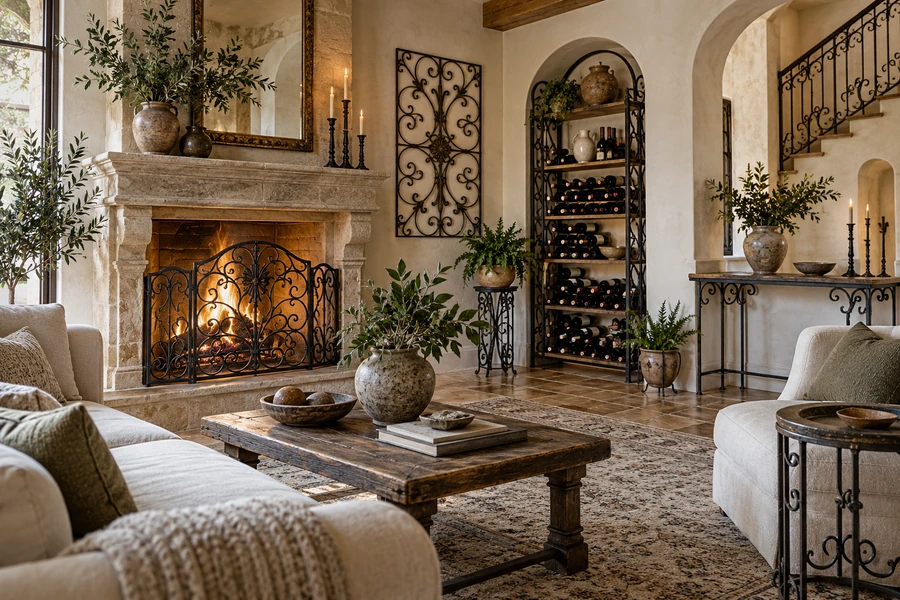
A decorative fireplace screen is one of the strongest ways to introduce ornamental iron because the piece has both a practical and visual role.
Artistic Iron Works includes fireplace covers among its core ornamental-iron home décor applications, while custom fabricators also show fire screens as a recurring residential product category.
A good iron screen can add:
- Dark contrast
- Architectural shape
- Fine pattern
- Historical character
- Visual depth
without filling the entire room with metal.
Choose the Pattern According to the Fireplace
For a traditional stone fireplace, consider:
- Gentle curves
- Small forged leaves
- Restrained scrolls
- Arched frames
For a cleaner modern fireplace, choose:
- Straight lines
- Sparse geometric patterns
- Fine mesh
- Matte black framing
The fireplace already has strong visual weight.
The screen should finish the composition rather than compete with it.
Pair Iron With Softer Materials
Around the fireplace, combine dark iron with:
- Limestone
- Travertine
- Plaster
- Oak
- Linen
- Wool
This is one of the simplest ways to prevent ornamental metal from making a living room feel cold.
Keep Safety Separate From Decoration
A decorative fireplace accessory should still be appropriate for its intended use.
If it is being used as an actual spark guard or safety screen, confirm:
- Dimensions
- Stability
- Heat suitability
- Construction
- Clearance
with the manufacturer.
Do not assume every decorative iron panel is suitable as a functioning fireplace barrier simply because it visually fits the opening.
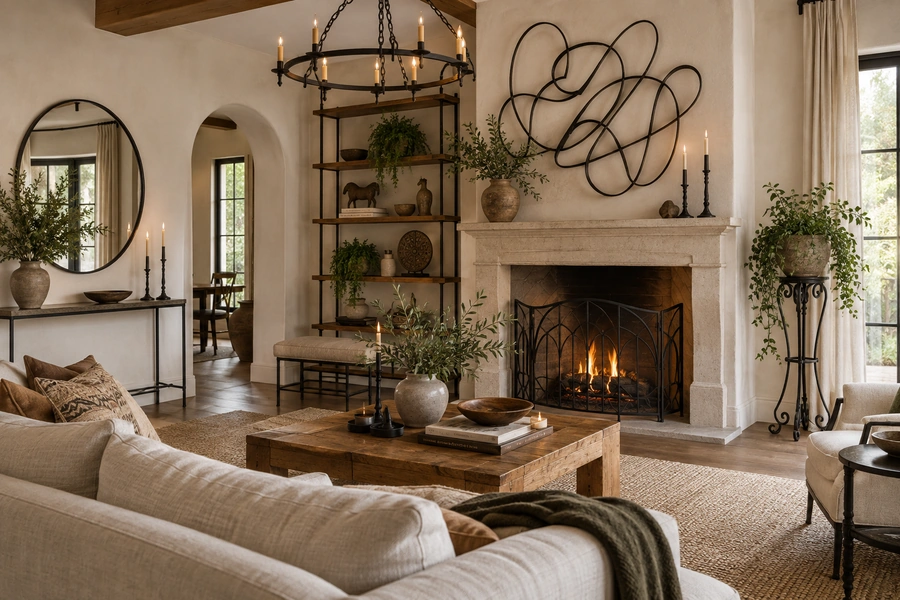
Idea 2: Turn Ornamental Iron Wall Art Into One Large Statement
Iron wall art can replace a collection of smaller framed accessories and add texture without taking up floor space.
Both ornamental-iron fabricators and residential metalwork companies currently list wall art, plaques, sculptures, signs, and custom decorative fabrication among common applications.
The most effective approach is usually:
one strong piece + empty space
rather than covering an entire wall with small iron motifs.
Good Locations for Iron Wall Art
Try it:
- Above a console
- Over a sideboard
- In a stair landing
- On a double-height wall
- In a covered patio
- At the end of a hallway
A large ornamental panel can become architectural artwork.
Botanical Ironwork
Leaves, branches, vines, flowers, and tree forms work especially well in iron because they soften the hardness of the material.
Custom ornamental metal suppliers currently offer floral panels and decorative castings specifically for this purpose.
To keep botanical ironwork current, choose:
- Open negative space
- Irregular branches
- Limited ornament
- Matte finishes
rather than extremely dense floral scrolls.
Geometric Ironwork
For a contemporary home, use:
- Circles
- Arches
- Repeated vertical lines
- Abstract grids
- Minimal curves
The material can remain traditional while the geometry becomes modern.
Do Not Overfill the Wall
Iron has greater visual weight than a pale canvas or simple photograph.
A large metal artwork needs breathing space around it.
If the wall also contains:
- Shelves
- Mirrors
- Sconces
- Several pictures
the iron can disappear into visual clutter.
Idea 3: Make Wine Storage Part of the Décor
An ornamental iron wine rack combines display and function.
Artistic Iron Works specifically identifies wine-rack displays, wall racks, carts, and freestanding bottle storage as ornamental home décor applications. Other iron fabricators also list wine racks among custom residential projects.
This can work especially well in:
- Dining rooms
- Home bars
- Kitchens
- Wine rooms
- Entertaining spaces
Wall-Mounted Wine Rack
This works in a smaller room because it uses vertical space.
Choose a design that:
- Holds bottles securely
- Leaves labels visible where desired
- Uses a simple frame
- Does not project excessively into circulation space
Freestanding Wine Display
A freestanding iron rack can look more like furniture.
Pair it with:
- Reclaimed oak
- Stone countertop
- Leather
- Warm plaster
- Antique brass accents
The mix of materials keeps the result from becoming too industrial.
Iron + Wood Is Usually Stronger Than Iron Alone
A useful formula is:
iron frame + timber shelves
The iron provides structure.
The wood adds warmth.
This combination can also work for:
- Bookshelves
- Bar shelving
- Kitchen storage
- Display cabinets
Idea 4: Raise Greenery With Ornamental Iron Planter Stands
Iron and greenery naturally balance each other.
The plant softens the metal, while the iron creates height and structure.
Current wrought-iron décor guidance includes planter stands and garden applications among useful ways to incorporate the material into a home or landscape.
Use ornamental iron planter stands in:
- Living rooms
- Sunrooms
- Entries
- Patios
- Balconies
- Courtyards
Use Different Heights
Instead of three identical plants in a straight row, try:
- One tall stand
- One medium stand
- One lower pot
This creates a more natural composition.
Pair With Terracotta
One of the strongest combinations is:
dark iron + aged terracotta + green foliage
It works particularly well for:
- Mediterranean interiors
- Spanish-inspired homes
- Rustic spaces
- Garden rooms
Other good containers include:
- Stoneware
- Matte ceramic
- Limestone-look planters
Real or Artificial Plants Can Both Work
Iron stands can support living or faux greenery.
For living plants, make sure the planter has appropriate:
- Drainage
- Water protection
- Light
For artificial plants, focus more on:
- Scale
- Realism
- Dusting
- Secure placement
The stand should look like part of the interior rather than a device used to fill an empty corner.
Idea 5: Commission One Custom Iron Furniture or Architectural Piece
Custom ornamental iron has the strongest impact when the piece is designed for a specific place.
Current fabricators offer residential work including:
- Tables
- Railings
- Shelves
- Benches
- Lighting
- Balconies
- Staircases
- Custom decorative fabrication
rather than limiting ornamental iron to small accessories.
A custom piece can include:
Entryway
- Iron console base
Dining room
- Iron table base
Kitchen
- Pot rack or shelf brackets
Staircase
- Ornamental railing
Bedroom
- Fine iron bed
Patio
- Bench or table
Functional Iron Usually Ages Better Than Novelty Décor
A railing has a purpose.
A shelf bracket has a purpose.
A table base has a purpose.
Because these pieces are integrated into the home, they usually have more design longevity than small decorative objects that depend heavily on a trend.
The Five Ideas at a Glance
| Idea | Best Location | Main Benefit |
|---|---|---|
| Fireplace screen | Living room | Functional focal point |
| Wall art | Entry/living room | Texture without floor space |
| Wine rack | Dining/bar | Storage + display |
| Planter stand | Indoor/outdoor | Softens iron with greenery |
| Custom furniture/ironwork | Any room | Architectural character |
What Rooms Are Best for Wrought Iron Home Decor?
Ornamental iron can work throughout a home, but it is strongest in rooms where dark metal can be balanced by light, texture, and natural materials.
Living rooms, dining rooms, entryways, kitchens, staircases, bedrooms, and patios are all strong locations for ornamental iron. Use larger iron pieces in rooms with enough visual space, and use smaller brackets, mirrors, candle holders, hooks, or plant stands where floor area is limited. Keep the iron proportional to the room.
Living Room
The living room can handle one substantial iron focal point.
Good choices include:
- Fireplace screen
- Console
- Wall sculpture
- Side table
Then introduce softer materials around it.
For example:
Iron fireplace screen + cream sofa + oak table + wool rug
The room gains structure without becoming dark.
Dining Room
Dining areas work particularly well with iron because the metal contrasts naturally with table surfaces.
Use:
- Wine rack
- Chandelier
- Iron table base
- Candle holders
Pair iron with:
- Oak
- Walnut
- Marble
- Travertine
If the dining table already has a heavy iron base, avoid adding a huge ornate iron wine rack and dense chandelier in the same small room.
Entryway
An entry can use iron to establish a visual identity quickly.
Try:
- Slim console
- Iron-framed mirror
- Wall hooks
- Decorative panel
Because people move through an entrance rather than spending hours there, a slightly stronger visual statement can work well.
Kitchen
Use smaller functional pieces.
Current handcrafted iron makers market:
- Pot racks
- Towel holders
- Shelf brackets
- Hooks
as practical home décor rather than purely decorative accessories.
The kitchen formula might be:
Iron brackets + reclaimed oak shelves + ceramic dishes
This delivers the material character without covering the room in black metal.
Staircase
A railing is one of the most permanent applications.
Custom ornamental-iron companies continue to specialize in interior stair rails and curved railing systems.
For an older home, more decorative forging may suit the architecture.
For a contemporary interior, choose:
- Slim verticals
- Controlled curves
- Open patterns
Bedroom
The bedroom needs more restraint because iron can feel visually hard.
Try:
- One iron bed
- One mirror
- One pair of small sconces
Do not automatically combine all three.
Current 2026 bedroom guidance similarly recommends balancing wrought iron’s visual weight with softer materials and limiting the number of major metal pieces.
Patio
Outdoor areas can accept more iron because:
- Stone
- Plants
- Sky
- Natural light
soften the material.
Good choices include:
- Plant stands
- Benches
- Tables
- Trellises
- Wall art
For outdoor pieces, corrosion protection becomes much more important.
Room-by-Room Guide
| Room | Good Ornamental Iron Choice |
|---|---|
| Living room | Fireplace screen |
| Dining room | Wine rack |
| Entry | Wall art or console |
| Kitchen | Shelf brackets |
| Staircase | Railing |
| Bedroom | Bed or mirror |
| Patio | Planter stand or furniture |
| Home bar | Bottle display |
| Hallway | Sconce or wall panel |
How Do I Prevent Wrought Iron Decor From Looking Heavy or Outdated?
The biggest styling risk is rarely the metal itself. It is using too much ornament, too many matching pieces, or combining dark iron with equally dark furniture.
Keep ornamental iron current by using one focal piece per zone, choosing simpler profiles, and balancing black or aged metal with light walls, warm timber, stone, linen, greenery, and open space. Ornamental curves can still work, but avoid repeating the same scroll motif on railings, furniture, wall art, lighting, and accessories simultaneously.
Use Iron as Contrast
Think of iron as the dark line in a drawing.
It can define:
- An edge
- A frame
- A silhouette
- A focal point
It does not need to fill the entire composition.
Use the 80/20 Principle as a Styling Guide
A useful informal ratio is:
about 80% softer or lighter materials
and
about 20% dark structural accents
This is not a design standard.
It is simply a practical way to avoid visual overload.
Combine Iron With Wood
One of the easiest pairings is:
black iron + oak
It works for:
- Consoles
- Shelves
- Dining tables
- Stair rails
The iron feels strong.
The wood feels warm.
Combine Iron With Stone
Use:
- Travertine
- Limestone
- Marble
for a more refined result.
Examples:
iron console + travertine top
iron candle stand + limestone fireplace
Combine Iron With Linen
Fabric is particularly useful in:
- Bedrooms
- Dining rooms
- Living rooms
An iron bed looks softer with relaxed linen.
Iron dining chairs look less severe with upholstered seats.
Let Some Curves Remain
Modernizing does not mean removing all ornament.
A forged curve can be the detail that makes iron feel handcrafted.
The problem appears when curves become repetitive visual noise.
Use:
- One arch
- One botanical motif
- One forged scroll
rather than covering every part of the object.
Avoid Complete Matching Collections
This is one of the fastest ways to date the room.
Avoid automatically buying:
- Iron console
- Iron mirror
- Iron chandelier
- Iron candle holders
- Iron wall art
from the same matching collection.
A room usually looks more sophisticated when objects appear to have been gathered gradually.
Choose the Finish Carefully
Modern finishes include:
- Matte black
- Charcoal
- Soft black
- Aged bronze
- Natural forged finish
Glossy black can still work, but it appears stronger and more formal.
Matte surfaces are generally easier to integrate into contemporary interiors.
Current vs Heavy
| More Balanced | More Likely to Feel Heavy |
|---|---|
| One large iron accent | Many matching pieces |
| Fine open patterns | Dense scrollwork |
| Iron + wood | Iron + dark iron |
| Matte finish | Heavy glossy finish |
| Negative space | Every wall filled |
| One botanical motif | Repeated vines everywhere |
| Natural textiles | Hard surfaces only |
How Do You Maintain and Protect Ornamental Iron Decor?
Iron décor is durable, but ferrous metals can corrode when moisture reaches exposed surfaces. Maintenance depends heavily on the actual metal and finish.
For indoor ornamental iron, remove dust regularly, keep the surface dry, avoid damaging the protective finish, and inspect scratches or joints for early corrosion. Outdoor iron needs more frequent checks because rain, humidity, condensation, and salts increase corrosion risk. Follow the maker’s care instructions before applying wax, oil, cleaners, or new coatings.
“Ornamental Iron” Does Not Always Mean Historic Wrought Iron
This distinction is worth understanding.
Historic wrought iron has a characteristic fibrous structure created by its manufacturing process.
Historic England explains that mild steel can reproduce the traditional forms and fixing styles associated with old ironwork, while modern construction commonly uses several different ferrous metals.
The U.S. National Park Service likewise distinguishes wrought iron from cast iron and steel when discussing historic metalwork.
Therefore, when buying new décor, ask:
- Is it wrought iron?
- Mild steel?
- Cast iron?
- Another metal?
This affects:
- Weight
- Fabrication
- Restoration
- Corrosion behavior
- Appropriate maintenance
Indoor Maintenance
For ordinary finished indoor ornamental iron:
- Remove loose dust.
- Use a soft cloth.
- Keep moisture low.
- Check scratches.
- Inspect welded joints and crevices.
- Follow the finish manufacturer’s care instructions.
One hand-forged iron maker recommends periodic inspection and reapplication of its own oil/wax finish, with frequency changing according to indoor moisture exposure. This is manufacturer-specific rather than a universal schedule.
Outdoor Maintenance
Outdoor iron faces more demanding conditions.
Check:
- Coating chips
- Weld joints
- Feet
- Horizontal surfaces
- Water traps
- Fasteners
Historic England emphasizes corrosion assessment, coatings, and ongoing maintenance as central parts of preserving ironwork.
Do Not Ignore Small Rust Spots
Corrosion does not improve by itself.
If the piece is a normal modern decorative object, the maker may recommend:
- Cleaning
- Rust removal
- Metal primer
- Compatible topcoat
For historic or valuable ironwork, use conservation-appropriate methods rather than aggressive DIY treatment.
The National Park Service recommends starting with the least abrasive appropriate methods for historic wrought iron, cast iron, and steel.
Humid Rooms Need More Attention
Iron in:
- Bathrooms
- Coastal homes
- Damp basements
- Conservatories
may require closer inspection than the same object in a dry living room.
This is another reason to check the actual coating before buying.
Maintenance Table
| Condition | Action |
|---|---|
| Light indoor dust | Soft dry cloth |
| Slight surface dirt | Manufacturer-approved cleaning |
| Damp surface | Dry promptly |
| Paint chip | Inspect and repair appropriately |
| Surface rust | Treat according to finish/material |
| Outdoor iron | Inspect more frequently |
| Historic iron | Use conservation guidance |
| Unknown coating | Ask maker before applying chemicals |
My Insights: What Are the Best 5 Ornamental Iron Home Décor Ideas
The best ornamental iron décor combines decoration with a practical reason to exist. Functional pieces usually integrate into a home more naturally and remain useful longer than purely themed accessories.
The five strongest ornamental iron home décor ideas are a fireplace screen, sculptural wall art, a wine rack or display shelf, a planter stand, and one custom furniture or architectural feature. The key is restraint: use dark iron as structure and contrast, then soften it with warm wood, stone, ceramics, textiles, plants, and intentional negative space.
My First Insight: Functional Iron Usually Looks More Expensive
A fireplace screen does something.
A wine rack does something.
A shelf bracket does something.
A railing does something.
Functional metalwork tends to feel more architectural because the decoration grows from a practical requirement.
That is often more convincing than buying ornamental objects purely to fill a wall.
My Second Insight: One Custom Piece Can Define the Whole Room
A custom iron console or railing can become the visual identity of a space.
The surrounding furniture can remain simple.
Current ornamental fabricators continue to emphasize custom residential fabrication because iron can be shaped around the dimensions and style of a specific property.
My Third Insight: Wall Art Is the Lowest-Commitment Large Idea
A railing requires construction.
A fireplace screen requires measurements.
A wall panel is easier.
It can create:
- Texture
- Black contrast
- Handcrafted detail
without remodeling the home.
My Fourth Insight: Iron and Greenery Are an Underrated Combination
A planter stand may be one of the easiest ornamental iron pieces to style because foliage naturally softens metal.
Try:
iron + olive tree
iron + trailing ivy
iron + terracotta
For faux plants, choose realistic greenery and keep it dust-free.
For living plants, protect the iron and flooring from excess water.
My Fifth Insight: Wine Racks Work Because the Contents Add Warmth
An empty black metal rack can feel hard.
Add:
- Bottles
- Timber
- Warm lighting
- Glassware
and it becomes layered.
That makes wine storage one of the most natural ways to use ornamental iron in dining and entertaining spaces.
My Sixth Insight: Avoid Decorating With the Word “Ornamental”
An ornamental iron product does not need to contain:
- Ten scrolls
- Three leaves
- Several flowers
- Decorative finials
to qualify as decorative metalwork.
Sometimes the most effective ornament is:
- One curve
- One hammered edge
- One forged joint
Restraint lets craftsmanship become visible.
My Seventh Insight: Match Ornament to Architecture
A Spanish Revival house can handle more decorative iron than a minimalist apartment.
Use this rough guide:
| Home Style | Iron Direction |
|---|---|
| Contemporary | Geometric and thin |
| Transitional | Simple curves |
| Spanish Revival | Forged curves and botanical detail |
| Mediterranean | Traditional but restrained |
| Rustic | Textured and aged |
| Industrial | Straight, structural profiles |
| Traditional | Classic curves |
| Minimalist | One sculptural accent |
My Eighth Insight: Modern “Wrought Iron” May Actually Be Steel
This matters especially when purchasing custom pieces.
Historic England notes that mild steel can be worked into traditional wrought-iron forms, while genuine wrought iron is a distinct historic material.
Ask the seller for:
- Material
- Finish
- Coating
- Indoor/outdoor suitability
instead of relying on the marketing term alone.
My Ninth Insight: Maintenance Should Influence Placement
A complicated iron sculpture outdoors may contain:
- Crevices
- Curves
- Welds
- Water traps
that need inspection.
A simple indoor wall panel may need little beyond dust removal.
Choose complexity according to how willing you are to maintain the piece.
My Tenth Insight: The Best Iron Décor Has Space Around It
Iron has a strong silhouette.
Let people see that silhouette.
Do not surround one ornate metal object with ten other visually strong accessories.
A better formula is:
iron focal piece + warm surface + soft texture + empty space
The Five-Idea Priority Guide
| Priority | Idea | Why It Works |
|---|---|---|
| 1 | Fireplace screen | Function + focal point |
| 2 | Wall art | Strong impact, easy installation |
| 3 | Wine rack | Storage becomes décor |
| 4 | Planter stand | Greenery softens metal |
| 5 | Custom furniture/ironwork | Maximum personalization |
My Preferred Ornamental Iron Formula
For a living or dining space, use:
- One major iron feature
- One warm wood or stone surface
- One soft textile
- One plant or botanical element
- Enough negative space to see the iron silhouette
For example:
ornamental iron fireplace screen + limestone surround + oak furniture + linen sofa + olive tree
This creates depth without turning iron into a theme.
My Final Rule
The best ornamental iron home décor does not make guests think:
“There is a lot of iron in this room.”
It makes them notice:
- Craft
- Contrast
- Structure
- Detail
- Permanence
Use fewer pieces, choose better proportions, and let each item have a clear role.
Conclusion
Use ornamental iron where beauty and function overlap. Fireplace screens, wall art, wine racks, planter stands, and custom ironwork create the strongest impact when balanced with warm, natural materials.