

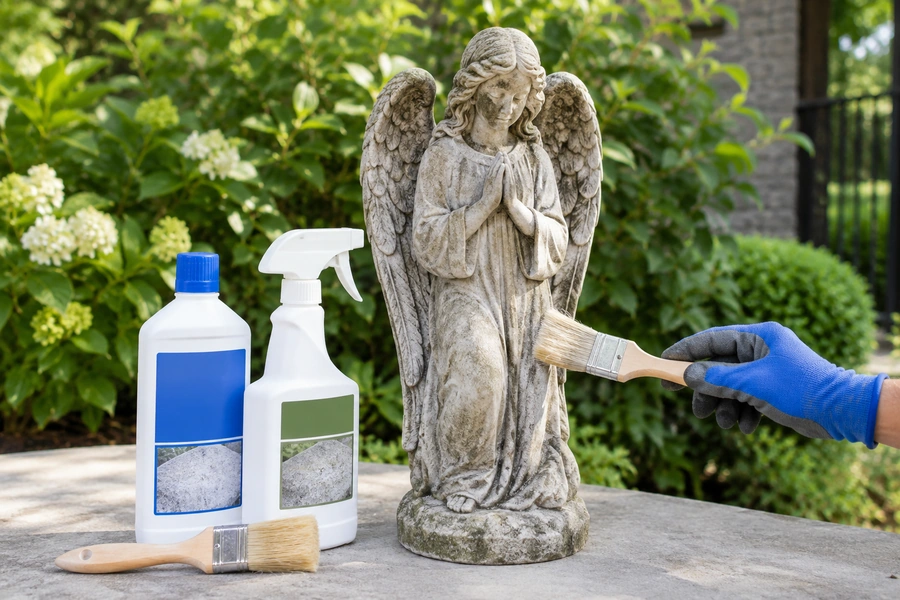
Concrete statues look solid, but their porous surface can absorb rain and moisture. The right sealer helps reduce water penetration without unnecessarily changing the statue’s appearance.
For most unpainted outdoor concrete statues, I seal them with a clear, breathable penetrating silane, siloxane, or silane-siloxane concrete sealer. For painted concrete statues, I use a compatible exterior-grade clear acrylic sealer instead. I avoid choosing a heavy waterproof coating simply because it sounds stronger, since moisture management and compatibility matter.
The best product depends on whether the statue is bare, painted, stained, historic, or already sealed. I always identify the surface before deciding what to put on it.
What Is the Best Sealer for an Outdoor Concrete Statue?
An outdoor statue faces rain, irrigation, temperature changes, dirt, and sometimes repeated freezing and thawing. I therefore prioritize water resistance and breathability rather than gloss.
For a natural, unpainted outdoor concrete statue, my first choice is usually a penetrating silane or siloxane sealer. These sealers enter the concrete instead of leaving a thick surface film, reduce moisture absorption, normally preserve the natural matte appearance, and allow water vapor to escape from the concrete.
I Prefer Penetrating Sealers for Bare Concrete
Penetrating concrete sealers include several chemical categories, such as:
- Silane
- Siloxane
- Silane-siloxane blends
- Siliconates
- Silicates
They do not all behave in exactly the same way.
For ordinary outdoor decorative concrete, I am particularly interested in silane and siloxane water repellents because their main purpose is reducing liquid-water penetration while leaving the concrete visually natural.
Concrete Network currently recommends penetrating sealers when exterior concrete needs weather protection and a natural matte finish. It also notes that most penetrating products remain breathable instead of forming a visible surface film.
Sika’s current penetrating silane and silane-siloxane systems similarly describe protection from moisture intrusion while allowing the substrate to remain breathable.
That combination is useful for garden statues because I usually do not want a stone-look sculpture to become glossy.
Silane vs. Siloxane
Both can work well, but they are not identical.
Silane molecules are relatively small and can penetrate deeply into porous concrete.
Siloxanes tend to work closer to the surface and are also widely used for water repellency.
Commercial products may combine the two.
For a homeowner, I would not choose between them only by chemistry. I check the manufacturer’s specifications for:
- Exterior concrete use
- Vertical surfaces
- Breathability
- Water repellency
- Freeze-thaw exposure
- Appearance change
- Required concrete age
- Reapplication requirements
A properly formulated silane-siloxane penetrating sealer is often an easy starting category for an ordinary unpainted garden statue.
What About Siliconate Sealers?
Siliconates are another penetrating option.
They can chemically react within porous concrete and create water repellency without leaving a decorative film.
I may consider them when the exact product is approved for vertical exterior concrete.
Again, the product specification matters more than the general chemistry name.
My Basic Choice for Bare Concrete
| Statue condition | Sealer I would consider first |
|---|---|
| Bare outdoor concrete | Penetrating silane-siloxane |
| Natural gray statue | Clear matte penetrating sealer |
| Porous cast concrete | Breathable water repellent |
| Freeze-thaw environment | Exterior penetrating sealer rated for freeze-thaw exposure |
| Statue where I want no color change | Non-film-forming penetrating sealer |
| Decorative concrete where I want richer color | Compatible acrylic may be considered |
I would not expect the sealer to repair cracks, weak concrete, or spalling. Penetrating sealers reduce water absorption, but they do not restore damaged concrete.
What Do You Seal Painted Concrete Statues With?
Painted concrete creates a different problem because the sealer must work with the coating already covering the statue.
For a painted concrete statue, I usually look for a clear exterior acrylic sealer that is specifically compatible with both concrete and the paint underneath. Acrylic sealers form a protective film and can be available in matte, satin, or gloss finishes. I test the product first because some clear coatings can alter color or sheen.
I Do Not Treat Painted and Bare Concrete the Same
A penetrating sealer needs access to the concrete’s pores.
Paint can block that access.
That means I do not simply take the same silane-siloxane sealer I would use on bare concrete and apply it over an existing painted surface.
Instead, I look for a topical coating intended for the existing finish.
Acrylic is often practical because it creates a relatively thin protective film and is commonly used on decorative exterior concrete. Concrete Network notes that acrylic sealers are used both indoors and outdoors and are commonly selected when appearance and color enhancement matter.
Rust-Oleum currently sells a urethane-fortified acrylic concrete sealer designed for painted, stained, or bare concrete, which illustrates that compatible clear acrylic products do exist for coated concrete surfaces.
I still read the specific product label before using it on a decorative statue.
Matte, Satin, or Gloss?
This is partly a design choice.
I generally prefer matte or low-sheen finishes for statues intended to resemble natural stone.
Satin can work when I want a slightly richer decorative surface.
Gloss creates a much more obviously coated appearance.
| Finish | Appearance |
|---|---|
| Matte | Natural and stone-like |
| Low sheen | Subtle protection |
| Satin | Slightly richer color |
| Gloss | Strong decorative shine |
| High gloss | Very coated appearance |
I do not choose gloss because I assume it protects better.
Appearance and performance are separate questions.
I Test Clear Sealers Before Committing
A product can be described as clear while still changing how light reflects from the surface.
This can make:
- Gray concrete appear darker
- Painted colors appear richer
- White surfaces look slightly different
- Aged finishes lose some visual softness
I therefore test the sealer on the back, underside, or another inconspicuous location first.
That small test is especially important with hand-painted statues.
Should I Use Polyurethane or Epoxy on a Concrete Statue?
Polyurethane and epoxy coatings can be strong, but strength alone does not make them my first choice for every outdoor sculpture.
Polyurethane and epoxy sealers create thicker film-forming coatings than most acrylics or penetrating sealers. I reserve them for applications where the coating system specifically calls for them. For ordinary outdoor statues, I usually prefer a breathable penetrating sealer on bare concrete or a compatible exterior acrylic on painted surfaces rather than automatically using the thickest coating available.
Thick Coatings Can Change the Look
A polyurethane or epoxy coating may create a strong surface film.
That can be useful in certain concrete applications.
It can also make a decorative statue look highly coated.
On a natural stone-effect garden sculpture, that may not be the appearance I want.
Film-forming sealers also behave differently from penetrating sealers. Concrete Network distinguishes penetrating products, which work within the pores, from acrylic, polyurethane, and epoxy products that create films on the surface.
Moisture Trapping Is a Real Concern
I am particularly cautious with very impermeable coatings on exterior concrete.
The National Park Service documented a concrete sculpture where a thick acrylic paint coating trapped moisture inside the concrete. As moisture tried to escape, parts of the coating blistered and contributed to surface deterioration.
That example does not mean every acrylic coating is harmful.
The documented problem involved a thick, compromised coating in a conservation setting.
It does show why I do not assume that making concrete completely impermeable is always desirable.
Breathability matters.
For historic masonry, the National Park Service also warns against water-repellent treatments that trap moisture or are applied when masonry is already wet.
How Do You Seal a Concrete Statue?
The application process matters almost as much as the sealer. A good product applied over dirt, moisture, algae, peeling paint, or damaged concrete may perform poorly.
I seal a concrete statue by inspecting and cleaning it first, allowing it to dry thoroughly, repairing significant damage, testing the sealer in a hidden area, and applying the product according to its specified coverage rate. I never keep adding penetrating sealer after the concrete stops absorbing it because excess material can leave residue or haze.
Step 1: I Inspect the Statue
Before cleaning anything, I look for:
- Cracks
- Spalling
- Loose concrete
- Peeling paint
- White mineral deposits
- Moss or algae
- Previous coatings
- Exposed reinforcement
- Water collecting around the base
If the statue is badly deteriorated, sealing may not be the first job.
Structural repairs should come first.
Step 2: I Clean It Gently
I remove loose soil, dust, biological growth, and contamination.
I avoid overly aggressive cleaning on delicate detail.
A strong pressure washer can damage weak decorative concrete.
I also avoid applying a coating over dirt because the sealer needs a sound surface.
For previously painted statues, I remove loose or peeling coating before applying another compatible finish.
Step 3: I Let the Concrete Dry
This is one of my most important steps.
I do not seal a statue while it is saturated from washing or rain unless the product instructions explicitly allow application under those conditions.
National Park Service masonry guidance warns that water-repellent coatings applied over damp material can interfere with moisture movement and increase deterioration risks.
I therefore plan the work around dry weather.
Step 4: I Test the Sealer
I choose a small hidden section.
I apply the product exactly as directed.
After it cures, I inspect:
- Color
- Sheen
- Surface texture
- Any white residue
- Darkening
- Compatibility with existing paint
Only then do I continue over the complete statue.
Step 5: I Apply an Even Coat
For penetrating sealers, the goal is usually to allow the porous concrete to absorb enough material without leaving excess product sitting on the surface.
Concrete Network’s current guidance says many penetrating sealers are applied as one saturation treatment or as wet-on-wet passes until the concrete stops absorbing. Extra product after that point can cause streaking or white haze rather than additional protection.
I always follow the actual product instructions because formulations differ.
Step 6: I Let the Sealer Cure
Dry-to-touch time and full curing time are not the same.
I keep the statue protected from rain and handling according to the manufacturer’s instructions.
Concrete Network notes that different categories of sealers cure at different rates, with acrylics generally drying faster than penetrating, epoxy, or urethane systems.
How Often Should I Seal Concrete Statues?
I do not automatically reseal a statue every year. The correct interval depends on the sealer chemistry and exposure.
I inspect a sealed concrete statue every year, but I reseal only when the existing protection is declining or the manufacturer recommends it. Penetrating silane and siloxane products can last several years, while topical acrylic coatings often require more frequent renewal. Sun, rain, freeze-thaw cycles, and cleaning all affect service life.
Penetrating Sealers Can Last Much Longer
Concrete Network’s 2026 guidance says many penetrating sealers last roughly five to ten years depending on chemistry and exposure, with some silane products lasting seven to ten years or longer.
A statue may experience less abrasion than a driveway, but weather still matters.
A covered statue in a mild climate and an exposed statue in a freeze-thaw climate should not necessarily follow the same maintenance schedule.
Acrylics Usually Need More Frequent Maintenance
Topical acrylic sealers generally wear faster.
Concrete Network gives acrylic-resin sealers a typical service life of around one to three years in general concrete applications, although actual performance depends on the product and environment.
Again, a statue is not a driveway.
It does not receive tire traffic.
So I use those numbers only as general guidance and follow the specific coating manufacturer’s instructions.
I Use Water Absorption as One Clue
For an unpainted statue protected with a penetrating water repellent, I can observe how water behaves.
If water beads or absorbs slowly, protection may still be working.
If clean, dry concrete immediately darkens and absorbs water, repellency may have declined.
Concrete Network recommends a similar water-drop test for evaluating penetrating sealers.
I do not use this test on a painted statue in exactly the same way because the coating system itself determines the surface behavior.
What Should I Avoid When Sealing a Concrete Statue?
Many sealing problems happen because people assume more product means more protection.
I avoid sealing damp concrete, coating over active damage, applying incompatible products, putting penetrating sealer over paint without approval, and adding excessively thick layers. I also avoid assuming that a completely waterproof film is automatically better than a breathable system, especially on porous exterior concrete.
I Do Not Seal Over Existing Problems
Sealer is protection.
It is not structural repair.
If the statue has a major crack, crumbling concrete, or exposed corroding reinforcement, I deal with that condition first.
A clear coating will not make weak concrete strong again.
I Do Not Mix Unknown Sealer Systems
If the statue has been sealed before, I try to identify the old product.
Some coating systems are not compatible with each other.
Applying a new solvent-based coating over an unknown old finish can cause clouding, lifting, poor adhesion, or other appearance problems.
If I cannot identify the existing coating, I test carefully before treating the entire statue.
I Avoid Overapplication
This problem is especially important with penetrating sealers.
Once the concrete is saturated, more material does not necessarily go deeper.
Concrete Network specifically identifies overapplication as a common mistake because excess penetrating sealer can remain on the surface and produce haze or streaking.
For topical sealers, overly thick applications can also create problems. Current resealing guidance warns that thick layers may crack or peel when the sealer does not bond properly.
I follow the specified coverage rate instead of trying to make the coating “extra strong.”
My insights: What Do You Seal Concrete Statues With
After comparing penetrating sealers, decorative coatings, conservation guidance, and exterior concrete systems, I think the most useful answer depends first on whether the concrete is bare or painted.
I seal most unpainted outdoor concrete statues with a breathable silane-siloxane penetrating sealer because it reduces water absorption while preserving a natural appearance. I seal painted statues with a compatible exterior-grade clear acrylic coating when the paint system allows it. For valuable or historic concrete sculpture, I would avoid experimenting with coatings and seek conservation guidance instead.
My First Insight: I Match the Sealer to the Surface
I do not use one universal product on every statue.
My starting point is:
| Statue type | My starting choice |
|---|---|
| Bare concrete | Silane-siloxane penetrating sealer |
| Natural stone-effect concrete | Clear matte penetrating sealer |
| Painted concrete | Compatible exterior acrylic clear coat |
| Stained decorative concrete | Compatible penetrating or decorative sealer |
| Previously sealed concrete | Identify existing sealer first |
| Cracked or spalling concrete | Repair before sealing |
| Historic sculpture | Conservation assessment first |
This one decision prevents many mistakes.
My Second Insight: Breathability Matters More Than Maximum Film Thickness
I do not measure protection by how thick the clear coating looks.
For porous exterior concrete, allowing moisture vapor to move is important.
Penetrating sealers are useful because they can reduce liquid-water absorption while remaining vapor permeable.
The National Park Service’s concrete-conservation examples reinforce why this matters: impermeable or excessively thick coatings can trap moisture within vulnerable concrete.
So for an unpainted statue, I usually prefer invisible protection over a shiny waterproof shell.
My Third Insight: Painted Statues Need a Different Strategy
Paint already changes how the concrete interacts with water.
That means I treat the decorative paint as part of the protection system.
I choose a clear coating that is compatible with the paint rather than trying to force a penetrating sealer through it.
Exterior acrylic concrete sealers are available for painted and decorative surfaces, but I still verify compatibility and test for appearance changes before applying them to the entire statue.
My Fourth Insight: A Sealer Cannot Fix Poor Drainage
This is easy to overlook.
If the statue sits in standing water, constantly receives sprinkler spray, or has a base that traps rain, I should improve those conditions.
A sealer can reduce water penetration.
It cannot compensate forever for continuous saturation.
The National Park Service’s conservation work on concrete sculpture has highlighted drainage and retained moisture as important contributors to deterioration.
For outdoor statuary, I therefore think about both the coating and the site.
My Fifth Insight: Natural Appearance Is Part of Performance
A garden statue is decorative.
If the sealer protects it but makes it look like glossy plastic, I may not consider that a successful result.
That is why I like penetrating silane-siloxane products for natural concrete.
Current penetrating-sealer guidance specifically identifies invisible protection and a natural matte finish as key advantages.
For a painted or deliberately glossy statue, the aesthetic requirement may be different.
The protection system should match both the environment and the intended appearance.
My Final Approach
When someone asks me “What do you seal concrete statues with?”, my answer is straightforward.
For unpainted outdoor concrete, I start with a clear breathable silane-siloxane penetrating concrete sealer.
For painted concrete, I look for a compatible exterior clear acrylic sealer.
I do not assume epoxy or polyurethane is better simply because it forms a stronger-looking film.
I inspect the statue first.
I repair problems before sealing.
I clean the surface.
I let it dry.
I test the product.
I apply only the amount the concrete or coating system requires.
And I inspect the statue periodically instead of automatically adding another coat every year.
That approach protects the concrete while respecting the most important thing about a statue: its surface, details, color, and natural appearance.
Conclusion
I seal bare concrete statues with a breathable silane-siloxane penetrating sealer and painted statues with a compatible exterior acrylic clear coat, always after proper cleaning, drying, testing, and repair.