
Fake plants once meant shiny leaves, stiff plastic stems, and dusty greenery. Today, better materials and more thoughtful styling have changed that image significantly.
Fake plants are still in style in 2026, especially when they look realistic and are used intentionally. I see high-quality faux trees, branches, and greenery used in current interiors, but designers remain divided. Poor-quality glossy plants can look dated, while realistic plants with natural shapes, good planters, and restrained placement can feel stylish and contemporary.
I do not think the useful question is simply whether artificial plants are fashionable. I look at quality, scale, placement, planter choice, and how much faux greenery appears in the room.
Are Fake Plants Tacky in 2026?
The reputation of fake plants still comes largely from older products. Many people remember artificial ficus trees, plastic ivy, and glossy leaves that immediately revealed themselves as fake.
Fake plants are not automatically tacky in 2026, but low-quality ones can still make a room look dated. Current design coverage shows both sides of the debate. Some designers prefer real greenery and natural materials, while others openly use premium faux plants. The difference usually comes down to realism, quality, restraint, and styling.
The Material Has Improved
One reason attitudes toward artificial plants have changed is simple: the products have improved.
Architectural Digest noted several years ago that faux plants were beginning to lose their old tacky reputation as better products became available. Its 2025 shopping coverage still included realistic artificial plants as worthwhile interior accessories.
House Beautiful went further in June 2026, describing modern faux greenery as increasingly convincing and offering styling advice for making artificial plants work in sophisticated interiors.
I now look for features such as:
- Matte leaves instead of strong plastic shine
- Several related green tones
- Realistic leaf veins
- Irregular branch positions
- Natural-looking trunks
- Flexible or wired stems
- Different leaf sizes
- Slight imperfections
These details matter because real plants are not perfectly uniform.
A fake plant becomes easier to identify when every leaf has exactly the same color, angle, size, and surface.
Current Designers Do Not Completely Agree
I think this disagreement is important.
Homes & Gardens reported in 2026 that several designers are tired of faux plants and would rather see real greenery, natural branches, wood, stone, or other authentic materials in interiors. Their criticism focused partly on artificial plants feeling lifeless or becoming dust collectors.
At the same time, House Beautiful has featured designers who argue that well-selected faux trees can be attractive, especially when they are large, realistic, and styled carefully. One recommendation is to use a single convincing statement plant rather than filling a room with artificial greenery.
The Spruce has also recently published designers criticizing glossy fake plants while separately reporting that real or faux plants and flowers can help refresh a living room.
So I would not say that fake plants are universally “in” or universally “out.”
The more accurate answer is that good faux greenery remains acceptable and useful, while obviously artificial greenery is increasingly difficult to hide in more natural, material-focused interiors.
What Looks Current and What Looks Dated?
| Fake plant choice | How it tends to feel |
|---|---|
| Large realistic faux tree | Current when styled well |
| Matte leaves with color variation | Current |
| Natural-looking trunk | Current |
| Oversized ceramic or terracotta planter | Current |
| One statement artificial plant | Current |
| Faux branch arrangement | Current |
| Real and faux greenery mixed together | Current |
| Glossy bright-green plastic plant | Dated |
| Small generic plant on every shelf | Easy to overdo |
| Visible black nursery pot | Unfinished |
| Perfectly symmetrical branches | Artificial-looking |
| Dust-covered faux ficus | Dated |
For me, this distinction is much more useful than treating every artificial plant as one trend.
Do Interior Designers Use Fake Plants?
Professional designers do use artificial greenery, but they tend to be selective about where and how they use it.
Yes, some interior designers use fake plants, particularly in spaces where maintaining living plants is inconvenient or where natural light is poor. Current designer advice favors high-quality faux trees, realistic branches, and carefully chosen statement greenery. However, other designers prefer real plants and avoid artificial versions altogether, so faux greenery remains a design choice rather than a universal rule.
I Use Faux Plants Where They Solve a Problem
This is where artificial plants make the most sense to me.
I do not use them because I believe every living plant should be replaced.
I use them where real plants are difficult.
Interior designer Shea McGee has publicly defended using faux greenery in situations such as basements and vacation homes, where living plants may be impractical.
That approach makes sense.
A fake plant can work particularly well in:
- Windowless bathrooms
- Basements
- Guest rooms
- Vacation homes
- High shelving
- Dark corridors
- Hard-to-water locations
- Commercial interiors
- Short-term staging
- Difficult architectural corners
If I have a bright room and enjoy caring for plants, I may prefer real greenery.
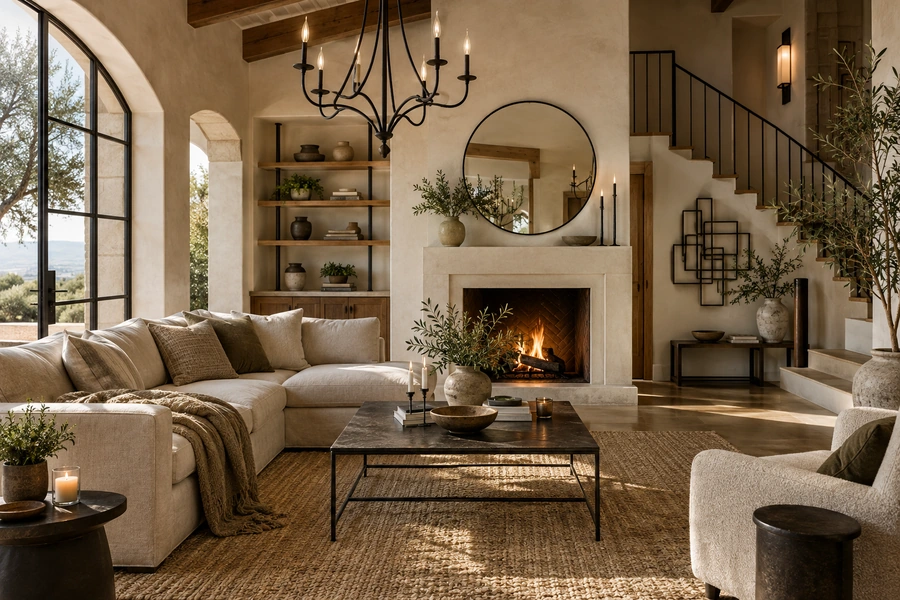
If I have a dark corner where a living olive tree would never thrive, a convincing artificial version can solve the visual problem.
Large Faux Plants Can Work Better Than Many Small Ones
I often prefer one large artificial tree to many little faux plants.
House Beautiful reported designer advice that larger faux plants can appear more convincing because they work as sculptural forms and are often viewed from farther away. Designers also recommend using them sparingly and intentionally.
This is an important styling principle.
A tall olive tree can:
- Add height beside a sofa
- Fill an empty corner
- Soften hard architectural lines
- Balance tall furniture
- Introduce green color
- Create a focal point
A collection of twelve tiny fake succulents may create much more visual clutter without giving me the same impact.
I think current interiors generally benefit from stronger, fewer objects rather than many small decorative accessories.
Fake Plants Should Fit the Architecture
I also consider whether the plant makes visual sense in the room.
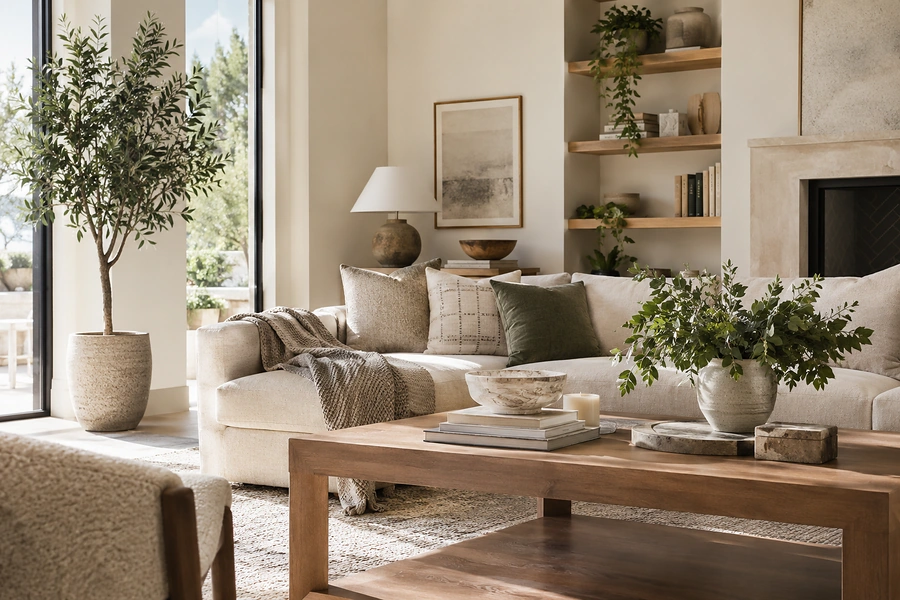
An artificial olive tree beside a bright window feels believable.
The same tree placed in a completely dark closet-like corner may draw attention to the fact that it is artificial.
The plant does not actually need sunlight, but the interior still needs visual logic.
I therefore try to place faux plants where living greenery could plausibly appear, even if the exact light level would not be ideal for keeping the real species healthy.
How Do You Make Fake Plants Look Stylish?
The plant itself is only part of the finished result. I can buy an expensive artificial tree and still make it look cheap if I leave it compressed in its shipping pot.
I make fake plants look stylish by reshaping the branches, using a substantial planter, hiding the artificial base, choosing natural colors, keeping the leaves clean, and placing the plant where it suits the room. I also avoid excessive symmetry and use faux greenery sparingly instead of putting artificial plants on every available surface.
I Always Reshape the Plant
Artificial trees are often packed tightly for shipping.
When I open the box, the branches may point straight upward.
Leaves may overlap.
The silhouette may look narrow and artificial.
I do not treat this as the final shape.
I spread the branches outward.
I rotate some leaves.
I bend flexible stems in different directions.
I create small gaps.
I make one side slightly different from the other.
House Beautiful’s 2026 faux-plant styling advice similarly emphasizes manipulating artificial branches rather than leaving them exactly as they arrive.
The goal is controlled irregularity.
I Upgrade the Planter
A good planter can make a major difference.
Many artificial plants come in very small plastic nursery pots because those containers are designed for shipping rather than interior styling.
I normally put that pot inside something larger.
I may use:
| Planter material | Effect |
|---|---|
| Terracotta | Warm and natural |
| Textured ceramic | Refined |
| Stone-effect pot | Architectural |
| Woven basket | Casual and soft |
| Aged clay | Organic |
| Simple plaster-look pot | Contemporary |
| Wood | Warm and relaxed |
Architectural Digest’s 2025 faux-plant coverage specifically recommends ceramic pots as a way to improve the overall appearance.
I also check scale.
A six-foot artificial tree in a tiny pot looks unstable.
A larger planter gives the tree visual weight.
I Hide the Artificial Base
I do not leave visible foam around the trunk.
I cover the surface with:
- Preserved moss
- Bark
- Pebbles
- Decorative stone
- Coconut fiber
- Soil-like artificial material
This small detail can significantly improve realism.
The top dressing also creates another natural texture around the plant.
I Pair Faux Greenery With Natural Materials
This is one of my favorite techniques.
If the leaves are artificial, I place them around genuine natural textures.
House Beautiful reports similar designer advice: pairing faux plants with materials such as natural wood, stone, and preserved botanical elements can help ground them visually.
I might combine a faux olive tree with:
- Linen curtains
- Oak furniture
- Wool rug
- Stone table
- Ceramic pottery
- Woven basket
- Handmade objects
The artificial plant then becomes one element in a room full of authentic texture rather than the only object trying to create a connection with nature.
I Keep Them Clean
Dust is one of the fastest ways to make an artificial plant look old.
Fake plants may require less maintenance than living plants, but they are not maintenance-free.
I dust broad leaves regularly with a soft cloth or appropriate duster.
I also check the trunk, pot, and lower branches.
One current House Beautiful designer explicitly notes that faux plants need to be part of the normal dusting routine because accumulated dust quickly reveals their artificial nature.
That is simple advice, but it matters.
Are Real Plants or Fake Plants Better for Home Decor?
I do not think this needs to become an either-or decision. Real and artificial greenery have different strengths.
Real plants are better when I want living growth, natural variation, and the experience of caring for plants. Fake plants are better when I need predictable shape, low maintenance, or greenery in a difficult location. For many homes, I think the most flexible approach is to use real plants where conditions support them and high-quality faux plants where they solve a practical problem.
Real Plants Bring Natural Change
A living plant changes.
It produces new leaves.
It grows toward light.
Its shape develops.
That natural movement is difficult for artificial greenery to reproduce perfectly.
If I enjoy caring for plants and have good growing conditions, I see no reason to replace every real plant with a fake one.
There is also a broader 2026 design movement toward authentic materials, craftsmanship, personality, and natural texture. That trend helps explain why some designers are pushing back against generic artificial greenery.
Fake Plants Give Me Control
Artificial plants solve a different problem.
Their shape stays predictable.
They do not grow beyond the intended scale.
They do not need watering.
They do not depend on the room’s light for survival.
They work in vacation properties or spaces that are not maintained daily.
That makes them useful design objects.
| Situation | My preference |
|---|---|
| Bright kitchen | Real plant |
| Dark hallway | Faux plant |
| Home of a plant enthusiast | Real plant |
| Vacation home | Faux plant |
| High shelf | Faux plant |
| Living room beside good window | Either |
| Large statement tree | Either |
| Windowless bathroom | Faux plant |
| Indoor herb garden | Real plants |
| Styling for a temporary event | Faux plants |
| Collected interior | Mix of real and faux |
I would not use this table as a strict rule.
It simply shows why both categories can exist in the same home.
Mixing Them Can Be More Convincing
A mixed approach can also make artificial plants less noticeable.
I might place a real pothos near a faux olive tree.
I might use real seasonal branches on the dining table while keeping an artificial tree in a difficult corner.
I can use living herbs in the kitchen and faux greenery on a high shelf.
This gives the room natural variation without forcing me to maintain living plants in every location.
What Fake Plants Are Most in Style Right Now?
Current design coverage suggests that sculptural, realistic greenery works better than generic decorative plants.
The fake plants that feel most current are large realistic trees, loose branches, restrained trailing greenery, and sculptural plants with recognizable natural forms. Faux olive trees, ficus, palms, monstera, cactus, and natural-looking branches can work well when the scale is right. I avoid glossy miniature plants and repetitive matching sets.
I Prefer Sculptural Forms
A plant should contribute something to the composition.
An olive tree creates height and fine branching.
A palm creates movement.
A monstera gives me broad sculptural leaves.
A cactus adds a strong vertical form.
I choose according to the architecture.
Current 2026 landscape trends similarly favor larger architectural plants and statement containers rather than collections of many small pots. Although that guidance concerns real container planting, I think the same visual principle translates well to faux greenery indoors.
Branches Can Look More Current Than Traditional Fake Plants
I also like artificial branches.
They can be easier to style than a complete artificial plant because they feel closer to a floral arrangement.
A few long branches in a large ceramic vessel can add height without creating the visual weight of a complete faux tree.
I can change them seasonally.
I can also reshape them more easily.
This fits current interiors that favor sculptural objects and fewer decorative pieces.
My insights: Are Fake Plants In or Out of Style
Current design coverage does not support a simple universal verdict. Faux greenery appears in stylish interiors in 2026, while some designers are simultaneously moving away from low-quality artificial plants in favor of authentic natural materials.
Fake plants are still in style in 2026, but the standard has become higher. I see the strongest results when faux greenery is realistic, sculptural, properly scaled, carefully shaped, and used with restraint. What is moving out of style is not necessarily artificial greenery itself, but glossy, generic, overly perfect fake plants used as filler throughout a room.
My First Insight: Fake Plants Are No Longer One Design Category
I think this is the most important distinction.
A $10 glossy plastic plant and a carefully made six-foot faux olive tree are both called fake plants.
They do not create the same interior.
This makes broad statements such as “fake plants are out” less useful.
I judge:
- Leaf quality
- Trunk quality
- Shape
- Scale
- Color variation
- Planter
- Placement
- Quantity
The finished composition matters more than the category name.
My Second Insight: 2026 Design Is Favoring Authenticity, Not Necessarily Literal Reality
This explains the apparently conflicting opinions.
Some designers are rejecting fake plants because current interiors increasingly emphasize authentic materials, personal objects, craftsmanship, and natural texture.
At the same time, designers continue using premium artificial greenery.
I do not think those ideas necessarily contradict each other.
A carefully chosen faux tree can still support an authentic-feeling interior when the rest of the room uses natural wood, stone, linen, ceramics, vintage furniture, and personal objects.
What feels less current is a room filled with generic mass-produced objects—including generic fake plants.
So authenticity today often means intentionality, not a requirement that every decorative object literally come from nature.
My Third Insight: Scale Is Becoming More Important
I see a clear advantage in larger statement greenery.
House Beautiful’s designer guidance recommends larger faux trees because their scale can create a convincing sculptural effect, while current planting trends more broadly favor oversized planters and architectural plant forms.
This fits the way I would use fake plants now.
Instead of five small plants, I might use one tall tree.
Instead of several identical succulents, I might use one sculptural cactus.
Instead of artificial greenery on every shelf, I might use one branch arrangement.
That restraint makes the room feel more intentional.
My Fourth Insight: Good Styling Matters as Much as Product Quality
I can take a high-quality plant and make it look bad.
I can leave it compressed.
I can keep it in a tiny nursery pot.
I can expose the foam.
I can let dust collect on the leaves.
I can place it in an unnatural location.
Then I may conclude that fake plants are out of style when the real problem is styling.
My basic formula is:
| Element | What I prefer |
|---|---|
| Plant quality | Realistic and matte |
| Color | Several natural green tones |
| Shape | Slightly irregular |
| Scale | Large enough for the space |
| Planter | Substantial and appropriate |
| Base | Hidden with natural-looking material |
| Placement | Visually believable |
| Quantity | Restrained |
| Maintenance | Clean and reshaped |
| Surroundings | Natural textures |
That combination matters much more to me than simply buying whatever product is currently described as trendy.
My Fifth Insight: I Would Use Faux Plants Strategically, Not Everywhere
This is ultimately how I decide whether fake plants belong in a current interior.
I use them where they offer a real advantage.
A dark corner can use one.
A vacation property can use one.
A difficult high shelf can use one.
A large room may benefit from a faux tree that creates height without adding another maintenance responsibility.
I do not automatically put artificial greenery into every empty area.
That approach is consistent with current designer advice favoring larger, intentionally placed faux plants rather than overusing them.
My Final View
When someone asks me, “Are fake plants in or out of style?”, I would answer that high-quality fake plants are still in style, while obviously artificial decorating is increasingly out of style.
That is an important difference.
Current design is less forgiving of glossy leaves, tiny generic plants, repetitive accessories, and décor that looks mass-produced or thoughtlessly placed.
At the same time, realistic artificial trees and greenery continue to appear in design publications and professionally styled homes. Architectural Digest, House Beautiful, and Realtor.com have all recently treated premium faux greenery as a viable decorating option rather than a universal faux pas.
So I would not remove a good faux plant simply because someone says fake greenery is finished.
I would look at the plant itself.
Does it have realistic leaves?
Is the trunk convincing?
Is it the right size?
Is the planter good?
Does it improve the room?
Is it clean?
Is it being used because the space needs greenery, or because I felt every empty corner needed an accessory?
If the plant contributes to the composition and looks intentional, it can still feel completely current in 2026.
If it looks glossy, generic, dusty, undersized, or overly perfect, then it may make the room feel dated regardless of what current trend reports say.
Conclusion
Fake plants are still in style in 2026 when they are realistic, well-scaled, clean, and thoughtfully placed. What looks outdated is cheap, glossy, generic faux greenery used without restraint.