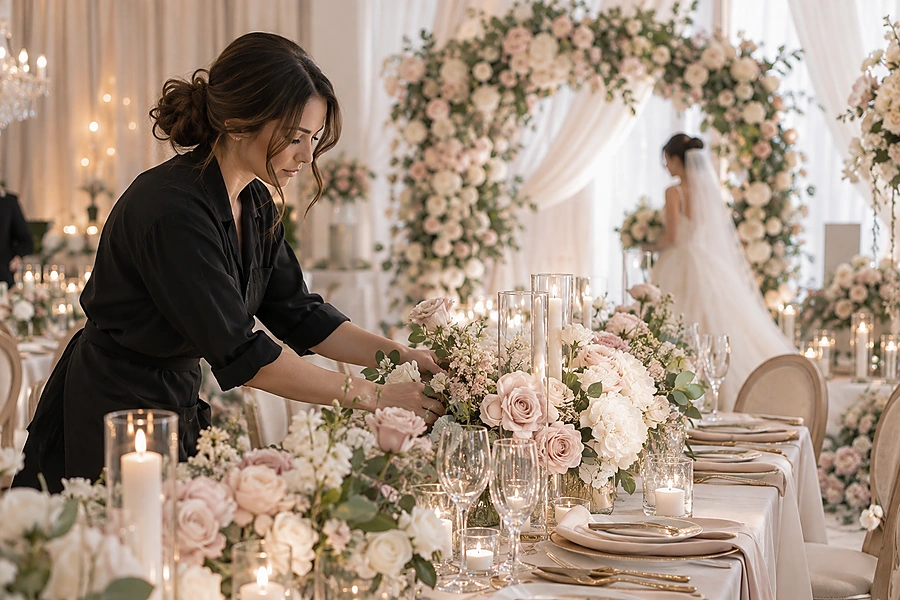

Real touch flowers can look so natural that it is easy to wonder whether they are preserved, treated, or actually fresh flowers.
No, real touch flowers are not real living flowers. They are premium artificial flowers made to copy the look, softness, texture, weight, and shape of fresh blooms. I usually see materials such as polyurethane, latex, silicone, coated fabric, and plastic used to create petals that look and feel surprisingly natural.
The word “real” in real touch describes the experience, not the origin of the flower. I find this distinction important because real touch flowers are very different from fresh flowers, preserved flowers, and many standard silk flowers.
What Does Real Touch Mean in Flowers?
When I first hear “real touch,” the name can sound as if the flower contains a real flower or has been preserved from a fresh bloom. That is not what the term normally means.
Real touch means an artificial flower has been designed to reproduce the natural look and feel of a fresh flower. I expect softer petals, flexible surfaces, natural curves, detailed veins, realistic colors, and less shine than basic artificial flowers. The flower itself is still manufactured rather than grown.
I See Real Touch as a Performance Description
I do not treat “real touch” as the name of one exact raw material.
Instead, I treat it as a description of what the artificial flower is supposed to achieve.
A good real touch flower should appear realistic from normal viewing distance. It should also remain convincing when someone walks closer and touches the petals.
That is a major difference from many basic fake flowers.
Older or lower-cost artificial flowers may rely on thin polyester petals or hard molded plastic. These materials can still create attractive decorations, but they may feel obviously artificial when I touch them.
Real touch flowers try to reduce that difference.
Manufacturers may reproduce:
- Soft petal surfaces
- Natural flower shapes
- Fine veins
- Curved petal edges
- Color gradients
- Small imperfections
- Flexible stems and leaves
- Natural petal thickness
These small details matter because fresh flowers are not perfectly flat or identical.
Real Touch Does Not Mean Fresh
I think this is the easiest way to understand the term:
| Flower type | Is it a living flower? | Main characteristic |
|---|---|---|
| Fresh flower | Yes | Naturally grown and temporary |
| Preserved flower | Originally yes | Real flower treated for longer display |
| Dried flower | Originally yes | Natural flower dried after harvesting |
| Real touch flower | No | Artificial flower designed for high realism |
| Silk flower | No | Usually fabric-based artificial flower |
| Plastic flower | No | Molded artificial flower focused on durability |
A real touch rose may look close to a fresh rose, but it does not need water to remain open.
A real touch tulip may feel soft, but it does not continue growing.
A real touch orchid can remain in the same stage of bloom for months or years because it is an artificial product.
That is why I use the term lifelike artificial flowers when I want a description that is especially clear.
What Are Real Touch Flowers Made Of?
The realistic texture can make people assume that real touch flowers must be made from one special material. In practice, I find much more variation.
Real touch flowers can be made from polyurethane, latex or synthetic rubber, silicone, polymer-coated fabric, polyester, plastics, and combinations of these materials. There is no single universal real touch formula. Manufacturers select materials according to the flower type, desired softness, petal thickness, flexibility, appearance, and production method.
Polyurethane Is Common in Real Touch Flowers
Polyurethane, often called PU, is one material I often see associated with real touch artificial flowers.
It can be molded into detailed shapes. It can also provide the soft and flexible feel needed for petals that should not feel like rigid plastic.
This makes PU useful for flowers where petal thickness and shape are important.
Peonies, tulips, calla lilies, gerberas, and similar flowers may use molded polymer materials to reproduce natural curves and surfaces.
Latex Can Create Soft Coated Petals
Another method uses fabric with a latex or synthetic rubber coating.
The fabric provides the basic petal structure. The coating changes the surface feel.
This can give the petals more body than ordinary fabric flowers and make them feel softer and more natural.
Roses and peonies are examples where this type of construction can be useful because their petals need softness without looking too thick.
Silicone and Other Polymers Can Also Be Used
Some artificial flowers use silicone or similar soft polymers.
These materials can be molded into detailed shapes and can work well for flowers that need fine petal detail.
The important point for me is that the label real touch does not tell me exactly what the flower contains.
Two real touch roses from different factories can use different materials.
Two products may both look realistic, yet one may feel softer, one may be more flexible, and one may handle heat or moisture differently.
For larger purchases, I therefore prefer to ask for the actual material specification instead of relying only on the words “real touch.”
| Material | Why it may be used |
|---|---|
| Polyurethane | Softness, shape, texture, molded detail |
| Latex coating | Natural-feeling flexible petal surface |
| Silicone | Fine molded detail and flexibility |
| Polyester fabric | Lightweight petal structure |
| Plastic | Stems, leaves, structural parts |
| Metal wire | Allows stems or leaves to hold a position |
| Adhesives | Holds flower components together |
This material mix is one reason modern artificial flowers can look much more natural than the simple fake flowers many people remember from the past.
What Is the Difference Between Real Touch and Silk Flowers?
Real touch and silk flowers are both artificial, so the difference is not simply “real versus fake.” I mainly look at material, feel, structure, and viewing distance.
Real touch flowers usually focus on tactile realism and often use PU, latex, or soft polymer coatings. Modern silk flowers usually use polyester or other fabrics rather than genuine silk. Real touch petals tend to feel softer and more natural in the hand, while silk flowers often feel lighter and more fabric-like.
I Choose Real Touch When People Will See the Flowers Closely
Real touch flowers make the most sense to me when people will stand close to the arrangement.
Examples include:
- Bridal bouquets
- Wedding centerpieces
- Dining table flowers
- Reception desk arrangements
- Product photography
- Retail displays
- Hotel arrangements
- Small luxury floral designs
In these situations, texture matters.
If someone touches a rose and immediately feels stiff fabric or hard plastic, the illusion becomes weaker.
A high-quality real touch flower is designed to remain more convincing during close inspection.
I Still Find Silk Flowers Useful
I do not consider silk flowers inferior in every situation.
Modern silk flowers can look very realistic. They can also be lighter, flexible, and practical for large installations.
The term “silk flower” can also be confusing because most modern products called silk flowers are actually made from polyester or synthetic textile materials rather than genuine silk.
For a large wedding arch, ceiling installation, flower wall, or distant display, I may use more fabric flowers because people are not touching every bloom.
For a bridal bouquet or centerpiece, I may use more real touch flowers.
I can also combine both.
The Best Arrangements Do Not Always Use One Material
I often think about the arrangement as a whole instead of asking which single material is best.
A realistic design may combine:
| Part of arrangement | Material I may choose |
|---|---|
| Main roses | Real touch |
| Peonies | Real touch |
| Hydrangeas | Premium fabric or real touch |
| Small filler flowers | Fabric |
| Green leaves | Fabric, PE, or molded plastic |
| Hanging greenery | Fabric or plastic |
| Close-up focal flowers | Higher-grade real touch |
This combination can help control cost while keeping the flowers that attract the most attention very realistic.
The question is not always whether real touch is “better.”
I ask where the flower will be placed and how closely people will see it.
How Long Do Real Touch Flowers Last?
Fresh flowers eventually wilt, which is one of the main reasons I would consider real touch flowers for long-term decoration or reusable event designs.
Good real touch flowers can remain attractive for several years indoors, but there is no universal lifespan. Their condition depends on material quality, sunlight, heat, moisture, dust, handling, cleaning, and storage. Unlike fresh flowers, they do not wilt after several days, but their surfaces and colors can still age.
Artificial Does Not Mean Permanent
A real touch flower does not die because it was never alive.
However, that does not mean it stays new forever.
Over time, I may see:
- Dust buildup
- Faded color
- Yellowing
- Surface changes
- Bent petals
- Loose flower heads
- Cracked coatings
- Damaged stems
Direct sunlight can be especially important.
Strong UV exposure may slowly fade pigments and age some polymers. Heat and moisture may also affect certain coatings or adhesives.
This is why I keep premium real touch flowers away from prolonged direct sunlight when they are designed mainly for indoor use. Current care guidance also recommends checking the flower material before using water because different real touch constructions require different cleaning methods.
I Look at Display Life, Not Just Physical Life
A flower may still exist physically after many years but no longer look good enough for a wedding, hotel lobby, restaurant, or premium retail display.
For that reason, I separate two ideas.
Physical lifespan is how long the artificial flower remains intact.
Display lifespan is how long it still looks attractive enough for the intended space.
For decorative flowers, I care more about display lifespan.
A faded rose may still be a complete artificial flower, but I would probably replace it if the arrangement needs to look premium.
Simple Care Makes a Difference
I usually protect real touch flowers with simple habits.
I remove dust gently instead of waiting for a heavy layer to form.
I avoid crushing petals during storage.
I keep them away from unnecessary heat.
I avoid strong direct sunlight for indoor products.
I check the supplier’s instructions before washing them.
These steps are simple, but they can help preserve the realistic surface that makes real touch flowers valuable.
My insights: Are Real Touch Flowers Real
The name creates a useful illusion but also creates confusion. The flower can feel real without being biologically real, and that difference matters when I compare materials, care, price, and intended use.
No, real touch flowers are not real flowers. They are advanced artificial flowers designed to imitate fresh flowers closely enough that they can look and feel natural at short viewing distances. I see “real touch” as a realism category rather than proof of a specific material, manufacturing method, or quality level.
My First Insight: “Real” Describes the Experience
This is the main idea I use when explaining real touch flowers.
The word does not mean:
- Fresh
- Living
- Preserved
- Naturally grown
Instead, it means that the product is trying to create a realistic touch experience.
That experience can include softness, flexibility, texture, natural petal thickness, detailed veins, color variation, and realistic movement.
I find this description much more accurate than saying the flowers are “almost real.”
They are artificial.
They are simply designed to be more convincing.
My Second Insight: Real Touch Is Not One Material
I would not assume that every real touch flower is made from silicone.
I would also not assume that every one is made from latex.
Current products may use polyurethane, latex, silicone, coated fabric, plastic, or several materials together.
This means the term real touch works more like a product category.
It tells me what result the manufacturer wants.
It does not give me the complete technical specification.
That matters when I need to know about:
- Cleaning
- Outdoor use
- UV resistance
- Water resistance
- Heat resistance
- Long-term storage
- Wholesale quality
- Expected lifespan
For these questions, I need more information than the real touch label.
My Third Insight: Quality Can Vary Even Within the Real Touch Category
I also avoid assuming that every product called real touch will feel equally realistic.
The quality can depend on petal thickness, molding, coating, color, assembly, stem construction, and finishing.
A good real touch rose may have:
- Soft petal edges
- Natural curves
- Subtle color changes
- Matte surfaces
- Realistic veins
- Flexible stems
- Slight differences between petals
A weaker product may technically use a soft-touch coating but still have an unnatural shape or color.
For me, this means sample evaluation is especially useful when buying artificial flowers for weddings, retail, hotels, event businesses, or resale.
I want to see the flower in normal light.
I want to touch the petals.
I want to look at the underside.
I want to bend the stem.
I also want to see whether the flower still looks convincing from very close range.
My Fourth Insight: Real Touch Flowers Solve a Different Problem From Fresh Flowers
I do not see real touch flowers as a perfect replacement for nature.
Fresh flowers still offer natural fragrance, growth, variation, and the emotional experience of living flowers.
Real touch flowers solve another set of problems.
They do not wilt during an event.
They can be prepared far in advance.
They can be reused.
They are available without depending as heavily on flower season.
They can remain visually consistent throughout a long event.
They also work well in spaces where replacing fresh arrangements every few days is not practical.
So I choose between fresh and real touch flowers based on the project rather than treating one as universally better.
| If I need… | I may choose… |
|---|---|
| Natural fragrance | Fresh flowers |
| Living botanical experience | Fresh flowers |
| Long-term display | Real touch flowers |
| Reusable wedding décor | Real touch flowers |
| Close-up artificial realism | Real touch flowers |
| Low-cost large volume | Fabric artificial flowers |
| Strong outdoor durability | Outdoor-rated artificial flowers |
| Seasonal flowers at any time | Real touch or other artificial flowers |
My Fifth Insight: The Best Definition Is Simple
When someone asks me, “Are real touch flowers real?”, I use a very simple answer.
They are realistic, not real.
That difference explains the entire category.
They are manufactured artificial flowers.
Their value comes from how well they reproduce the visual and tactile features people associate with fresh flowers.
This is why they are useful for weddings, homes, restaurants, hotels, photography, retail displays, and other places where people want the appearance of fresh flowers without the short life of fresh blooms.
When I am choosing them, I therefore do not ask only, “Does this look real?”
I also ask:
- Does it feel natural?
- Is the color realistic?
- Does the petal surface look matte or artificial?
- Is the flower shape botanically believable?
- What material is it made from?
- How should it be cleaned?
- Is it made for indoor or outdoor use?
- How will it look from close range?
- Can it be reused for my project?
- Does the quality justify the price?
Those questions tell me much more about a real touch flower than the marketing name alone.
The final answer remains clear: real touch flowers are artificial flowers, but high-quality versions can be realistic enough to make the difference difficult to notice until I inspect them closely.
Conclusion
Real touch flowers are not living flowers. They are premium artificial blooms made with lifelike materials and details to closely reproduce the look and feel of fresh flowers.