

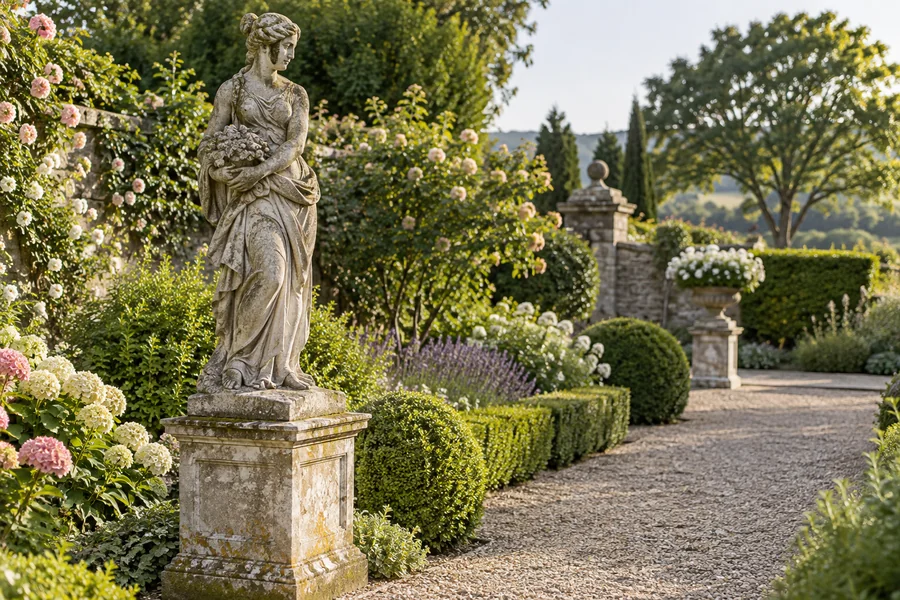
Concrete garden statues can survive for decades, but water, freezing, cracks, unstable bases, and poor construction can make some pieces deteriorate much sooner.
A well-made concrete garden statue can usually last for many decades outdoors. A practical planning range is roughly 30–80 years, while high-quality, well-maintained pieces may survive 50–100 years or longer. This is not a guaranteed industry lifespan: concrete quality, moisture, freeze-thaw exposure, reinforcement, drainage, and maintenance determine actual durability.
Concrete is naturally durable, but garden statuary experiences harsher conditions than indoor decorative concrete. Rain, irrigation, snow, soil moisture, direct sun, biological growth, and temperature changes all affect how quickly the surface and structure age.
How Long Do Concrete Garden Statues Last Outdoors?
Outdoor concrete garden statues can remain serviceable for decades when they are made from sound concrete, properly cured, placed on stable drainage, and protected from severe moisture-related deterioration.
For planning purposes, roughly 30–80 years is a reasonable industry-based range for outdoor concrete statuary, while well-manufactured and carefully maintained pieces may remain usable for 50–100 years or more. These numbers should be treated as estimates rather than guarantees because climate, concrete mix, curing, reinforcement, and maintenance vary dramatically.
Concrete Itself Can Be Extremely Durable
Concrete is one of the longest-lasting common landscape materials.
Concrete Network notes that ordinary properly installed residential concrete commonly performs for many decades—for example, concrete patios are often expected to last 30+ years and driveways 40+ years. Garden statues are different from slabs, but those figures illustrate that properly produced concrete is not inherently short-lived.
The challenge is that statues often include:
- Thin projections
- Decorative details
- Horizontal water-catching surfaces
- Internal reinforcement
- Irregular thicknesses
These features can create more localized weaknesses than a simple concrete slab.
Historic Outdoor Concrete Shows the Potential
The U.S. National Park Service has documented outdoor concrete artworks constructed in the:
- 1910s
- 1930s
- 1960s
that remain extant today.
That provides better evidence for long-term durability than simply claiming that “concrete lasts forever.”
However, those same artworks demonstrate that surviving for decades does not mean remaining maintenance-free.
NPS conservators documented:
- Freeze-thaw damage
- Water infiltration
- Reinforcement corrosion
- Surface erosion
- Cracking
- Delamination
in older concrete sculpture.
So there are really two different lifespans.
Structural Lifespan vs Decorative Lifespan
Structural lifespan means the statue remains stable and intact.
Decorative lifespan means it still looks the way the owner wants it to look.
A statue might remain structurally sound for 60 years while developing:
- Moss
- Patina
- Color variation
- Small surface cracks
- Paint fading
after a much shorter period.
Some owners consider those changes damage.
Others prefer an aged garden appearance.
Concrete Network notes that some cast-stone manufacturers intentionally recommend allowing statuary to weather naturally so it develops an antiqued look and even moss growth.
Climate Makes a Major Difference
Two identical statues can age very differently.
Consider:
Statue A
- Mild climate
- Covered courtyard
- Good drainage
Statue B
- Heavy rain
- Saturated soil
- Repeated winter freezing
- Snow accumulation
The second piece faces much more aggressive exposure.
The NPS specifically identifies water entrapment, freeze-thaw cycling, and reinforcing-steel corrosion as major destructive forces in outdoor concrete artwork.
A Practical Lifespan Guide
| Condition | Practical Expectation |
|---|---|
| Poor-quality concrete + severe weather | Can deteriorate relatively early |
| Ordinary outdoor statuary | Decades |
| Good concrete + normal maintenance | 30–80 years is a useful planning range |
| High-quality, protected piece | 50+ years is very plausible |
| Excellent construction + conservation | 100+ years can be possible |
These are planning categories, not warranties.
The actual statue matters more than the number printed in a general article.
What Causes Concrete Garden Statues to Crack?
The biggest causes of cracking are water penetration, freeze-thaw cycling, corroding internal reinforcement, unstable foundations, impact, and weaknesses introduced during manufacturing or curing.
Concrete garden statues commonly crack when absorbed water freezes and expands, when steel reinforcement corrodes and pushes outward, or when the statue settles unevenly. High porosity, poor curing, inadequate freeze-thaw protection, standing water, thin decorative details, and physical impact can increase the risk of early deterioration.
Freeze-Thaw Damage Is One of the Biggest Risks
Concrete contains pores.
Water can enter those pores.
If saturated concrete freezes, the water expands and produces pressure inside the material.
The American Concrete Institute states that water expands by roughly 9% when it freezes and explains that properly distributed entrained air helps provide space that relieves this pressure.
That is why concrete designed for freezing climates often incorporates an intentional microscopic air-void system.
Air-Entrained Concrete Lasts Better in Cold Climates
ACI states that entrained air can improve resistance to freeze-thaw deterioration by several hundred percent compared with concrete lacking the appropriate air-void system.
ACI also recommends several factors for freeze-thaw durability:
- Freeze-thaw-resistant aggregate
- Proper air entrainment
- Adequate maturity
- About 3,500 psi / 24 MPa strength before severe freeze exposure
For someone buying a concrete statue in Minnesota, Canada, or another cold climate, this information may matter more than whether the statue has a decorative sealer.
Standing Water Creates Local Weak Spots
Garden statuary often contains small depressions.
Examples include:
- Hands
- Flower baskets
- Folded clothing
- Birdbath bowls
- Fountain basins
- Planters
If water sits in these areas and freezes repeatedly, localized deterioration becomes more likely.
Concrete statuary specialists consistently recommend preventing water from collecting and freezing in concrete bowls, planters, fountains, and birdbaths.
Internal Steel Can Cause Major Damage
Large concrete statues may contain:
- Rebar
- Steel rod
- Metal armatures
Steel improves structural capacity.
But if moisture reaches it and corrosion begins, rust expands inside the concrete.
That expansion can force the surrounding concrete outward.
NPS conservation studies have documented exactly this mechanism: water infiltration led to reinforcing-steel corrosion, cracking, structural instability, and loss of concrete material.
Watch for:
- Rust-colored stains
- Cracks following internal reinforcement
- Bulging
- Flaking concrete
- Exposed steel
These deserve more attention than harmless superficial hairline marks.
Poor Curing Can Shorten Lifespan
A good concrete mix can still underperform if curing is poor.
Concrete Network notes that properly curing concrete improves durability and strength by keeping sufficient moisture available for continued cement hydration.
For newly manufactured statuary, proper curing helps create a denser, more durable casting.
The Base Can Cause Cracks Too
Heavy statues need stable support.
If one side settles into soft ground while the other remains supported, the statue can experience:
- Leaning
- Twisting
- Concentrated stress
Place larger statues on a suitable:
- Concrete pad
- Paver
- Compacted gravel base
- Stable stone plinth
depending on size and weight.
Thin Features Break First
A massive torso may last for decades while a thin:
- Finger
- Ear
- Wing
- Tail
- Decorative finial
breaks from one impact.
That does not necessarily mean the concrete mix has reached the end of its life.
It may simply be a geometry problem.
| Failure Cause | Typical Damage |
|---|---|
| Freeze-thaw | Scaling, cracking |
| Standing water | Local cracking |
| Rebar corrosion | Spalling and deep cracks |
| Poor curing | Weak surface/durability |
| Unstable base | Structural cracking |
| Impact | Broken details |
| High porosity | Faster moisture penetration |
| Failed coating | Moisture-related deterioration |
Should You Seal Concrete Garden Statues?
Sealing can help reduce water penetration, but it is not automatically necessary for every concrete statue and should never replace good drainage and correct winter care.
Many outdoor concrete statues can benefit from a compatible breathable penetrating sealer, particularly in wet or freeze-thaw climates. However, some cast-stone manufacturers intentionally leave statuary unsealed so it develops natural patina. The correct decision depends on the concrete, existing finish, climate, and manufacturer instructions rather than a universal resealing schedule.
What Does a Sealer Do?
Concrete is porous.
A suitable sealer can reduce moisture entering the surface.
That may help reduce:
- Water absorption
- Freeze-thaw exposure
- Staining
- Surface deterioration
Concrete Network notes that sealing exterior concrete can reduce moisture penetration and help limit cracking, pitting, spalling, and freeze-thaw damage.
Penetrating Sealers Often Suit Natural-Looking Concrete
A penetrating product goes into the concrete rather than forming a thick glossy film.
That can be useful when you want the statue to continue looking like:
natural stone or concrete
rather than shiny coated plastic.
Some sculpture-specific guidance emphasizes breathable sealers for outdoor pieces, particularly where freeze-thaw exposure is severe.
Breathability Matters
More coating is not automatically more protection.
The NPS conservation study of the 1952 Iwo Jima concrete monument found that impermeable, inflexible coatings contributed to deterioration because they prevented moisture from escaping saturated concrete.
That is a strong warning against simply applying the thickest waterproof-looking coating available.
Painted Statues Need Different Care
A painted concrete statue has two systems:
- Concrete substrate
- Paint/coating
The concrete may remain sound even after decorative paint:
- Fades
- Peels
- Chalks
Before sealing a painted statue, determine whether the proposed sealer is compatible with the existing paint.
How Often Should You Reseal?
There is no universal schedule specifically for all garden statues.
Broader exterior-concrete guidance commonly cites approximately 2–5 years, depending on sealer chemistry, climate, wear, and exposure.
But individual statuary manufacturers may recommend:
- More frequent treatment
- Less frequent treatment
- No sealing at all
Follow the actual product instructions.
Sealing Cannot Fix Bad Drainage
If the statue sits permanently:
- In saturated soil
- In standing water
- In a frozen puddle
sealer is being asked to solve the wrong problem.
The better order is:
stable base → drainage → crack inspection → appropriate sealer if needed.
How Do You Protect Concrete Statues in Winter?
Winter protection focuses on preventing concrete from remaining saturated when temperatures repeatedly fall below freezing.
Protect concrete garden statues in winter by removing standing water, draining fountains and birdbaths, raising the statue above wet ground, and moving smaller pieces into shelter when practical. Larger statues should be protected from accumulating water, snow, and ice. In cold climates, properly air-entrained concrete provides the most important built-in resistance to freeze-thaw damage.
Empty Anything That Holds Water
Before freezing weather arrives, inspect the statue from above.
Look for:
- Bowls
- Cups
- Shells
- Planters
- Fountain basins
- Birdbaths
Concrete Network specifically recommends draining fountains and preventing birdbath or fountain bowls from filling with water that can freeze and expand.
Raise the Statue From Wet Ground
Winter ground can remain:
- Saturated
- Snow-covered
- Frozen
for long periods.
Concrete Network recommends raising statuary and bench legs so they do not remain in direct contact with soil during winter.
Use a stable support system appropriate for the weight of the piece.
Store Small Statues Under Cover
If a statue can be moved safely, storage may be easier than trying to weatherproof it outside.
Suitable locations can include:
- Garage
- Shed
- Covered porch
The main goal is reducing repeated saturation and freezing.
Fountains Require More Care
Fountains have extra risk because they are intentionally designed to hold water.
Before winter:
- Switch off the fountain.
- Drain all bowls.
- Remove the pump if recommended.
- Empty accessible plumbing.
- Prevent rain or snow from refilling the bowls.
A sealer cannot reliably protect a water-filled fountain from repeated freezing.
Be Careful With Covers
A cover can reduce direct snow and water exposure.
But trapping moisture against concrete can be counterproductive.
Clean and dry the statue first and use the method recommended by the manufacturer.
Avoid Deicing Salt Around Decorative Concrete
ACI notes that freeze-thaw damage and scaling can be aggravated by chemicals used for ice removal and that air entrainment improves resistance.
Keep deicing salts away from garden statues and concrete pedestals where practical.
Winter Checklist
| Task | Why |
|---|---|
| Remove leaves and dirt | Reduces moisture traps |
| Empty bowls | Prevents frozen water |
| Drain fountains | Reduces cracking risk |
| Raise base | Limits soil moisture |
| Move small pieces | Reduces weather exposure |
| Inspect cracks | Stops problems growing unnoticed |
| Avoid deicers | Reduces scaling risk |
| Follow cover instructions | Avoids trapped moisture |
My Insights: How Long Do Concrete Garden Statues Last
The best answer is measured in decades, but the number matters less than whether the statue stays sound, relatively dry, and protected from the failure mechanisms that actually destroy concrete.
Concrete garden statues can realistically last for several decades. I would use roughly 30–80 years as a planning range rather than a guarantee, while recognizing that well-built and carefully maintained concrete sculpture can survive 50–100 years or longer. Water exposure, freeze-thaw design, curing, reinforcement, drainage, and maintenance matter more than age alone.
My First Insight: Do Not Sell “100 Years” as a Guarantee
Concrete can absolutely survive a century.
Historical concrete proves that.
But the phrase:
lasts 100 years
ignores too many variables.
A more defensible statement is:
Quality concrete garden statuary can last many decades, and favorable construction and maintenance can extend that lifespan toward a century or longer.
My Second Insight: Water Is the Common Factor Behind Most Serious Problems
Look at the major failure modes:
Freeze-thaw: needs water.
Steel corrosion: needs moisture reaching reinforcement.
Moss and staining: favor damp surfaces.
Surface deterioration: often accelerates with repeated wetting.
NPS conservation evidence repeatedly identifies moisture infiltration as a central problem in aging outdoor concrete sculpture.
So if you want a statue to last, manage water first.
My Third Insight: Freeze-Thaw Durability Starts at the Factory
Winter maintenance helps.
But part of durability was determined before the customer purchased the statue.
ACI shows that correct air entrainment and suitable aggregate are fundamental to concrete’s freeze-thaw resistance.
For cold-climate buyers, I would ask:
- Is this concrete air entrained?
- Is it designed for outdoor freeze-thaw exposure?
- What winter care does the manufacturer require?
Those questions are more useful than simply asking whether the statue is “weatherproof.”
My Fourth Insight: The Base Is Part of the Statue’s Lifespan
A premium concrete statue installed on poor drainage starts with a disadvantage.
I would prioritize:
stable + level + drained
before worrying about decorative sealer.
For larger pieces, the support must also handle the statue’s weight without settlement.
My Fifth Insight: Solid Statues Are Easier Than Water-Holding Ornaments
A simple solid garden figure mainly sheds rain.
A:
- Birdbath
- Fountain
- Planter
is designed to hold water.
That makes freeze management much more important.
If low maintenance is your priority, a solid statue with no deep horizontal cavities is generally easier to preserve.
My Sixth Insight: Natural Patina Is Not the Same as Failure
Concrete often changes color outdoors.
It may develop:
- Moss
- Lichen
- Darkened areas
- Soft patina
Concrete Network notes that some cast-stone manufacturers deliberately encourage this weathering.
I would distinguish those cosmetic changes from serious symptoms such as:
- Deep cracking
- Spalling
- Bulging
- Loose sections
- Rust staining
My Seventh Insight: Reinforced Statues Need Special Attention
Large pieces containing steel can fail internally before the surface looks catastrophic.
The NPS Iwo Jima conservation project documented severe cracking linked to rebar corrosion and continuous water ingress.
If a large statue shows:
- Rust
- Long cracks
- Exposed metal
I would not treat it as a simple cosmetic maintenance issue.
My Eighth Insight: Annual Inspection Is More Useful Than Obsessing Over a Lifespan Number
Once per year, inspect:
- Surface cracks
- Base stability
- Water traps
- Paint or sealer
- Loose details
- Rust staining
- Drainage
A 40-year-old statue with no serious deterioration may have many decades left.
A five-year-old piece with deep water-filled cracks may already need repair.
My Ninth Insight: Sealer Is a Supporting Tool
Sealer can reduce water absorption.
It cannot compensate for:
- Bad concrete
- Deep structural cracks
- Permanent standing water
- Corroding reinforcement
- Unstable foundations
The maintenance system matters more than the coating alone.
My Tenth Insight: Buy for Climate
If I were buying in a mild climate, I would focus on:
- Casting quality
- Appearance
- Stable installation
In a freeze-thaw climate, I would additionally prioritize:
- Air-entrained concrete
- Low moisture absorption
- Good drainage
- Winter instructions
ACI’s freeze-thaw guidance makes this distinction technically important, not merely cosmetic.
Practical Lifespan Factors
| Factor | Effect on Lifespan |
|---|---|
| Dense, well-made concrete | Positive |
| Proper curing | Positive |
| Freeze-thaw air entrainment | Strong positive in cold climates |
| Stable base | Positive |
| Good drainage | Strong positive |
| Annual inspection | Positive |
| Standing water | Negative |
| Saturated winter exposure | Strong negative |
| Corroding rebar | Strong negative |
| Severe impact | Strong negative |
| Appropriate sealing | Potential positive |
| Moisture-trapping coating | Potential negative |
My Preferred Longevity Formula
For a concrete garden statue I wanted to keep for decades, I would aim for:
**high-quality outdoor concrete
- correct curing
- freeze-thaw design where needed
- stable raised base
- no standing water
- compatible breathable protection if appropriate
- winter drainage
- annual inspection**
That is a much stronger durability strategy than relying on one advertised lifespan.
My Final Answer
So, how long do concrete garden statues last?
Think in decades.
A useful planning range is roughly 30–80 years, but it is not an official universal service-life standard. Industry estimates suggest well-made and maintained concrete sculpture can sometimes reach 50–100 years or more, and documented historical concrete artworks show that multi-decade survival is entirely realistic.
The biggest factors are:
- Concrete quality
- Proper curing
- Water absorption
- Freeze-thaw resistance
- Internal reinforcement
- Drainage
- Base stability
- Winter care
- Compatible sealing
- Regular inspection
If you control moisture and prevent serious cracking, a good concrete garden statue can remain part of a landscape for generations.
Conclusion
Concrete garden statues can last many decades. Quality concrete, good drainage, freeze-thaw resistance, stable installation, and regular inspection matter more than any single advertised lifespan.