

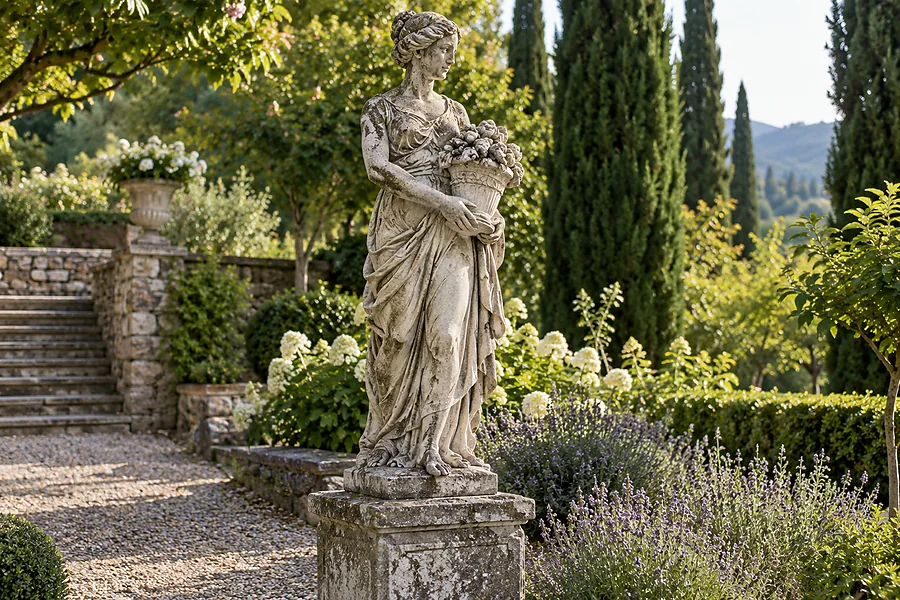
Concrete statues can look permanent, but moisture, freezing, cracking, poor drainage, and neglected coatings can shorten their useful life much faster than many owners expect.
A well-made concrete statue can last for several decades outdoors. A practical planning range is roughly 30–80 years, while high-quality, well-maintained pieces can sometimes remain serviceable for 50–100 years or longer. Actual lifespan depends on concrete quality, water exposure, freeze-thaw cycles, reinforcement, installation, sealing, and maintenance.
Concrete itself is capable of lasting a very long time. The more useful question is not simply how old the statue can become, but how long it can remain structurally sound and visually attractive without major repair.
How Long Do Concrete Statues Last Outdoors?
Outdoor concrete statues commonly last for decades when the concrete is well made, correctly cured, properly supported, and protected from long-term moisture damage.
For normal garden use, I would treat 30–80 years as a reasonable planning range rather than a guarantee. High-quality concrete sculptures can last longer, especially when water does not remain trapped in the material. Poor-quality castings exposed to repeated freezing, standing water, cracks, or corrosion may deteriorate much sooner.
Why Concrete Can Last So Long
Concrete develops strength through cement hydration.
When it is:
- Properly proportioned
- Properly mixed
- Properly compacted
- Properly cured
it becomes a strong mineral-based material capable of resisting years of outdoor exposure.
Concrete Network notes that proper curing significantly improves durability and wear resistance and that concrete continues gaining strength beyond its initial curing period.
This is why two statues that look almost identical in a garden shop can age very differently.
One may have:
- Dense concrete
- Good aggregate
- Low unnecessary water
- Proper curing
while another may have:
- High porosity
- Excess water
- Poor compaction
- Weak edges
The difference may not become obvious until years later.
Historical Concrete Shows That Decades Are Possible
The U.S. National Park Service has documented outdoor concrete artworks dating from:
- The 1910s
- The 1930s
- The 1960s
that are still extant today.
These pieces also demonstrate an important limitation.
Long survival does not mean zero deterioration.
The NPS found problems including:
- Water infiltration
- Freeze-thaw damage
- Corroding reinforcement
- Surface erosion
- Cracking
- Failed coatings
So a statue can technically survive for 80 years while still requiring significant conservation.
Lifespan and Appearance Are Different
It helps to separate:
Structural lifespan
How long the statue remains intact.
from:
Decorative lifespan
How long it still looks attractive without major repair.
A statue may remain standing but develop:
- Surface scaling
- Moss
- Small cracks
- Stains
- Faded paint
Some owners enjoy that aged appearance.
Others consider the statue ready for restoration.
Climate Makes a Major Difference
A concrete statue in a mild, dry garden faces very different conditions from one in a cold, wet climate.
A simplified comparison looks like this:
| Environment | Main Risk |
|---|---|
| Dry, mild climate | Surface weathering |
| Warm, humid climate | Moisture, algae, staining |
| Freeze-thaw climate | Internal freezing damage |
| Coastal climate | Moisture and salts |
| Heavy-rain climate | Saturation and drainage problems |
| Shaded garden | Moss and biological growth |
The harsher the moisture and freezing exposure, the more important concrete quality becomes.
Painted Statues May Look Old Before the Concrete Fails
A painted garden statue may have two different lifespans:
- Concrete body
- Decorative finish
Paint may:
- Fade
- Peel
- Chalk
- Crack
long before the concrete structure fails.
That means a 30-year-old statue may still be structurally strong but need repainting several times during its life.
Natural Weathering Is Not Always Damage
Concrete Network notes that some cast-stone makers intentionally leave statuary unsealed so it can age naturally and develop an antiqued appearance or moss.
So a darker or weathered surface does not automatically mean the statue is failing.
I would worry more about:
- Deep cracks
- Loose pieces
- Spalling
- Exposed reinforcement
- Large surface losses
than harmless color change alone.
What Makes Concrete Statues Crack?
Concrete statues crack mainly because of moisture, freeze-thaw cycling, poor mix design, corrosion, impact, unstable bases, or defects that were already present in the casting.
The most serious outdoor cracking usually occurs when water enters porous concrete and then freezes, when internal steel reinforcement corrodes and expands, or when a heavy statue settles unevenly. Poor curing, excess mixing water, thin decorative details, and trapped water in bowls or cavities can increase the risk.
Freeze-Thaw Is One of the Biggest Risks
Concrete contains pores.
If those pores become highly saturated, freezing water creates internal pressure.
The American Concrete Institute explains that air entrainment improves resistance to freeze-thaw deterioration by providing tiny air spaces that relieve pressure as water freezes.
This is especially important for outdoor concrete in cold regions.
A statue made from concrete that was not designed for severe freeze-thaw exposure may deteriorate much faster.
Water Expands When It Freezes
ACI notes that water expands by about 9% when it freezes.
That matters greatly in:
- Birdbath bowls
- Fountain basins
- Planters
- Hands or folds that hold rainwater
- Hollow ornament cavities
A small pool of water repeatedly freezing in the same place can eventually create cracks.
Corroding Reinforcement Can Break Concrete From Inside
Large statues may contain internal steel.
If water reaches that steel, corrosion can develop.
Rust occupies more space than the original steel surface.
That expansion can push against surrounding concrete.
The NPS has documented reinforced concrete sculpture where water infiltration caused steel corrosion, cracking, instability, and surface loss.
This is why a crack that exposes reinforcement deserves more attention than a tiny superficial surface line.
Poor Drainage Creates Long-Term Saturation
A statue sitting directly in wet soil may remain damp around its base.
That can lead to:
- Persistent moisture
- Freeze-thaw exposure
- Staining
- Biological growth
Concrete Network recommends raising statuary and other cast-stone pieces off the ground during freezing weather so they do not remain in direct contact with soil and ice.
An Unstable Base Can Cause Mechanical Cracking
Concrete statues can be very heavy.
If one side sinks into soft soil, the statue may:
- Tilt
- Twist
- Stress a narrow section
- Fall
Install larger pieces on:
- Compacted gravel
- Concrete pad
- Stable pavers
- Appropriate pedestal
according to size and weight.
Thin Details Are More Vulnerable
Fine concrete details such as:
- Fingers
- Wings
- Ears
- Branches
- Thin edges
are naturally more fragile than thick sections.
Impact from:
- Lawn equipment
- Falling branches
- Moving furniture
- Rough handling
may damage them long before the main statue body deteriorates.
Main Causes of Early Failure
| Cause | Possible Result |
|---|---|
| Excess water in mix | Higher porosity |
| Poor curing | Lower durability |
| Freeze-thaw | Scaling and cracking |
| Standing water | Localized damage |
| Steel corrosion | Internal cracking |
| Unstable base | Structural stress |
| Impact | Broken details |
| Failed coating | Moisture problems |
| Poor drainage | Persistent saturation |
Should You Seal Concrete Statues?
Many outdoor concrete statues benefit from an appropriate sealer, especially in wet or freeze-thaw climates, but sealing is not always required and should match the statue’s material and finish.
A breathable penetrating concrete sealer can help reduce water absorption and protect unpainted outdoor statues without creating a heavy surface film. Painted statues may require a different compatible coating. Sealer improves protection, but it cannot compensate for standing water, poor drainage, active cracks, or a fountain bowl left full during freezing weather.
What Sealer Actually Does
A suitable sealer can reduce the amount of water that enters concrete.
That can help reduce exposure to:
- Rain
- Freeze-thaw
- Staining
- Moisture-driven deterioration
Some penetrating sealers work below the surface instead of leaving a thick visible film.
This can help preserve a natural concrete appearance.
Breathability Matters
One important lesson from concrete conservation is that trapping moisture can create new problems.
The NPS documented outdoor concrete artwork where a thick acrylic coating trapped moisture beneath the surface and contributed to blistering and delamination.
That is why a sealer should not simply be chosen because it creates the thickest waterproof-looking layer.
A suitable system should be compatible with the concrete and exposure.
Natural Concrete vs Painted Concrete
For natural concrete, a penetrating breathable sealer may be a good starting point.
For painted concrete, you need to consider:
- Paint type
- Existing coating
- UV exposure
- Adhesion
- Compatibility
Do not automatically apply a penetrating treatment or clear coat over unknown paint.
Sealing Frequency Is Not Universal
Concrete Network’s statuary guidance includes recommendations from one supplier of approximately:
- Annual treatment for fountains and birdbaths
- Every other year for statues and benches
but it also notes that some manufacturers deliberately do not seal statuary at all because they prefer natural aging.
That shows why manufacturer guidance matters.
Do not turn one maintenance interval into a universal rule.
Inspect Before Resealing
Look for:
- Water soaking rapidly into the surface
- Faded finish
- Peeling coating
- Surface cracks
- Failed previous sealer
If a coating is peeling, putting another coat over it may make things worse.
Sealer Does Not Replace Good Concrete
The long-term durability hierarchy is closer to:
**good concrete
- good curing
- drainage
- stable base
- correct winter care
- suitable sealer**
rather than:
poor concrete + lots of sealer
A coating is one part of the system.
How Do You Protect Concrete Statues in Winter?
Winter protection focuses on keeping concrete from becoming saturated and then repeatedly freezing.
Before winter, empty all bowls and cavities, drain fountains, raise the statue above wet soil, and move smaller pieces into shelter if practical. Larger statues should be protected from accumulated snow, ice, and standing water. In severe freeze-thaw climates, the concrete’s original air-entrained mix and moisture condition strongly influence long-term durability.
Drain Every Water-Holding Feature
This is especially important for:
- Fountains
- Birdbaths
- Planters
- Bowls
- Decorative basins
The Cement Barn advises never allowing water to collect and freeze in concrete bowls, planters, birdbaths, or fountains because freezing water can crack or deteriorate the casting.
Store Small Pieces Indoors
If a statue is small enough to move safely, winter storage is often the simplest option.
Use:
- Garage
- Shed
- Covered structure
The goal is to reduce:
- Water saturation
- Snow accumulation
- Ice cycles
It does not necessarily need to sit inside a heated living room.
Elevate Large Statues
Keep the base away from pooled water.
Possible support surfaces include:
- Pavers
- Pressure-treated support where appropriate
- Raised stone base
- Concrete plinth
Concrete Network specifically recommends raising statuary and bench legs off the ground in winter.
Protect Fountains More Aggressively
Fountains have extra risk because they are designed to hold water.
Before freezing weather:
- Shut down the pump.
- Drain the system.
- Remove the pump when appropriate.
- Empty all bowls.
- Prevent rain and snow from refilling them.
Do not assume sealer alone will protect a full frozen fountain.
Be Careful With Covers
Different statuary manufacturers give different cover recommendations.
Some recommend waterproof winter covers, while others warn that non-breathable plastic can trap condensation.
That means the safest rule is:
follow the statue maker’s winter instructions for the exact product.
Whatever cover is used, avoid creating a situation where wet concrete stays sealed inside a damp microclimate.
Avoid Deicing Chemicals Nearby
Freeze-thaw exposure becomes more severe when deicing salts are involved.
ACI specifically notes that air entrainment helps reduce scaling associated with chemicals used for ice removal.
Keep salts away from decorative concrete where practical.
Winter Protection Checklist
| Before Winter | Action |
|---|---|
| Statue surface | Clean and inspect |
| Bowl | Empty |
| Fountain | Drain |
| Pump | Remove/store if required |
| Base | Raise above pooled water |
| Small statue | Store under cover |
| Large statue | Protect according to manufacturer |
| Cracks | Repair appropriately |
| Deicing salt | Avoid near statue |
My Insights: How Long Do Concrete Statues Last
The useful lifespan of a concrete statue is controlled more by water management and material quality than by age alone.
Concrete statues can last several decades outdoors, and well-made pieces can remain serviceable for 50 years or longer. I would use 30–80 years as a practical planning range rather than a guarantee. The strongest predictors of longevity are concrete quality, curing, freeze-thaw resistance, drainage, reinforcement condition, stable installation, and consistent maintenance.
My First Insight: Decades Are Normal for Good Concrete
Concrete is not a short-lived garden material.
When properly made, it can remain outdoors for decades.
The NPS’s documentation of concrete artwork from the early and mid-20th century demonstrates that concrete sculpture can survive for very long periods.
But long survival usually requires periodic maintenance or conservation.
My Second Insight: I Would Not Promise “100 Years”
A supplier may advertise:
lasts 100 years.
That can be possible.
It is not predictable from the word concrete alone.
A more responsible statement is:
Quality concrete can last many decades, and some well-maintained pieces can approach or exceed a century.
That leaves room for real-world variation.
My Third Insight: Freeze-Thaw Quality Is Built Into the Concrete
Owners often think winter care starts after they buy the statue.
Part of winter durability was already decided when the concrete was mixed.
ACI explains that properly distributed entrained air greatly improves freeze-thaw resistance.
For cold-climate buyers, I would ask the manufacturer:
- Is the concrete designed for freeze-thaw exposure?
- Is it air entrained?
- Is outdoor winter exposure covered by the warranty?
My Fourth Insight: Water Is the Common Thread Behind Many Failures
Consider several common problems:
Freeze-thaw
Requires moisture.
Steel corrosion
Requires moisture reaching reinforcement.
Moss and algae
Favor damp conditions.
Surface erosion
Can accelerate with repeated wet exposure.
This is why drainage is often more important than adding another decorative coating.
My Fifth Insight: The Base Deserves More Attention
People focus on the sculpture.
I also inspect what it sits on.
A base should be:
- Level
- Stable
- Well drained
A beautiful statue placed directly in constantly wet soil is starting with a disadvantage.
My Sixth Insight: Reinforced Statues Have a Different Failure Mode
Small solid castings may contain little or no internal reinforcement.
Large sculptures may contain steel.
When steel corrodes, deterioration can progress from inside the statue.
NPS conservation cases show how corroded internal reinforcement can create severe cracking and structural instability in old concrete sculpture.
Visible rust staining or exposed metal should therefore be taken seriously.
My Seventh Insight: Sealing Helps Most When the Rest of the System Is Good
A breathable sealer can be useful.
But I would first fix:
- Standing water
- Drainage
- Active cracks
- Unstable placement
Then seal when appropriate.
Otherwise the coating is being asked to compensate for a larger design problem.
My Eighth Insight: Aged Does Not Mean Failed
Garden statuary often looks better after some natural weathering.
A light patina may add:
- Character
- Depth
- Integration with the landscape
Concrete Network notes that some cast-stone manufacturers intentionally encourage weathering rather than maintaining a permanently new appearance.
The goal should be structural durability, not necessarily permanent showroom color.
My Ninth Insight: Birdbaths and Fountains Need More Maintenance Than Solid Statues
A solid statue mainly receives rain.
A fountain is designed to hold water.
That makes the fountain inherently more vulnerable in cold climates.
If you want the lowest-maintenance concrete ornament, a solid statue with:
- No deep bowl
- No water reservoir
- A raised base
is generally simpler to protect.
My Tenth Insight: Inspect Annually Instead of Waiting for Major Damage
Once a year, check:
- Cracks
- Loose pieces
- Surface scaling
- Base movement
- Water traps
- Coating condition
- Exposed reinforcement
A small problem is easier to address before it becomes structural.
Concrete Statue Lifespan by Condition
| Condition | Expected Effect |
|---|---|
| Dense, high-quality concrete | Longer lifespan |
| Proper curing | Longer lifespan |
| Stable dry base | Longer lifespan |
| Good freeze-thaw resistance | Much better in cold climates |
| Standing water | Shorter lifespan |
| Repeated freezing while saturated | Major risk |
| Corroding reinforcement | Major structural risk |
| Regular inspection | Helps extend service life |
| Poor coating trapping moisture | Can accelerate damage |
My Practical Lifespan Guide
I would think about concrete statuary this way:
Under 10 years
Early serious failure usually suggests:
- Poor construction
- Severe exposure
- Impact
- Bad drainage
- Unusual defects
20–40 years
A realistic life for many ordinary outdoor pieces exposed continuously to weather.
40–80 years
Very achievable for sound, well-maintained concrete under appropriate conditions.
80–100+ years
Possible for durable, well-constructed concrete, but maintenance and conservation become increasingly important.
These are planning categories rather than engineering guarantees.
My Preferred Longevity Formula
For a garden statue I wanted to preserve for decades, I would use:
**quality freeze-thaw-appropriate concrete
- proper curing
- stable raised base
- no standing water
- compatible breathable protection when appropriate
- annual inspection
- careful winterization**
That combination addresses the main causes of deterioration.
My Final Answer
So, how long do concrete statues last?
Expect decades, not just a few years.
A sensible planning estimate for outdoor concrete statuary is roughly 30–80 years, while well-made and well-maintained pieces can potentially last 50–100 years or more.
But the number alone is less important than these factors:
- Concrete mix quality
- Proper curing
- Freeze-thaw resistance
- Water absorption
- Drainage
- Reinforcement condition
- Base stability
- Sealing and coatings
- Winter protection
- Regular maintenance
If the statue stays relatively dry, stable, and free from severe internal cracking, concrete can remain a very long-lasting garden material.
Conclusion
Concrete statues can last for many decades. Good concrete, drainage, freeze-thaw resistance, a stable base, and regular maintenance matter far more than any single advertised lifespan.