

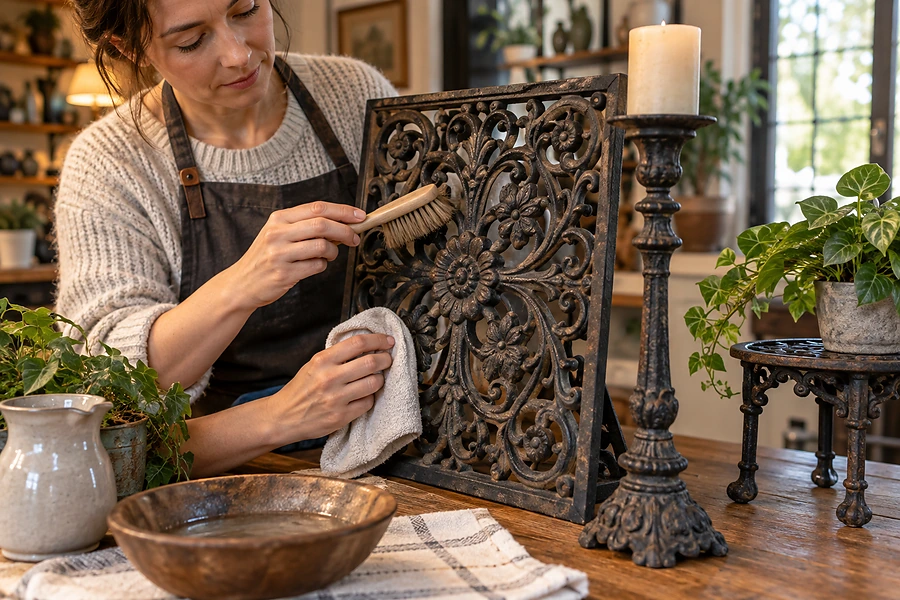
Cast iron decorations collect dust, dirt, moisture, and rust, but aggressive scrubbing can remove paint, patina, fine details, or protective finishes that should remain.
To clean cast iron decorations, first identify whether the surface is painted, bare, waxed, or historically finished. Remove loose dust with a soft brush, then clean stable modern pieces gently. Dry the iron immediately and completely. Treat light rust cautiously, and avoid aggressively stripping antique or heavily corroded decorations without specialist advice.
The safest principle is simple: use the least aggressive method that achieves the cleaning you need. Decorative cast iron is often highly textured, painted, assembled from several parts, or historically significant, so preservation matters as much as removing dirt.
What Is the Best Way to Clean Cast Iron Decorations?
The best cleaning method depends on whether the cast iron is a modern painted ornament, bare iron object, antique decoration, or outdoor architectural feature.
Start with dry cleaning using a soft natural-bristle brush or vacuum with a protected brush attachment. For stable modern painted cast iron, mild soapy water can be appropriate, followed by immediate and thorough drying. For valuable, antique, or historically painted iron, avoid wet cleaning or aggressive abrasion until you understand the existing coating.
Step 1: Identify the Surface Before Cleaning
Do not assume black cast iron is bare metal.
It may have:
- Paint
- Lacquer
- Wax
- Oil
- Historic patina
- Modern powder coating
- A deliberately aged finish
The Canadian Conservation Institute notes that iron is commonly coated and that the condition and nature of that coating should influence how the object is cleaned.
This is particularly important for:
- Antique bookends
- Fireplace ornaments
- Garden urns
- Decorative statues
- Doorstops
- Architectural plaques
- Vintage benches
A cleaner appropriate for bare metal may damage paint.
Step 2: Remove Dry Dust First
For indoor decorative cast iron, dry cleaning is the safest starting point.
Use:
- Soft natural-bristle brush
- Soft toothbrush for crevices
- Microfiber cloth
- Low-suction vacuum with a brush attachment
CCI specifically recommends brushes of different sizes and stiffnesses for removing accumulated dust from stable indoor iron objects without introducing unnecessary water.
Cast iron decorations often contain:
- Scrollwork
- Lettering
- Floral motifs
- Textured surfaces
- Deep recesses
Work slowly through these details.
Do not scrape hard just because dirt is lodged inside an ornamental recess.
Step 3: Decide Whether Water Is Appropriate
For a modern, stable painted garden decoration, gentle washing can be reasonable.
Homes & Gardens recommends mild soapy water and a cloth or sponge for painted cast-iron garden furniture, followed by a clean rinse and drying.
A basic method is:
- Remove loose dust.
- Mix a small amount of mild soap with water.
- Wipe gently with a soft cloth or sponge.
- Use a nylon brush for detailed areas if necessary.
- Remove soap residue.
- Dry immediately and thoroughly.
However, CCI recommends avoiding water and detergent for small museum-type iron objects stored indoors, particularly where preservation of the existing finish is the goal.
So the correct rule is not:
Always wash cast iron.
It is:
Use water only when the finish and condition make wet cleaning appropriate.
Step 4: Dry Immediately
Moisture is one of the main drivers of iron corrosion.
CCI explains that rusting accelerates when iron is exposed to humidity, surface moisture, salts, and pollutants.
After wet cleaning:
- Wipe every visible surface.
- Dry crevices.
- Check screw holes.
- Check the underside.
- Check joints.
- Do not leave water trapped around decorative details.
Outdoor cast iron should not be left wet simply because it will eventually “air dry.”
The period before drying is exactly when corrosion conditions can develop.
Step 5: Inspect While Cleaning
Cleaning is the ideal time to look for:
- Orange rust
- Flaking rust
- Peeling paint
- Cracks
- Loose joints
- Water traps
- Failed coatings
Historic England notes that damaging corrosion on cast-iron statuary is particularly likely where water collects, including bases, construction joints, and complex sculptural details.
These areas deserve extra attention.
Cleaning by Decoration Type
| Decoration | Best Starting Method |
|---|---|
| Modern painted ornament | Dust + gentle mild-soap cleaning |
| Indoor bare iron | Dry brushing first |
| Antique painted cast iron | Dry clean; preserve coating |
| Lightly rusted bare iron | Controlled mechanical cleaning |
| Heavily rusted antique | Conservator/specialist |
| Outdoor statue | Clean, dry, inspect coating |
| Cast iron bench | Mild wash if finish is sound |
| Historic architectural iron | Conservation-based approach |
How Do You Remove Rust From Cast Iron Decorations?
Light rust can often be removed mechanically, but severe rust or corrosion beneath historic paint requires greater caution.
For light surface rust on stable bare cast iron, gently remove loose corrosion with a fine abrasive method appropriate to the object, then clean away residue and apply a suitable protective finish. Do not grind every rusty object back to bright bare metal. Heavy flaking corrosion, fragile details, historic paint, or valuable antiques should be evaluated professionally.
Light Rust Is Different From Severe Corrosion
A small orange spot is not the same problem as an ornament shedding flakes of metal.
CCI distinguishes relatively stable iron from actively corroding iron.
Warning signs of more serious corrosion include:
- Loose rust powder around the object
- Flaking
- Cracking
- Detaching corrosion layers
- Fragile metal underneath
If the decoration is deteriorating rather than simply showing cosmetic surface rust, stop treating it as a normal DIY cleaning job.
Fine Steel Wool Can Work on Appropriate Bare Iron
For lightly corroded iron that was originally bright or bare, CCI describes gentle cleaning with very fine 000 or 0000 steel wool and a small amount of light oil.
This can work on suitable:
- Bare decorative hardware
- Machine-like decorative parts
- Simple unpainted pieces
But it should not automatically be used on painted ornament.
Steel wool can remove:
- Paint
- Patina
- Fine surface details
Use it only when you know those layers are not supposed to remain.
Do Not Automatically Remove Every Trace of Rust
This is particularly important with antiques.
CCI specifically warns against cleaning museum objects all the way to bright bare iron simply for appearance. Stable corrosion can sometimes be part of the object’s historical surface, and excessive removal may disfigure the object.
The goal is not always:
make it shiny.
The goal may be:
stop active deterioration while preserving character.
Wire Brushing Is More Aggressive
The U.S. National Park Service identifies hand scraping and wire brushing as common methods for removing failing paint and light rust from architectural cast iron. However, it also warns that experienced workers are needed to avoid scoring surfaces or damaging fragile detail.
For an inexpensive modern outdoor ornament, controlled wire brushing may be reasonable before repainting.
For an antique:
- Plaque
- Statue
- Fireplace insert
- Architectural panel
do not immediately attack it with a power wire wheel.
Avoid Aggressive Sandblasting on Fine Decorations
Abrasive blasting can remove corrosion quickly, but speed is not always desirable.
The NPS notes that abrasive cleaning pressure and material need careful control because excessive blasting can damage cast iron and nearby surfaces.
Fine decorative details can be permanently softened or erased by aggressive blasting.
Be Careful With Acid Rust Removers
Vinegar and acidic commercial rust removers are commonly recommended for cast-iron cookware.
Decorative antiques are different.
CCI advises against commercial liquid rust strippers for conservation cleaning because acids can quickly expose bare metal and alter the surface.
For historic architectural cast iron, the NPS does recognize controlled chemical rust removal as a professional treatment option, but stresses that the technique must match the object and be properly neutralized.
Therefore:
Do not soak an antique cast-iron ornament in vinegar merely because the method works on a skillet.
Tannic Acid Is a Specialist Option for Certain Black Iron Objects
CCI notes that tannic acid can convert rust into a blue-black ferric tannate layer and may suit rusted wrought or cast iron where a black finish is historically appropriate.
However, it should not be used indiscriminately.
It is unsuitable for objects intended to remain:
- Bright
- Painted another color
- Historically finished in a different way
and it does not eliminate problems caused by soluble salts.
Rust Removal Decision Guide
| Condition | Approach |
|---|---|
| Tiny rust spot on modern bare iron | Gentle controlled abrasion |
| Light rust on suitable bare iron | Fine steel wool/oil may work |
| Rust under failing modern paint | Remove loose failure, prepare, repaint |
| Historic paint still present | Preserve and seek conservation advice |
| Flaking active corrosion | Specialist evaluation |
| Deep pitting | Avoid aggressive DIY restoration |
| Fine antique detail | Minimal intervention |
| Large outdoor modern ornament | Mechanical prep + protective coating |
Can You Use Soap and Water on Cast Iron Decorations?
Yes for some stable modern decorations, but not as a universal treatment for every cast-iron object.
Mild soap and water can be used on many sound, modern painted cast-iron decorations, especially outdoor furniture and ornaments, provided they are rinsed appropriately and dried immediately. For bare antique iron, fragile surfaces, unknown coatings, or historically significant paint, begin with dry cleaning and avoid unnecessary water until the finish has been identified.
Why Water Creates Confusion
Cast iron does not instantly disintegrate when water touches it.
Outdoor cast-iron objects have survived rain for generations.
The problem is prolonged moisture and unprotected metal.
CCI explains that clean, dry iron corrodes relatively slowly, while corrosion accelerates in humid conditions and even more when a film of water remains on the surface.
So water use is really a question of:
finish + duration + drying.
Safe Modern Painted-Iron Routine
For sound contemporary painted décor:
- Dust first.
- Use diluted mild soap.
- Wipe rather than soak.
- Use a soft nylon brush in recesses.
- Remove cleaning residue.
- Dry thoroughly.
- Inspect chipped paint.
This works well for many:
- Garden chairs
- Benches
- Decorative urns
- Modern statues
- Wall ornaments
Never Soak Decorative Cast Iron Without a Good Reason
Even if water washing is appropriate, soaking rarely adds value.
Water can become trapped in:
- Joints
- Screw holes
- Hollow sections
- Decorative seams
Those locations are already common corrosion points.
Historic England specifically identifies construction joints and detailed areas where water collects as vulnerable parts of cast-iron statuary.
Harsh Detergents Are Usually Unnecessary
For general dirt, stronger chemistry is rarely your first choice.
Harsh cleaners may:
- Dull paint
- Strip wax
- Affect lacquer
- Leave residue
- Expose metal
Start mild.
Escalate only when you understand the finish and the contaminant.
What About Pressure Washing?
I would not make pressure washing the default for decorative cast iron.
High-pressure water can:
- Drive moisture into joints
- Lift loose paint
- Damage fragile finishes
For ordinary décor, controlled hand cleaning gives you much more control.
What About Vinegar?
For decorative cast iron, vinegar deserves caution.
Its acidity can dissolve rust, but it can also continue attacking exposed iron after the rust is gone.
CCI’s conservation guidance favors controlled mechanical cleaning for stable objects and warns against indiscriminate acidic commercial rust strippers.
For antiques, I would not use a vinegar bath unless a knowledgeable conservator or restoration specification calls for it.
Cleaning Products to Treat Cautiously
| Product/Method | Why Be Careful? |
|---|---|
| Strong acids | May attack iron/finish |
| Vinegar soaking | Can etch exposed metal |
| Bleach | Unnecessary and potentially damaging |
| Power wire wheel | Can erase detail |
| Pressure washer | Can lift paint/drive water into joints |
| Aggressive sanding | Removes historic coating |
| Thick oil | Attracts dust and affects repainting |
| Random metal polish | May alter patina |
How Do You Protect Cast Iron Decorations After Cleaning?
Once cast iron has been cleaned, protection should focus on keeping moisture and corrosive contaminants away from the metal.
Protect cleaned cast iron by drying it completely, keeping indoor pieces in stable low-humidity conditions, repairing failed protective finishes when appropriate, and using a compatible wax, paint, lacquer, or other coating suited to the original surface. Outdoor pieces need regular inspection because chipped coatings and water-trapping joints are common starting points for renewed corrosion.
Painted Outdoor Cast Iron
Paint is more than decoration.
It creates a barrier between iron and moisture.
If a modern outdoor piece has:
- Peeling paint
- Chips
- Exposed rust
repairing the coating system can slow future corrosion.
The NPS describes protective coating maintenance as central to long-term cast-iron preservation after proper cleaning and surface preparation.
Wax Can Protect Some Indoor Pieces
CCI recommends a light application of microcrystalline wax or suitable paste wax for some iron objects exposed to humidity or regular handling.
Apply thinly.
Too much wax can become trapped in the deep texture of cast iron and create a white or smeared appearance.
This is a good example of why:
more coating does not automatically mean more protection.
Oil Is Not Always the Right Finish
Light oil can be useful on certain bare iron surfaces.
However, Historic England cautions that oil applied to external ironwork can make future painting difficult because coatings may not adhere properly afterward.
Before oiling outdoor décor, decide whether the long-term plan is:
oiled bare appearance
or:
painted protection.
Keep Indoor Cast Iron Dry
CCI notes that rust risk increases with humidity and contamination from salts, dust, and fingerprints.
Store valuable cast iron away from:
- Damp basement walls
- Condensation
- Leaking windows
- Humid garages
For valuable pieces, handling with clean gloves can also reduce transfer of salts and skin oils.
Inspect Outdoor Decorations Regularly
Check:
- Base
- Underside
- Bolts
- Joints
- Crevices
- Water-holding details
These hidden locations may rust before the front surface shows obvious damage.
Historic England specifically identifies water traps around bases, joints, and sculptural details as likely corrosion locations.
Protection by Environment
| Environment | Main Protection Priority |
|---|---|
| Dry indoor room | Dust control |
| Humid indoor room | Humidity + protective finish |
| Bathroom | Moisture inspection |
| Outdoor covered area | Paint/coating inspection |
| Full outdoor exposure | Coating + drainage |
| Coastal location | Salt removal + frequent inspection |
| Antique display | Preserve existing finish |
| Historic outdoor object | Conservation maintenance |
My Insights: How to Clean Cast Iron Decorations
The safest method is not the strongest cleaner. It is the method that removes harmful dirt or corrosion while preserving as much original surface and detail as possible.
To clean cast iron decorations correctly, identify the finish first, remove loose dust dry, use mild wet cleaning only on stable surfaces, dry immediately, treat light rust without excessive abrasion, and restore a compatible protective coating when needed. Antique, heavily corroded, or historically painted cast iron should be cleaned conservatively rather than stripped automatically to bare metal.
My First Insight: Do Not Treat Decorations Like Cookware
This is the biggest mistake.
A cast-iron frying pan is intentionally maintained with polymerized cooking oil.
A decorative cast-iron statue may have:
- Historic paint
- Bronze-effect finish
- Lacquer
- Wax
- Deliberate patina
A skillet restoration tutorial can therefore be completely inappropriate for an antique garden urn or fireplace ornament.
My Second Insight: Start Dry
My default order is:
inspect → dust → clean gently → dry → treat corrosion → protect
not:
soak → scrub → repaint.
CCI’s guidance on small indoor iron similarly begins with dry brushes rather than water.
My Third Insight: Patina and Dirt Are Not the Same Thing
An aged dark surface may be part of the object’s character.
Do not assume every discoloration needs removal.
I would remove:
- Loose dirt
- Active powdery rust
- Harmful deposits
more readily than stable historical surface coloration.
This is especially important for antiques.
My Fourth Insight: Paint Can Be Historical Evidence
Historic England recommends identifying and recording existing paint schemes on cast-iron statuary before intervention and preserving sound historic paint during cleaning.
So an old green or bronze layer should not automatically be stripped simply because modern black paint seems more attractive.
My Fifth Insight: Water Traps Matter More Than Front Surfaces
The front of a statue may look excellent while its:
- Foot
- Base
- Bolt
- Internal joint
is corroding.
After cleaning, inspect where water can remain.
This is where many serious problems begin.
My Sixth Insight: Heavy Rust Is Not a Cleaning Problem Alone
If rust is:
- Flaking
- Deep
- Causing cracks
- Weakening connections
the task has moved from cleaning into conservation or repair.
CCI advises referral to a metals conservation specialist where corrosion is extensive or parts are becoming loose.
My Seventh Insight: Avoid the “Bright Metal” Goal
A newly manufactured cast-iron part may look good stripped clean.
A 120-year-old ornament may lose historical character if aggressively polished.
CCI specifically warns that complete corrosion removal can expose iron unnecessarily and create a disfiguring over-cleaned result.
Clean for stability, not brightness.
My Eighth Insight: Protection Begins With Drying
Many people search immediately for:
- Wax
- Rust converter
- Primer
- Oil
But if moisture remains in a joint, none of those decisions starts from a good foundation.
After wet cleaning, thorough drying is essential.
My Ninth Insight: Modern Outdoor Decorations Are Easier to Treat
For a recent mass-produced painted cast-iron garden ornament, you can generally be more practical:
dust → mild wash → dry → remove loose rust → repair coating.
For an antique:
inspect → preserve → minimize intervention → consult when uncertain.
The value and history of the object should change your method.
My Tenth Insight: Regular Light Cleaning Beats Major Restoration
Dust and small coating failures are inexpensive to address.
Years of neglected rust are not.
A simple inspection routine can look for:
- Dirt buildup
- Paint chips
- New rust
- Water collection
- Loose fasteners
before the problem becomes serious.
My Recommended Cleaning Method
For a modern painted cast-iron decoration, my preferred workflow is:
- Remove loose dust with a soft brush.
- Check whether the paint is stable.
- Wipe with a mild soap solution if appropriate.
- Use a soft nylon brush in ornamental details.
- Remove cleaning residue.
- Dry the piece completely.
- Inspect paint chips and rust.
- Remove only loose corrosion using an appropriate controlled method.
- Repair the protective finish if necessary.
- Keep the piece dry and inspect periodically.
For valuable antique cast iron, I would stop after gentle dry cleaning if I were uncertain about the surface.
What I Would Avoid
I would avoid automatically using:
- Vinegar soaking
- Acid rust remover
- Power sanding
- Aggressive wire wheels
- High-pressure washing
- Heavy coats of oil or wax
- Complete paint stripping
until I knew exactly what surface I was trying to preserve.
Cast Iron Cleaning Quick Guide
| Problem | My Starting Solution |
|---|---|
| Dust | Soft dry brush |
| Dirt on sound modern paint | Mild controlled wash |
| Light rust on appropriate bare iron | Fine controlled abrasion |
| Rust beneath modern failing paint | Prepare and restore coating |
| Historic paint | Preserve; clean minimally |
| Thick flaking rust | Specialist assessment |
| White wax buildup | Reduce excess wax carefully |
| Outdoor recurring rust | Fix water exposure + coating |
| Corrosion at joints | Investigate moisture source |
My Final Answer
So, how do you clean cast iron decorations?
For ordinary modern décor, begin with dry dusting, then use mild soap and limited water only if the finish is stable, and dry the iron completely.
For light rust, use a controlled mechanical method appropriate to the finish rather than immediately reaching for strong acids.
After cleaning, protect exposed iron with an appropriate:
- Paint system
- Wax
- Lacquer
- Other manufacturer- or conservation-approved finish
depending on the object.
For valuable, antique, or heavily corroded cast iron, the best cleaning method may actually be less cleaning.
Preserving original paint, patina, fine casting details, and structurally sound corrosion layers can be more important than making an old decoration look newly manufactured. CCI and Historic England both emphasize condition assessment and preservation of existing finishes when caring for historical iron.
Conclusion
Clean cast iron gently, dry it thoroughly, control rust early, and protect the existing finish. For antiques or severe corrosion, preserve original surfaces instead of aggressively stripping them.