
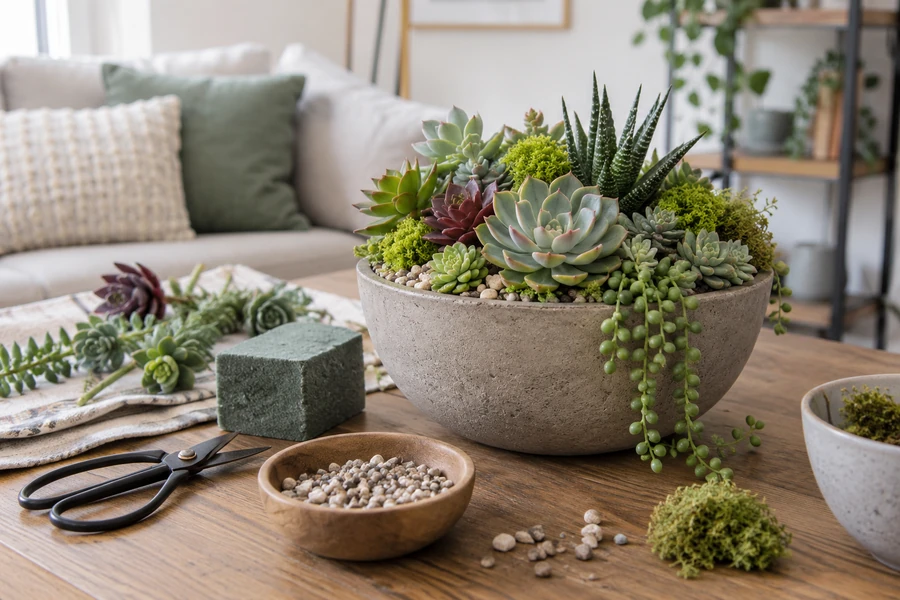
A fake succulent arrangement can look natural and polished, but poor spacing, visible foam, and overly perfect plants can quickly reveal that it is artificial.
I make a fake succulent arrangement by fitting dry floral foam inside a planter, arranging artificial succulents in different sizes and shapes, securing their stems in the foam, and covering the exposed base with moss, gravel, or decorative stones. I use varied heights, colors, and textures to create a more natural appearance.
The basic project is simple. The biggest difference comes from how I choose the succulents, create the composition, hide the mechanics, and imitate the irregular growth of real plants.
What Do I Need to Make a Fake Succulent Arrangement?
I do not need many supplies to make a faux succulent garden, but choosing the right container, foam, plants, and finishing material makes the final arrangement much easier to build.
To make a fake succulent arrangement, I usually need artificial succulent stems, a planter, dry floral foam, wire cutters, hot glue if permanent fixing is needed, and moss, gravel, sand, or small stones to cover the base. I also like using several succulent varieties so the arrangement has different heights, colors, and leaf shapes.
My Basic Materials List
For a simple artificial succulent arrangement, I prepare:
- Artificial succulent picks
- A decorative planter or bowl
- Dry floral foam
- A serrated knife for cutting foam
- Wire cutters
- Hot glue and a glue gun
- Preserved or artificial moss
- Decorative gravel or pebbles
- Optional sand
- Optional filler material for deep containers
I normally use dry floral foam rather than wet floral foam because there is no need to hold water for artificial plants. A faux succulent wall-planter tutorial specifically notes that wet-use foam is more brittle and recommends using a more suitable foam for artificial arrangements.
I Choose the Container First
One advantage of fake succulents is that I do not need to worry about drainage holes or suitable growing soil.
That gives me much more freedom when selecting a container.
I can use:
| Container | Style |
|---|---|
| Terracotta pot | Natural and Mediterranean |
| Ceramic bowl | Clean and modern |
| Concrete planter | Minimal and architectural |
| Wooden box | Rustic |
| Galvanized container | Farmhouse or industrial |
| Vintage cup | Small decorative arrangement |
| Stone-effect bowl | Organic and contemporary |
| Woven basket | Soft and casual |
DIY faux succulent projects use everything from ceramic pots and galvanized containers to unconventional vessels because artificial succulents do not require watering or drainage.
I prefer wider, shallow containers when I want to create a mixed succulent garden. A taller pot can also work, but I may need filler underneath the floral foam so I do not waste material filling the entire container.
For a deep pot, I can place clean packaging material or another lightweight filler below the foam. One faux succulent tutorial suggests filling unused space first and then placing floral foam near the top of the planter.
I Mix Several Succulent Shapes
I rarely use ten identical artificial echeverias.
Real succulent gardens usually contain differences in shape, height, color, and texture.
I may combine:
- Echeveria-style rosettes
- Aloe-like upright succulents
- Sedum-style fillers
- Haworthia-inspired plants
- Trailing burro’s tail
- Small clustered succulents
- Muted purple or burgundy accents
Apartment Therapy found that artificial succulent arrangements containing diverse plant types tended to look more organic, and trailing forms helped strengthen the effect.
That is why variety is one of my first design choices.
How Do You Secure Fake Succulents in a Pot?
The succulents need a stable structure underneath them, even though the finished arrangement should hide every sign of that structure.
I secure fake succulents by cutting dry floral foam to fit tightly inside the planter and pushing the stems into the foam. If I want a permanent arrangement, I can glue the foam into the container and add a small amount of hot glue around loose stems. For a reusable arrangement, I usually avoid unnecessary glue.
Step 1: I Fit the Floral Foam
I place the planter upside down over the foam or measure the inside dimensions.
Then I cut the floral foam slightly larger than the space I need to fill.
I want it to sit firmly inside the container without moving.
The cut does not have to look perfect because the foam will eventually disappear under the succulents and top dressing.
Several DIY faux succulent tutorials use the same basic method: cut floral foam to fit the vessel, place or glue it securely, and insert the artificial stems directly into it.
Step 2: I Decide Whether to Glue the Foam
I do not automatically glue everything.
If I want to change the arrangement for another season, I may simply press the foam tightly into the planter.
If the arrangement will be transported, sold, displayed commercially, or handled regularly, I prefer stronger fixing.
Hot glue can secure the foam to the bottom of many craft containers, although I always check that the heat and adhesive are compatible with the vessel.
A permanent arrangement benefits from extra stability.
A temporary arrangement benefits from flexibility.
Step 3: I Trim the Artificial Stems
Artificial succulent picks sometimes arrive with stems that are too long.
I use wire cutters when the stem contains internal metal.
I leave enough stem to hold securely in the floral foam.
If I cut the stem too short, the succulent can sit loosely on top.
If I leave it too long, the flower head may sit much higher than I intended.
I adjust each one separately.
Step 4: I Place the Largest Succulent First
I normally start with one of the strongest visual elements.
I do not always put it directly in the center.
Placing a larger succulent slightly off-center can create more visual interest. One faux succulent arrangement tutorial recommends starting with a large piece off-center, then adding smaller plants at varying heights around it.
From there, I build outward.
I rotate the planter as I work.
That helps me see the arrangement from several angles instead of creating one attractive front and one empty back.
Step 5: I Fill the Gaps Gradually
I place medium succulents next.
Then I use smaller pieces to fill obvious spaces.
I leave a little breathing room between some plants because an arrangement packed too tightly can look artificial.
For a round planter, I may let one trailing succulent move over the edge.
For a long rectangular container, I can create several small groups rather than making one continuous straight line.
Step 6: I Hide the Foam
This step is essential.
Visible floral foam immediately makes the arrangement look unfinished.
I cover it with:
- Preserved moss
- Artificial moss
- Fine gravel
- Small pebbles
- Decorative stones
- Sand
- A combination of moss and rock
DIY faux succulent arrangements commonly use moss to hide floral foam, while simpler mini planters can use pebbles and moss as both filler and visual finishing material.
Once the mechanics disappear, the arrangement begins to look much more convincing.
How Do You Make Fake Succulents Look Real?
Artificial succulents are easier to make convincing than many other fake plants because real succulent leaves already have thick, waxy, sculptural surfaces.
I make fake succulents look realistic by choosing matte leaves with natural color variation, mixing several species, avoiding perfect symmetry, varying plant height, and hiding the artificial base. I also use realistic gravel, moss, or soil-like material because the surface around the plants can reveal a fake arrangement just as quickly as the leaves.
I Pay Attention to Leaf Texture
Succulents can naturally look almost artificial.
Their thick leaves and geometric rosettes make them especially suitable for faux décor.
However, quality still matters.
I avoid extremely glossy leaves because excessive shine can make molded plastic obvious.
I prefer:
- Matte surfaces
- Soft-touch finishes
- Slight leaf texture
- Natural color gradients
- Different shades at the tips
- Small variations between plants
Recent guidance on realistic faux succulents highlights surface variation, layered coloring, and natural changes from the center to the leaf tips as important characteristics of convincing products.
I Avoid One Uniform Green
Real succulents are not all the same green.
Depending on the variety, I may see:
- Blue-green
- Sage green
- Gray-green
- Bright fresh green
- Dusty purple
- Burgundy edges
- Pink tips
- Pale silvery tones
I use these variations carefully.
I might create an arrangement that is 70 to 80 percent green and use muted purple or reddish succulents as accents.
I normally avoid too many highly saturated colors because the arrangement can begin to feel decorative rather than botanical.
I Use Different Heights
Flat arrangements often look artificial.
I create a low, medium, and slightly higher level.
The height difference does not need to be dramatic.
One upright aloe-shaped succulent may rise above the rest.
Several rosettes can sit lower.
A trailing stem may fall over the edge.
This creates a more natural silhouette.
I Avoid Perfect Symmetry
If I put one green rosette on the left and an identical rosette at exactly the same angle on the right, the design may look manufactured.
Real planting rarely creates that type of perfect mirror image.
I use balance without duplication.
For example, I can balance one large succulent on the left with two smaller succulents on the right.
The visual weight remains balanced, but the pieces are not identical.
I Make the Base Believable
Apartment Therapy’s comparison of faux succulents found that the soil texture and planter can be important clues when deciding whether a succulent looks real or artificial. Adding an organic-looking surface can make a faux plant more believable.
I therefore spend time finishing the base.
For a desert-style arrangement, I prefer small gravel.
For a woodland or softer style, moss can work.
For a modern arrangement, I may use pale stones or dark decorative gravel.
I avoid leaving exposed Styrofoam, floral foam, hot glue, or plastic nursery pots.
I Keep the Arrangement Clean
Artificial succulents collect dust.
That dust is particularly visible on broad upward-facing leaves.
I clean the arrangement with a soft brush, microfiber cloth, or gentle air as appropriate for the material.
I do not assume every artificial succulent can be washed because coatings and adhesives differ.
Good cleaning helps preserve the surface texture that makes a high-quality faux succulent convincing.
What Do You Put in the Bottom of a Fake Succulent Planter?
Because fake succulents do not need soil, I can build the inside of the planter for stability and appearance rather than plant health.
I usually put inexpensive lightweight filler in the bottom of a deep faux succulent planter, place dry floral foam near the top, and finish the visible surface with moss, gravel, pebbles, or sand. For a shallow planter, floral foam alone may be enough. If the arrangement is tall or top-heavy, I add weight to the base for stability.
I Do Not Waste Floral Foam in a Deep Container
Imagine that I have a 10-inch-deep vase but my artificial succulent stems only need two or three inches of foam.
Filling the whole container with floral foam would be unnecessary.
Instead, I can fill some of the lower space first.
Depending on the project, filler can include suitable clean packaging material or empty lightweight containers hidden below the foam. DIY tutorials use this approach to reduce the amount of floral foam required.
Then I place the foam closer to the rim.
This keeps the succulents at the correct height.
I Add Weight When Needed
A wide shallow bowl may already be stable.
A narrow tall planter can be different.
If I build a large arrangement with heavy artificial succulents, I do not want the planter to tip over.
I can place stones or another appropriate heavy filler in the bottom before adding the lighter structure above.
For commercial or event use, I take this especially seriously because arrangements may be moved frequently.
I Choose Top Dressing Based on the Style
The visible top layer should support the design.
| Top dressing | Best effect |
|---|---|
| Preserved moss | Soft and organic |
| Green artificial moss | Full garden appearance |
| Fine gravel | Natural succulent garden |
| White pebbles | Clean contemporary look |
| Dark gravel | Strong modern contrast |
| Sand | Desert-inspired |
| Mixed stones | Natural outdoor appearance |
I do not need to fill the entire pot with expensive decorative stone.
I only need enough to cover the visible top.
I Sometimes Combine Materials
A single material can look flat.
I may use moss around the stems and add a few scattered stones.
Or I may use fine gravel with two or three larger rocks.
The important part is keeping the top dressing in scale.
Large landscaping stones can overwhelm miniature succulents.
Very fine sand may look strange around a large statement planter.
I match the particle size to the arrangement.
Can I Make a Fake Succulent Arrangement Without Floral Foam?
Floral foam is convenient, but it is not the only way to support artificial succulents. Some containers and small projects can use much simpler construction.
Yes, I can make a fake succulent arrangement without floral foam. Small succulent picks can be supported with pebbles, gravel, moss, clay, or another stable craft filler. For lightweight mini arrangements, I can simply fill a container with stones and moss and insert the artificial stem at the correct height. Larger arrangements usually benefit from a firmer internal structure.
Pebbles Work for Small Arrangements
One simple faux succulent project uses small mason jars filled with pebbles and moss, with the artificial succulent stem tucked directly into the center.
This works because the arrangement is small and light.
The decorative filler also becomes the structural support.
I like this method for:
- Desk décor
- Small bathroom shelves
- Party favors
- Mini gifts
- Bookshelves
- Small windowsill displays
Larger Arrangements Need More Control
For a wide centerpiece or large planter, loose pebbles may not hold every stem at the angle I want.
Floral foam gives me more precise placement.
I can insert one succulent vertically.
I can angle another outward.
I can remove and reposition a stem until the composition feels right.
That control is useful when I am combining many artificial succulents.
Permanent Designs Can Use Adhesive
For a wall planter or arrangement that will travel frequently, I may need adhesive.
A wall-planter tutorial uses glue to secure floral foam inside the frame before arranging the succulent picks. It also recommends deciding on placement before permanently gluing the plants.
I follow the same idea.
I first create the complete composition without permanently fixing every stem.
Then I step back and inspect it.
Only after I am satisfied do I add glue where necessary.
That prevents me from locking the wrong arrangement in place.
My insights: How to Make a Fake Succulent Arrangement
The basic technique is easy, but I think a convincing artificial succulent arrangement depends less on complicated construction and more on natural composition.
I make the best fake succulent arrangement by combining realistic artificial succulents in different sizes and textures, anchoring them securely in dry floral foam, creating uneven heights, leaving controlled negative space, and completely hiding the mechanics with natural-looking moss or gravel. I focus on botanical variety and subtle asymmetry instead of trying to make every part perfectly matched.
My First Insight: I Design the Shape Before I Start Gluing
I do not immediately glue the first succulent into place.
I gather all of my stems first.
Then I group them roughly by:
- Size
- Height
- Shape
- Color
- Texture
This lets me understand what I have.
I usually select one or two focal succulents first.
Then I choose several supporting plants.
Finally, I identify smaller fillers and trailing pieces.
This simple step prevents the arrangement from becoming a random collection of artificial plants.
My Second Insight: I Start Off-Center
For most mixed succulent arrangements, I prefer not to put the biggest plant directly in the middle.
An off-center focal point creates movement.
A DIY mini faux succulent guide uses the same principle, recommending a large piece placed away from the center before additional stems are layered around it.
I might place a large echeveria slightly to the left.
Then I place an upright aloe-like succulent behind it.
A smaller rosette can sit toward the front.
A trailing stem can move toward the opposite edge.
This creates balance without symmetry.
My Third Insight: Variation Makes Fake Succulents More Convincing
I do not use only one type of succulent unless I am intentionally creating a minimalist arrangement.
For a mixed garden, variety matters.
Apartment Therapy found that faux arrangements containing multiple succulent types could feel more organic, especially when they included differences in texture and trailing forms.
That matches the way I approach the composition.
I vary:
- Rosette size
- Leaf length
- Green tone
- Plant height
- Growth direction
- Surface texture
I still keep some repetition.
If every plant is completely different, the arrangement can feel chaotic.
I may repeat one rosette shape two or three times while varying the surrounding plants.
My Fourth Insight: The Base Is Part of the Arrangement
I do not treat moss and gravel as an afterthought.
The top of the planter occupies a large visible area.
If people can see white foam between the plants, the illusion disappears immediately.
I cover every exposed section.
For realism, I also avoid making the surface perfectly uniform.
I can place a little moss near one group of succulents and use more visible gravel in another area.
A few larger decorative stones can create another level of texture.
The base should look designed, but not mechanically arranged.
My Fifth Insight: I Match Detail to Viewing Distance
This is one of the most useful rules for me.
A small fake succulent arrangement on a dining table will be viewed closely.
I therefore invest more attention in leaf texture, color gradients, realistic gravel, and hidden stems.
A large artificial succulent display on a high shelf can rely more on overall shape.
People may never see each leaf closely.
A commercial arrangement in a reception area needs both a strong overall silhouette and enough close-up realism to survive closer inspection.
The viewing distance helps me decide where to spend effort and budget.
My Simple Arrangement Formula
When I want a dependable starting point, I use this formula:
| Element | My approach |
|---|---|
| Container | One suitable low or medium planter |
| Focal plant | 1 large succulent |
| Secondary plants | 2–4 medium succulents |
| Fillers | Several smaller succulents |
| Trailing element | 0–2 stems |
| Height | At least 2–3 levels |
| Color | Mostly natural green with limited accents |
| Structure | Dry floral foam |
| Finish | Moss, gravel, stones, or a combination |
I do not treat the numbers as strict rules.
A small arrangement may need only three plants.
A large centerpiece may require many more.
The formula simply keeps me thinking about visual roles instead of buying a pile of identical faux succulents.
My Final Approach
When someone asks me “How to make a fake succulent arrangement?”, my process is straightforward.
I choose a container that fits the space.
I secure dry floral foam inside it.
I select realistic artificial succulents with different forms.
I begin with the largest focal plant.
I build outward using medium and small stems.
I vary height and direction.
I add a trailing element when the container allows it.
I rotate the arrangement as I work.
I stop before it becomes overcrowded.
Then I completely hide the foam with moss, gravel, or stones.
Finally, I inspect the arrangement from the distance where it will normally be seen.
If I notice the floral mechanics first, I keep working.
If I notice the plants, color, texture, and overall shape first, the arrangement is doing what I want.
That is the difference between simply placing artificial succulents in a pot and creating a finished faux succulent arrangement.
Conclusion
I make a realistic fake succulent arrangement with varied artificial plants, secure floral foam, uneven heights, natural spacing, and a carefully finished base of moss, gravel, or stones.