

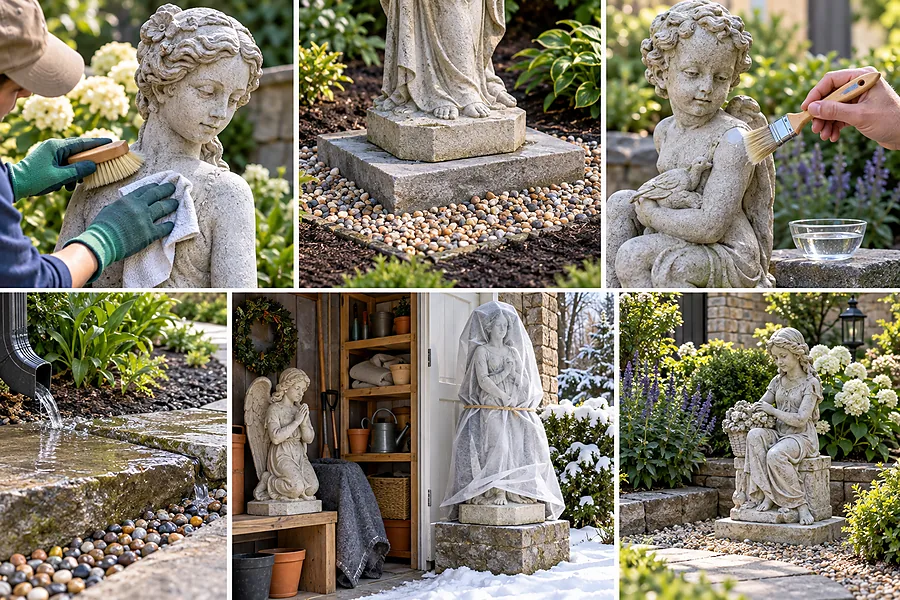
Concrete garden statues are durable, but constant rain, standing water, dirt, freezing temperatures, and damaged finishes can gradually cause staining, scaling, cracks, or surface deterioration.
To protect concrete garden statues, keep them clean and well drained, raise them slightly above wet ground, use a compatible breathable concrete sealer when appropriate, prevent standing water, and winterize them before freezing weather. In cold climates, moving smaller statues into shelter or covering and elevating larger pieces can significantly reduce freeze-thaw damage.
Concrete is porous, so moisture management is the main theme behind good protection. Sealing helps, but drainage, placement, cleaning, winter preparation, and timely maintenance are just as important. Concrete Network notes that penetrating sealers can reduce water penetration while maintaining a natural appearance and allowing moisture vapor to escape.
Should You Seal Concrete Garden Statues?
Sealing is often useful for outdoor concrete statues, particularly in wet climates or locations exposed to repeated freezing and thawing, but not every statue needs the same type of coating.
Yes, many outdoor concrete statues benefit from a compatible concrete sealer because it can reduce water absorption, staining, and weather-related deterioration. A breathable penetrating sealer is often suitable for natural-looking unpainted concrete, while painted or decorative finishes may require a compatible topical product. Always check the statue maker’s instructions before sealing.
Why Water Is the Main Enemy
Concrete looks solid, but it contains pores.
Water can move into these pores through:
- Rain
- Splashing irrigation
- Snow
- Ground moisture
- Condensation
- Standing water
In mild weather, this may simply lead to:
- Dark staining
- Moss
- Algae
- Efflorescence
- Dirty surfaces
In freezing climates, the stakes become higher.
When absorbed water repeatedly freezes and thaws, the concrete can experience:
- Scaling
- Surface flaking
- Cracking
- Spalling
Concrete Network specifically recommends penetrating sealers for exterior concrete exposed to freeze-thaw conditions because they reduce moisture penetration without necessarily creating a visible film.
Sealing Is Not the Same as Making Concrete Waterproof
This distinction matters.
A sealer can reduce water absorption.
It cannot make every concrete object immune to:
- Standing water
- Ice pressure
- Structural movement
- Existing cracks
- Poor drainage
For example, sealing a birdbath does not mean it is safe to leave the bowl completely full of water through repeated freezes.
Concrete statuary suppliers consistently recommend emptying or protecting bowls and fountains because water freezing inside a container can still create damaging pressure.
Clean Before You Seal
Never treat sealing as a way to hide dirt.
Before applying a sealer:
- Remove loose leaves and debris.
- Brush away soil.
- Clean stains with an appropriate mild method.
- Rinse if the cleaning method requires it.
- Let the concrete dry thoroughly.
- Repair significant damage first.
Concrete Network specifically warns against applying sealer to damp surfaces for several exterior applications.
If moisture is trapped beneath an incompatible topical coating, the finish may:
- Turn cloudy
- Peel
- Blister
- Fail prematurely
Keep the Statue Off Constantly Wet Soil
Direct ground contact can expose the base to persistent moisture.
A better foundation may include:
- Pavers
- Stone
- A concrete pad
- Gravel
- A pedestal
- Another stable, well-drained base
Current statuary-care guidance recommends raising concrete pieces off wet ground, particularly during winter, so water and ice do not remain trapped around the base.
Make Sure the Base Is Stable
Protection is not only about weather.
A heavy statue can crack if it:
- Tilts
- Falls
- Settles unevenly
- Sits on unstable soil
Prepare the location before installation.
For a heavy ornament, create a flat, compacted base and make sure the statue is level.
Do Not Seal Until You Understand the Existing Finish
A natural gray statue, painted statue, stained piece, and antique cast-stone ornament should not automatically receive the same coating.
Before resealing an existing piece, determine:
- Is it already sealed?
- Was it painted?
- What coating was used?
- Is the existing coating peeling?
- Does the manufacturer specify a product?
Concrete Network recommends compatibility with the existing sealer when resealing rather than blindly applying a different chemistry over it.
What Is the Best Sealer for Concrete Garden Statues?
There is no single best sealer for every concrete statue. The correct product depends on whether the concrete is natural, colored, painted, glossy, exposed to freezing weather, or intended to develop an aged patina.
For unpainted outdoor concrete statues, a breathable penetrating silane, siloxane, siliconate, or similar exterior concrete sealer is often a strong choice because it reduces water penetration while preserving a natural appearance. For painted or color-enhanced pieces, a compatible exterior acrylic or other manufacturer-approved decorative sealer may provide better finish protection.
Penetrating Sealers
Penetrating sealers soak into the concrete rather than creating a thick film on top.
Common categories include:
- Silane
- Siloxane
- Silicate
- Siliconate
Concrete Network’s 2026 guide describes penetrating sealers as particularly useful for exterior concrete exposed to moisture, deicing chemicals, corrosion risks, and freeze-thaw conditions. Most provide a natural matte finish and allow moisture vapor to escape.
They are a strong choice when you want the statue to continue looking like:
natural concrete
rather than glossy coated stone.
Acrylic Sealers
Acrylic sealers are commonly used on decorative outdoor concrete.
They can:
- Enhance color
- Add sheen
- Help resist stains
- Reduce moisture absorption
Concrete Network identifies acrylic products as a common option for decorative exterior concrete, especially when color enhancement or a visible finish is desired.
For an intentionally painted statue, check compatibility with:
- Existing paint
- Primer
- Previous sealer
before applying a new acrylic coating.
Painted Concrete Statues Need Different Thinking
Suppose your garden statue is painted as:
- A colorful gnome
- Animal
- Angel
- Buddha
- Decorative figure
Your goal is not only protecting concrete.
You are also protecting:
- Pigment
- Paint adhesion
- Surface color
- Decorative details
A compatible exterior UV-resistant coating may be appropriate, but the paint and sealer systems need to work together.
Do not assume the product recommended for a gray concrete driveway will automatically be the best finish for a hand-painted statue.
Avoid Creating an Unwanted Plastic Look
A thick glossy coating can visually change a statue.
Before sealing an entire ornament, test the product in an inconspicuous area.
Check whether it changes:
- Color
- Sheen
- Texture
- Surface depth
For stone-effect statuary, I generally prefer:
natural + matte + breathable
unless the original finish was intentionally glossy.
Do Not Overapply Sealer
More sealer does not automatically create more protection.
Concrete Network’s professional resealing guidance emphasizes thin application because applying too much sealer at once is a common failure point.
Follow the manufacturer’s instructions for:
- Coverage
- Number of coats
- Drying interval
- Temperature
- Surface moisture
- Recoat time
Do not improvise by adding extra thick coats.
Best Sealer by Statue Type
| Statue Type | Useful Starting Point |
|---|---|
| Natural gray concrete | Penetrating breathable sealer |
| Natural cast stone | Manufacturer-approved penetrating sealer |
| Colored concrete | Compatible penetrating or decorative sealer |
| Painted statue | Compatible exterior protective sealer |
| High-gloss decorative piece | Compatible topical sealer |
| Freeze-thaw exposure | Penetrating moisture protection |
| Historic/valuable statuary | Specialist conservation advice |
Check the Manufacturer First
Some cast-stone manufacturers intentionally leave statuary unsealed so it can weather and develop a natural aged appearance.
Concrete Network notes that certain cast-stone manufacturers specifically encourage natural weathering rather than sealing.
So do not assume:
Every concrete statue must be sealed.
If you want:
- Moss
- Patina
- Natural aging
you may intentionally choose a different maintenance strategy.
How Do You Protect Concrete Statues in Winter?
Winter protection is especially important in climates where temperatures repeatedly cross above and below freezing because water can enter concrete and then freeze inside pores or cavities.
To protect concrete statues in winter, remove standing water, elevate the base above wet or frozen ground, store smaller pieces indoors when possible, and shelter larger statues from snow and ice. Drain fountains and birdbaths completely. A breathable sealer can reduce moisture absorption, but it cannot safely protect a water-filled bowl from freezing.
Step 1: Clean Before Winter
Remove:
- Leaves
- Soil
- Moss
- Bird debris
- Organic buildup
Debris can retain moisture around the surface.
Allow the statue to dry before covering or storage.
Step 2: Remove Standing Water
Pay special attention to:
- Bowls
- Hands
- Folded clothing details
- Shells
- Planters
- Birdbaths
- Fountain reservoirs
A decorative depression only a few centimeters deep can collect rainwater.
If that water freezes, it can create unnecessary stress.
Step 3: Drain Fountains Completely
Before freezing weather:
- Shut off the fountain.
- Drain all bowls.
- Drain accessible water lines.
- Remove the pump where appropriate.
- Store the pump according to its instructions.
- Prevent new water from accumulating.
Oregon State University Extension recommends draining outdoor fountains and protecting or storing components before winter, while concrete statuary suppliers likewise emphasize never allowing water to freeze in fountain bowls.
Step 4: Empty Birdbaths
Do not leave an ordinary concrete birdbath filled with water if repeated freezing is expected unless the product is specifically designed for that use.
Options include:
- Store the bowl indoors.
- Invert it if the design allows.
- Cover it appropriately.
Oregon State University Extension specifically recommends turning birdbath bowls upside down to prevent water accumulation and freezing.
Step 5: Raise the Statue
Do not let the base sit in:
- Standing water
- Snowmelt
- Ice
- Saturated soil
Place it on a stable raised surface.
Current 2026 statuary-care guidance recommends keeping bases elevated to reduce direct moisture contact during freezing conditions.
Step 6: Store Small Statues When Possible
The simplest winter protection is often physical shelter.
Move manageable pieces into:
- Shed
- Garage
- Covered storage
They do not necessarily need a heated living space.
The goal is to reduce exposure to:
- Rain
- Snow
- Repeated icing
Step 7: Cover Large Statues Carefully
Large statues may be too heavy to move.
A weather-resistant cover can reduce direct exposure, but covering should not become a way to trap moisture against wet concrete.
Clean and dry the statue first.
Secure the covering against wind.
For large fountains, some winter-care methods use absorbent material below an exterior cover to help manage condensation.
Step 8: Avoid Deicing Salts Around Statues
Deicing chemicals can worsen deterioration of exterior concrete exposed to freeze-thaw conditions.
Concrete Network specifically notes that penetrating sealers can help protect exterior concrete from deicing chemicals and recommends caution with deicing salts on decorative concrete.
Keep salt application away from:
- Statue bases
- Decorative plinths
- Concrete planters
where possible.
Winter Protection Checklist
| Risk | Protection |
|---|---|
| Standing rainwater | Drain it |
| Snow accumulation | Shelter/cover |
| Frozen birdbath | Empty or invert |
| Fountain | Drain and remove pump |
| Wet soil | Elevate statue |
| Small movable statue | Store indoors |
| Freeze-thaw moisture | Compatible penetrating sealer |
| Deicing salt | Keep away where practical |
| Wind | Secure cover |
| Existing cracks | Repair before winter where appropriate |
Sealer Cannot Fix Poor Winterization
This is one of the most important rules.
A sealed fountain bowl full of water can still crack.
A sealed statue sitting in a puddle all winter can still experience excessive moisture exposure.
Think of sealer as:
one layer of protection
not:
permission to ignore drainage.
How Often Should You Reseal Concrete Garden Statues?
There is no universal resealing calendar because exposure, sealer chemistry, application quality, climate, finish, and manufacturer instructions all affect service life.
Inspect concrete garden statues at least annually and reseal when the existing protection is no longer performing as intended. General exterior-concrete guidance often suggests approximately every 2–5 years, but decorative statues in severe weather may need attention sooner. Use the specific sealer manufacturer’s interval rather than automatically resealing every season.
Why One Fixed Number Is Misleading
Imagine two identical statues.
Statue A
- Covered porch
- Mild climate
- Little rain
Statue B
- Full sun
- Heavy rain
- Snow
- Freeze-thaw cycles
They should not automatically follow the same maintenance schedule.
Concrete Network notes that resealing intervals vary according to:
- Sealer type
- Environmental conditions
- Wear
with broad exterior guidance often falling in the 2–5 year range.
Inspect Every Spring
A practical inspection schedule is easier than blindly applying sealer every year.
Look for:
- New cracks
- Flaking
- Peeling paint
- Chalky surface
- Fading
- Moss
- Staining
- Water absorption
- Failed coating
Photograph the statue annually.
Photos make gradual deterioration much easier to notice.
Watch How Water Behaves
If a previously water-repellent surface begins quickly absorbing water, its protective treatment may be weakening.
Concrete Network lists loss of water beading and increased absorption among indicators that resealing may be necessary.
However, do not use this test without knowing what sealer is present.
Different sealers behave differently.
Painted Statues May Need More Frequent Finish Maintenance
Paint and clear coatings may show:
- UV fading
- Chips
- Peeling
- Surface wear
before the underlying concrete is seriously damaged.
Inspect painted details annually and touch up only with compatible products.
Clean Regularly
Cleaning frequency depends on location.
A statue under trees may accumulate:
- Leaves
- Sap
- Bird debris
- Algae
more quickly than one on an open patio.
A light routine might be:
Every few months
- Remove debris
- Brush lightly
- Inspect surface
Once a year
- Deeper inspection
- Check coating
- Check base
- Prepare for winter if relevant
Avoid Aggressive Cleaning
Concrete statuary often contains fine detail.
Avoid unnecessarily aggressive:
- Wire brushing
- Acid cleaning
- High-pressure blasting
especially on:
- Painted pieces
- Older statues
- Delicate surfaces
Use the gentlest effective cleaning method.
Repair Problems Before Resealing
Do not cover up:
- Loose concrete
- Peeling paint
- Active cracks
- Failed coating
with another layer of sealer.
Find the cause first.
If cracking is structural or substantial, professional repair may be more appropriate.
Simple Maintenance Calendar
| Time | Task |
|---|---|
| Early spring | Inspect cracks and coating |
| Spring | Clean gently |
| Summer | Check staining and fading |
| Autumn | Remove leaves and debris |
| Before frost | Drain water features |
| Before winter | Elevate/store/cover as needed |
| Every 2–5 years* | Evaluate resealing |
*Broad exterior-concrete guidance only; actual intervals depend on product and exposure.
My Insights: How to Protect Concrete Garden Statues
The best protection strategy is not the thickest coating. It is controlling water from every direction before asking a sealer to solve the remaining exposure.
To protect concrete garden statues effectively, prioritize five things: drainage, elevation, compatible sealing, gentle maintenance, and winter moisture control. Keep water from pooling on or beneath the statue, use a breathable exterior sealer when appropriate, clean without damaging the surface, and prevent water-filled bowls or cavities from freezing. These steps matter more than frequent resealing alone.
My First Insight: Drainage Comes Before Sealer
If I could choose only one protection improvement, I would first stop standing water.
Check:
- Base
- Bowl
- Crevices
- Pedestal
- Surrounding soil
Water that cannot remain on the statue cannot freeze there.
My Second Insight: Elevating the Base Is Cheap Protection
A small gap between the statue and saturated ground can reduce prolonged moisture contact.
Use a stable solution appropriate to the statue’s weight, such as:
- Paver
- Stone base
- Concrete footing
Current concrete-statuary guidance repeatedly recommends keeping concrete pieces out of pooled water and ice.
My Third Insight: Penetrating Sealer Is My Starting Point for Natural Concrete
If I want natural gray concrete to remain natural-looking, I would first investigate a breathable penetrating product designed for exterior concrete.
Concrete Network’s 2026 guidance identifies this sealer category as particularly appropriate for:
- Outdoor exposure
- Freeze-thaw protection
- Moisture reduction
- Natural matte appearance
That does not mean every penetrating sealer is interchangeable.
Read the product specification.
My Fourth Insight: Painted Statues Are a Two-Layer Problem
With a painted garden statue, you are protecting:
- The concrete body
- The decorative paint system
If the paint fails, applying more water repellent to the wrong layer may not solve the appearance problem.
Identify the original coating first.
My Fifth Insight: Winter Damage Often Starts in a Small Pocket of Water
People naturally focus on the entire statue.
But a small:
- Bowl
- Fold
- Hand
- Flowerpot
- Fountain basin
can hold enough water to create localized damage during freezing.
Inspect the ornament from above before winter.
My Sixth Insight: Birdbaths and Fountains Need More Protection Than Solid Statues
A solid garden figure sheds most rain.
A birdbath is designed to hold water.
A fountain is designed to circulate water.
That makes them inherently more vulnerable when freezing temperatures arrive.
Oregon State University Extension recommends draining and protecting these water-holding concrete pieces before winter.
My Seventh Insight: Do Not Reseal Just Because a Calendar Says So
Current exterior-concrete guidance often cites a broad 2–5 year interval, but exposure and product type matter more than a universal date.
Inspect first.
Then reseal.
My Eighth Insight: Too Much Sealer Can Create Its Own Problems
More coating does not automatically mean better protection.
Overapplication can affect:
- Appearance
- Drying
- Adhesion
- Vapor movement
Concrete Network’s professional guidance specifically warns against applying excessive sealer thickness.
Follow coverage rates.
My Ninth Insight: Decide Whether You Want New-Looking or Naturally Aged
Not every concrete ornament needs to remain visually perfect.
Some garden styles look better when statues develop:
- Patina
- Moss
- Soft discoloration
- Natural weathering
Concrete Network notes that some cast-stone manufacturers intentionally recommend natural aging rather than sealing.
Protection and appearance are therefore separate decisions.
You can want structural longevity without demanding a brand-new appearance forever.
My Tenth Insight: Prevent Damage Before Repairing It
A simple annual routine can prevent much larger problems.
My preferred order is:
- Inspect
- Clean
- Drain
- Repair small problems
- Check the base
- Seal if needed
- Winterize
The sequence matters.
My 10-Point Concrete Statue Protection Checklist
| # | Protection Rule |
|---|---|
| 1 | Put the statue on a stable, drained base |
| 2 | Keep it out of standing water |
| 3 | Clean dirt and organic debris |
| 4 | Use compatible sealer where appropriate |
| 5 | Apply thin coats according to directions |
| 6 | Inspect cracks and damaged finishes |
| 7 | Empty bowls before freezing |
| 8 | Drain fountains completely |
| 9 | Store or protect statues in severe winter |
| 10 | Reinspect before automatically resealing |
What Damages Concrete Statues Most?
The main risks are:
Moisture
- Absorption
- Ground contact
- Standing water
Freeze-thaw
- Internal moisture freezing
- Water trapped in bowls
Poor coatings
- Peeling
- Trapped moisture
- Incompatibility
Neglect
- Moss
- Dirt
- Undetected cracks
Unstable placement
- Tilting
- Falling
- Settlement
Best Protection by Climate
| Climate | Priority |
|---|---|
| Hot and dry | UV/finish inspection |
| Warm and wet | Moisture control and cleaning |
| Freeze-thaw | Sealing + drainage + winterization |
| Heavy snow | Cover/store + prevent ice buildup |
| Coastal | Moisture and salt exposure |
| Shaded humid garden | Moss/algae management |
My Preferred Protection Formula
For a natural concrete garden statue in a climate with winter freezes, I would use this approach:
**Stable raised base
- good drainage
- clean, dry concrete
- compatible breathable penetrating sealer
- annual inspection
- no standing winter water
- storage or weather protection when practical**
This system attacks the actual source of deterioration rather than depending on one coating.
My Final Rule
The most important question is not:
How waterproof can I make this statue?
It is:
How can I keep water from remaining inside, underneath, and around this statue?
Concrete benefits from protection against excessive moisture, but sealing cannot compensate for:
- Poor drainage
- Water-filled bowls
- Ice buildup
- Failed coatings
- Unstable placement
Control those first.
Then the sealer becomes the final protective layer rather than the entire maintenance strategy.
Conclusion
Protect concrete garden statues by controlling moisture, elevating the base, sealing appropriately, cleaning gently, and winterizing before freezes. Drainage and freeze protection matter more than simply adding more sealer.