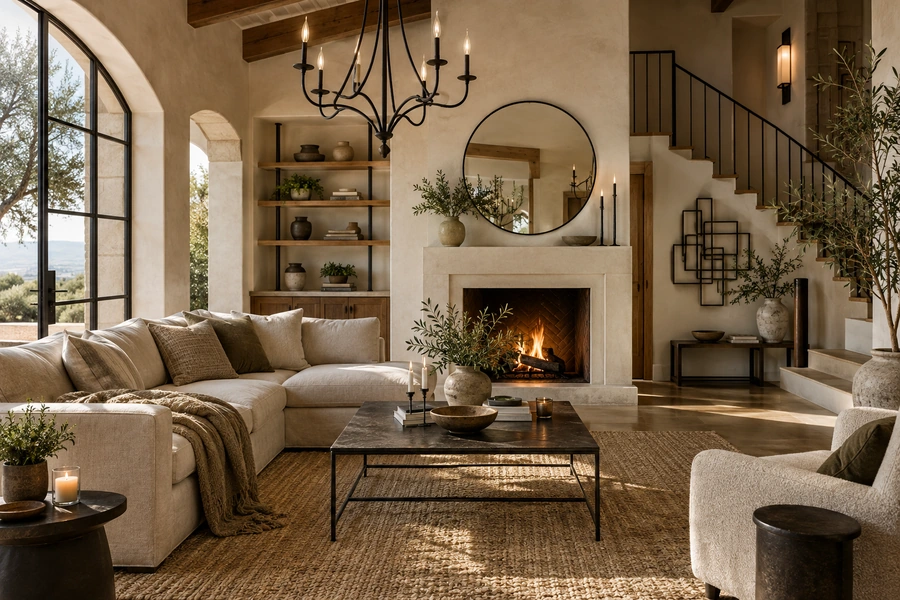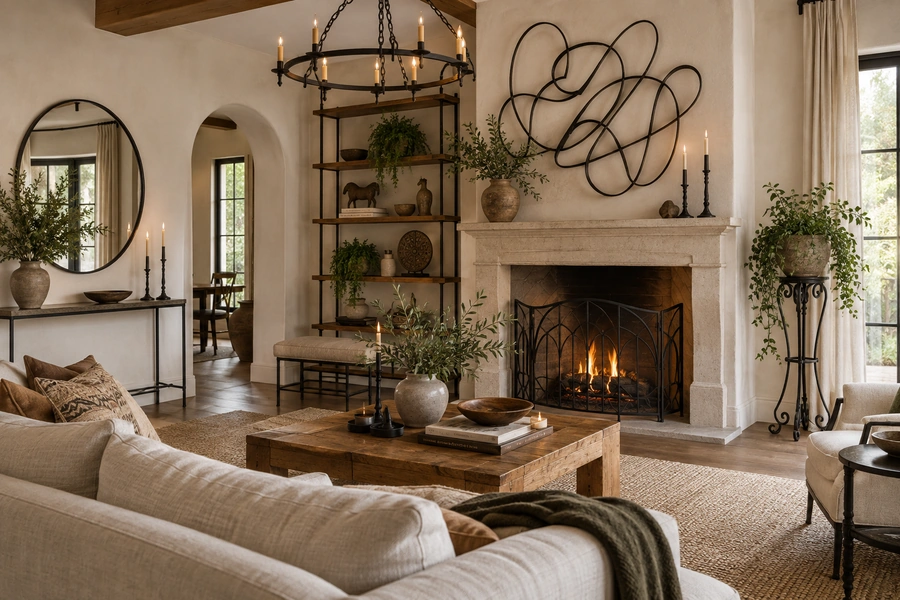

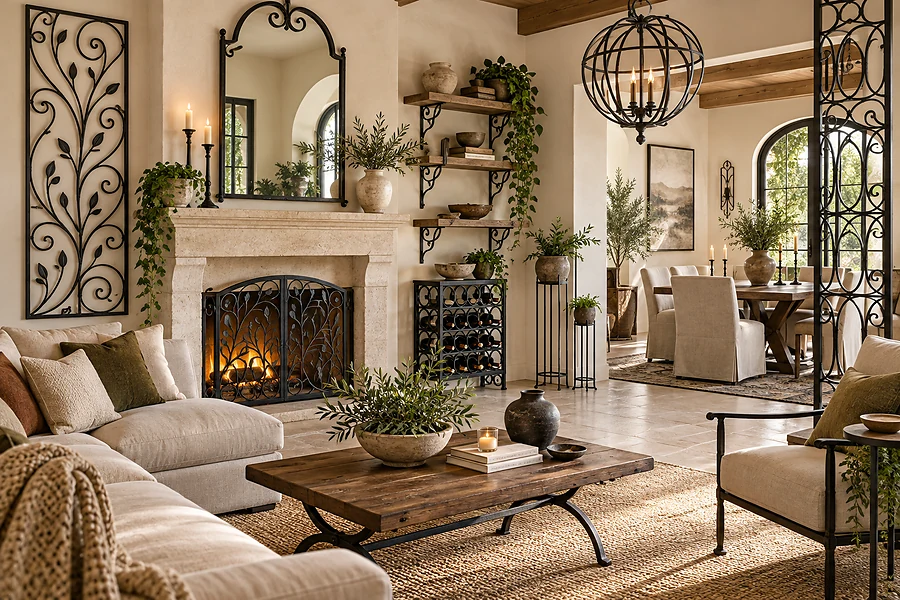
A room filled only with smooth furniture, pale walls, and predictable accessories can feel flat. Wrought iron adds shadow, structure, craftsmanship, and a sense of history.
Unique wrought iron décor ideas include sculptural wall grilles, forged pendant lights, fireplace screens, plant stands, architectural salvage, open shelving brackets, mirrors, wine racks, candle displays, custom furniture bases, decorative room dividers, and iron artwork. For a current look, use fewer statement pieces and combine iron with warm wood, stone, linen, plaster, ceramic, and glass.
Wrought iron works particularly well when it has a purpose. Current iron décor collections extend far beyond traditional scrollwork to lighting, mirrors, wall sculpture, storage, furniture, candle holders, brackets, fireplace accessories, and functional architectural accents.
Is Wrought Iron Décor Still in Style?
Wrought iron remains relevant, but the most current interiors use it differently from the heavy Mediterranean and Tuscan schemes popular in previous decades.
Yes, wrought iron décor is still in style. In 2026, the stronger approach is slimmer, sculptural, handcrafted, and selectively aged rather than filling a room with matching black scrollwork. One statement light, railing, grille, or furniture base paired with warm natural materials can give a room character without making it feel themed or outdated.
Why Iron Fits Current Interiors
Recent design coverage is moving away from generic minimalism toward rooms that feel collected, layered, personal, and rich in material character. Better Homes & Gardens’ current fall 2026 trend reporting highlights curated spaces, vintage influence, warmth, and dimensionality.
Iron fits that direction because it can provide:
- Handmade texture
- Architectural lines
- Dark contrast
- Historical reference
- Visible craftsmanship
- Three-dimensional shadow
Architectural Digest’s 2026 Paris apartment feature shows a wrought-iron pendant used alongside contemporary furniture, tapestry, resin, brass, and other expressive materials. The iron does not make the room old-fashioned; it adds another crafted layer.
1. Use a Sculptural Iron Wall Grille Instead of Framed Art
One of the most distinctive ideas is to treat decorative ironwork as wall sculpture.
A large open grille can work:
- Above a console
- Above a fireplace
- At the end of a hallway
- Between tall windows
- Over a sideboard
Open iron creates shadows as light moves through the day, so it behaves differently from a flat print.
Current wrought-iron wall décor sources include abstract patterns, botanical forms, scrollwork, architectural grilles, monograms, and geometric designs.
For a modern room, I would choose a relatively simple geometric or botanical structure rather than extremely dense ornament.
2. Turn Salvaged Ironwork Into Art
Old railings, balcony panels, gates, window grilles, and architectural fragments can become unique indoor décor.
A salvaged iron panel can become:
- Oversized wall art
- A headboard accent
- Decorative insert behind a console
- Room-divider panel
- Garden-wall feature
Current architectural-salvage guidance specifically recommends old wrought- or cast-iron railings as wall art and ornate metal corbels as functional shelf brackets.
This is particularly effective because the piece already contains:
- Patina
- Wear
- Handmade irregularity
- Historical character
Those qualities are difficult to reproduce convincingly in mass-market décor.
3. Install a Forged Statement Pendant
Lighting is one of the strongest ways to use iron because it operates both as sculpture and function.
Try a:
- Linear forged pendant
- Candelabra chandelier
- Minimal iron ring
- Branch-like fixture
- Lantern-inspired pendant
over a dining table or kitchen island.
Current iron décor retailers continue to feature chandeliers and sconces as core decorative categories, and Architectural Digest’s Paris project demonstrates how workshop-made iron lighting can sit comfortably in a sophisticated contemporary interior.
4. Create an Iron-and-Stone Console
Instead of buying an all-metal table, use iron as the structural base.
Combine:
slim forged iron base + limestone
or
iron base + travertine
or
iron base + warm oak
Artistic Iron Works currently highlights iron furniture combined with wood, glass, or tile, showing how the metal functions effectively as structure rather than the entire visual surface.
This combination feels lighter because the horizontal surface adds warmth.
Traditional vs Current Wrought Iron
| More Current | More Likely to Feel Dated |
|---|---|
| One sculptural grille | Many matching scroll pieces |
| Slim iron profiles | Thick heavy frames |
| Aged or matte finish | Uniform glossy black |
| Iron + oak | Iron + dark matching furniture |
| Iron + stone | Faux Tuscan surfaces |
| Salvaged architectural piece | Generic mass-produced ornament |
| Geometric curves | Dense repetitive vines |
| Functional décor | Decorative clutter |
How Can You Decorate With Wrought Iron Without Making a Room Look Heavy?
Iron becomes visually heavy when too many dark objects compete in the same room. The solution is contrast, negative space, and careful scale.
Keep wrought iron décor light by choosing one dominant iron piece, repeating the finish only through smaller details, and surrounding it with pale walls, warm wood, stone, linen, glass, ceramics, or greenery. Open-frame iron designs also feel lighter than solid metal furniture because the eye can see through them.
5. Use Open Iron Shelving Brackets
Decorative brackets are one of the simplest unique additions.
Combine:
forged brackets + thick oak shelf
for:
- Kitchen storage
- Library shelves
- Bathroom shelves
- Entry displays
Current iron décor collections include brackets and storage elements precisely because functional iron can provide decoration without adding another purely ornamental object.
The visual balance works because:
iron = line and structure
while
wood = warmth and mass.
6. Add a Fireplace Screen With Personality
A fireplace naturally suits iron.
Instead of a generic rectangular screen, consider:
- Simple forged arches
- Geometric mesh
- Subtle botanical details
- Antique-inspired forms
A screen provides a dark focal point without requiring another furniture piece.
Current iron-home collections continue to treat fireplace accessories as an important functional category, supporting the idea that the strongest iron accents often do a practical job.
7. Use a Tall Iron Plant Stand
A plant stand is useful when you want iron without making the room feel industrial.
Choose a narrow stand carrying:
- Ceramic planter
- Terracotta pot
- Trailing greenery
The contrast between rigid iron and organic foliage softens both materials.
For a more unusual arrangement, cluster three stands at different heights rather than using a matching row.
8. Design a Minimal Iron Room Divider
A custom metal screen can separate:
- Entry from living room
- Dining from kitchen
- Bedroom from dressing area
without building a solid wall.
Use:
- Thin vertical bars
- Gentle arches
- Sparse geometric forms
rather than a fully filled panel.
Because the eye can see through it, the iron becomes architectural rather than visually bulky.
Use the 70/20/10 Balance
A simple styling formula is:
70% soft or natural materials
such as plaster, linen, wood, stone.
20% secondary texture
such as ceramic, glass, leather.
10% dark iron accents
The exact numbers are not rules. The concept is simply to let iron create contrast rather than dominate every surface.
Give Iron Space
Handcrafted iron benefits from negative space.
Current artisan-wall-art guidance recommends allowing ironwork to breathe visually instead of surrounding it with excessive accessories.
If you have one large iron grille above a console, you probably do not also need:
- Three iron candleholders
- Iron lamp
- Iron picture frame
- Iron clock
on the same surface.
What Rooms Work Best With Wrought Iron Décor?
Wrought iron works throughout a home, but different rooms suit different types of pieces.
Dining rooms, entryways, living rooms, kitchens, staircases, bedrooms, bathrooms, patios, and gardens can all use wrought iron successfully. Larger rooms can handle statement lighting or furniture, while smaller spaces usually benefit from mirrors, sconces, hooks, brackets, candleholders, or other open, functional pieces.
9. Entryway: Create an Iron Mirror Moment
An iron-framed mirror is ideal for an entry because the dark outline adds structure without reducing perceived light.
Try:
arched iron mirror + oak console + ceramic lamp
or
round forged mirror + limestone shelf
The mirror reflects light while the frame provides the iron accent.
10. Dining Room: Use Iron Candle Architecture
Instead of many small candlesticks, try one dramatic centerpiece:
- Long forged candelabra
- Sculptural candle tree
- Iron taper holder with asymmetric arms
Current specialty iron décor collections continue to feature candleholders and lighting because firelight emphasizes metal texture particularly well.
Keep the dining table itself relatively simple.
11. Kitchen: Turn Storage Into Decoration
Iron works particularly well in kitchens because it can solve practical problems.
Use:
- Pot rack
- Mug rail
- Wine rack
- Shelf brackets
- Hooks
- Cabinet pulls
Artistic Iron Works specifically identifies pot racks, wine racks, cabinet hardware, door hardware, furniture, and lighting as common wrought-iron home applications.
This is more convincing than adding ornamental iron objects to a kitchen with no purpose.
12. Bedroom: Try an Iron Architectural Headboard
Instead of buying a complete traditional iron bed, consider a custom wall-mounted iron panel behind an upholstered bed.
This gives you:
- Architectural curves
- Dark contrast
- Old-world reference
without surrounding the mattress with metal.
Another option is to repurpose an antique iron grille as a decorative headboard element.
Living Room
Strong choices include:
- Fireplace screen
- Sculptural wall grille
- Iron coffee-table base
- Floor lamp
- Antique iron object
I would usually choose only one or two.
Bathroom
Smaller details are safer:
- Iron mirror
- Hooks
- Shelf brackets
- Towel hardware
Because bathrooms can be humid, protective finishes and corrosion resistance matter.
Staircase
A railing is enough to become the main iron feature.
If you already have wrought or ornamental iron balusters, you may not need additional iron décor nearby.
Let the architecture lead.
Patio
A vintage-style wrought-iron bistro set can provide strong character in a compact exterior space. Architectural Digest has specifically suggested small vintage wrought-iron bistro sets for porches where space is limited.
Best Idea by Room
| Room | Unique Iron Accent |
|---|---|
| Entry | Oversized iron mirror |
| Living room | Sculptural wall grille |
| Dining room | Forged chandelier |
| Kitchen | Iron pot rack |
| Bedroom | Salvaged headboard panel |
| Bathroom | Forged shelf brackets |
| Staircase | Custom railing |
| Home bar | Sculptural wine rack |
| Patio | Vintage bistro set |
| Garden | Iron trellis or sculpture |
Can Wrought Iron Be Mixed With Modern Décor?
Yes. Contrast between old-world metalwork and clean contemporary surfaces is one of the most interesting ways to use iron today.
Wrought iron mixes well with modern décor when the room contains clean shapes and only a few historic or handcrafted accents. Pair a forged iron pendant, salvaged grille, sculptural chair, or console base with modern upholstery, natural stone, contemporary art, and pale walls. Avoid making every object ornate; one historical-looking piece creates stronger contrast than a full matching collection.
Mix Iron With Contemporary Art
An antique iron console can look unexpectedly current beneath a large abstract painting.
The contrast is:
old material + new artwork
rather than:
old object + old object + old object.
This prevents the room becoming period-themed.
Mix Iron With Glass
Glass reduces visual weight.
A glass-topped iron table gives you:
- Visible forged base
- Minimal surface mass
- Contemporary transparency
This works particularly well in:
- Small dining rooms
- Entryways
- Apartments
Mix Iron With Natural Stone
Stone and iron share a sense of permanence but have very different textures.
Good combinations include:
- Iron + travertine
- Iron + limestone
- Iron + marble
- Iron + slate
Current 2026 trend coverage also points to renewed interest in natural finishes and tactile materials, making this pairing particularly compatible with present interiors.
Mix Iron With Soft Upholstery
Pair a black iron side table with:
- Bouclé chair
- Linen sofa
- Wool rug
Soft fabrics prevent the room feeling overly architectural.
Add Warm Metals
Wrought iron does not mean every metal in the room must be black.
Try:
iron + aged brass
or
iron + bronze
in different scales.
For example:
- Iron chandelier
- Brass picture lights
- Bronze cabinet hardware
The variation creates a collected appearance rather than a matching showroom.
Use Iron as a Line, Not a Block
This is especially useful in contemporary interiors.
Choose:
- Narrow frames
- Open legs
- Thin bars
- Sparse grids
instead of large solid surfaces.
The iron acts almost like a drawing inside the room.
Keep the Color Palette Warm
Dark metal is easier to live with when the surrounding palette includes:
- Cream
- Warm white
- Oatmeal
- Sand
- Terracotta
- Muted green
- Natural wood
Current 2026 décor trends are leaning toward warmth, personalization, and richer natural finishes rather than stark, uniform minimalism.
My Insights: What Are the Best Unique Wrought Iron Décor Ideas
The most distinctive wrought iron décor does not come from adding more ornamental metal. It comes from using iron in unexpected ways that combine function, craftsmanship, architecture, and contrast.
The best unique wrought iron décor ideas include salvaged railing wall art, custom room dividers, forged sculptural lighting, iron-and-stone furniture, architectural headboards, unusual plant stands, artistic fireplace screens, open shelving brackets, sculptural wine storage, and handmade mirrors. Use one major iron feature per visual zone and pair it with warmer natural materials.
My First Insight: Architectural Salvage Is More Unique Than Store-Bought Wall Décor
If uniqueness is the goal, reclaimed iron is difficult to beat.
An antique:
- Balcony section
- Gate
- Window grille
- Railing panel
already contains a history and surface that mass-produced décor cannot duplicate.
Current salvage guidance explicitly supports turning iron railings and architectural fragments into focal wall décor.
My Second Insight: Functional Iron Has More Staying Power
I would prioritize:
- Lighting
- Furniture bases
- Railings
- Screens
- Brackets
- Storage
- Mirrors
before buying purely decorative novelty pieces.
An iron wine rack still has value when décor trends change.
A custom bracket remains useful.
That usually makes functional iron feel more timeless.
My Third Insight: Iron Looks Most Expensive When It Is Not Everywhere
A single forged pendant can look bespoke.
Five matching iron objects can make the room feel catalogued.
Current iron retailers themselves describe their collections in terms of a “collected” rather than strictly matching aesthetic.
Repeat the finish lightly.
Do not repeat the exact motif.
My Fourth Insight: Light and Shadow Are Part of the Decoration
Open iron has an advantage that solid décor does not.
It casts shadows.
Use directional warm lighting around:
- Wall grilles
- Sculptures
- Railings
to create changing patterns on the wall.
Current handcrafted wall-art guidance specifically recommends side or warm accent lighting to emphasize wrought iron’s curves and cut-outs.
My Fifth Insight: Use Old-World Forms in Modern Geometry
You do not need to abandon curves.
Instead, simplify them.
Try:
- One oversized arch
- Gentle botanical curve
- Sparse scroll
- Asymmetric forged line
rather than hundreds of repeating ornamental loops.
This preserves the craft without recreating a themed historical interior.
My Sixth Insight: Custom Iron Can Solve Awkward Spaces
Some of the best iron décor can be designed for places where standard furniture does not fit.
Examples:
- Narrow console for a hallway
- Custom screen around stairs
- Corner shelf supports
- Odd-width wine rack
- Bespoke fireplace tools
- Small sculptural pedestal
Iron fabrication allows unusual dimensions while keeping the object visually light.
My Seventh Insight: A Large Piece Can Create Less Clutter Than Many Small Pieces
One 5-foot iron wall sculpture may actually make a room feel calmer than eight small framed objects.
Because open iron contains negative space, it can occupy a large wall without appearing visually solid.
That is particularly useful for:
- Tall entries
- Staircases
- Double-height rooms
My Eighth Insight: Combine Iron With Organic Materials
My favorite formula is:
iron + oak + limestone + linen + greenery
Each material solves a weakness of another.
Iron adds definition.
Wood adds warmth.
Stone adds visual permanence.
Linen softens the room.
Greenery adds organic shape.
My Ninth Insight: Do Not Assume Every “Wrought Iron” Product Is Historically Wrought Iron
In modern retail, the phrase is often used broadly for decorative ironwork or steel shaped in a wrought style.
If you are buying:
- Antiques
- Historic pieces
- Expensive artisan work
- Restoration materials
ask what the actual metal is.
For ordinary home styling, craftsmanship and finish may matter more than historical metallurgy.
My Tenth Insight: My Best 12 Unique Wrought Iron Décor Ideas
If I were creating a shortlist, I would use:
- Salvaged railing as wall sculpture
- Custom openwork room divider
- Forged branch-style pendant
- Iron-and-limestone console
- Architectural grille headboard
- Asymmetric candle sculpture
- Three-height iron plant stand
- Custom fireplace screen
- Forged oak shelf brackets
- Sculptural wine rack
- Oversized arched iron mirror
- Vintage iron bistro set indoors or on a porch
These ideas range from architectural to decorative, which keeps the material from feeling repetitive.
My Preferred Styling Formula
For one room, I would start with:
1 major iron statement
such as a chandelier or grille,
then add:
1 subtle iron echo
such as hardware or a bracket,
and balance everything with:
wood + stone + soft textile + empty space.
For example:
**forged pendant
- tiny black cabinet pulls
- oak table
- limestone vase
- linen curtains**
The iron becomes the punctuation instead of the entire sentence.
My Final Answer
Unique wrought iron décor works best when it feels crafted, functional, and slightly unexpected.
Rather than filling a home with conventional scrollwork, consider:
- Architectural salvage
- Sculptural lighting
- Open room screens
- Iron-and-stone furniture
- Wall grilles
- Fireplace screens
- Plant stands
- Unusual storage
- Oversized mirrors
- Handmade brackets
Current 2026 interiors are increasingly embracing personality, texture, vintage influence, and collected character, making iron particularly useful when it is paired with warmer, softer, more natural materials.
The goal is not to make the home look like an iron showroom.
It is to choose one piece whose line, shadow, texture, or craftsmanship changes the way the room feels.
Conclusion
Use wrought iron as sculpture, architecture, or functional décor. One distinctive forged piece paired with wood, stone, linen, and open space usually feels more original than a matching collection.