

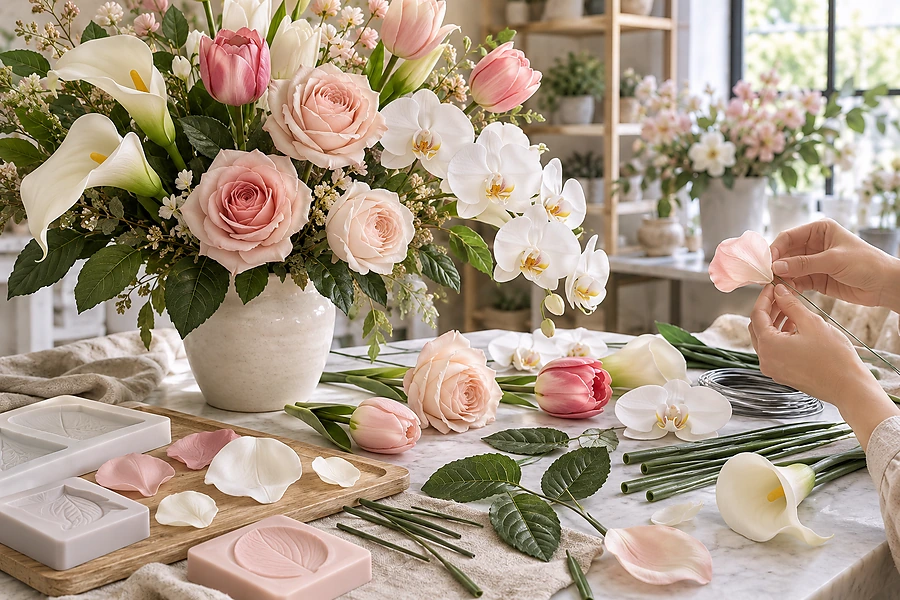
Real Touch flowers feel remarkably natural, but the name can be confusing because it does not identify one standardized material or manufacturing formula.
Real Touch flowers are usually made from polyurethane (PU), latex or synthetic rubber, silicone, polymer-coated synthetic fabric, and other plastics. Their stems and leaves may also contain plastic and internal metal wire. Manufacturers combine different materials to reproduce the softness, flexibility, veins, weight, and surface texture of specific fresh flowers.
The important point is that “Real Touch” describes a tactile and visual effect more than a precise chemical composition. A Real Touch rose may use fabric petals coated with latex, while a tulip, calla lily, or orchid may use molded polyurethane, silicone, or another polymer formulation.
Are Real Touch Flowers Made of Latex or Polyurethane?
Real Touch flowers can be made from either latex or polyurethane, and some products use silicone or a combination of polymer and fabric instead.
Both latex and polyurethane are common Real Touch materials. Latex-coated fabric is often used when manufacturers want thin, soft petals with a textile structure underneath, while molded polyurethane can create thicker petals with detailed curves and texture. Silicone and other polymers may be selected when a particular flower requires greater flexibility or finer molded detail.
1. Polyurethane
Polyurethane, usually abbreviated as PU, is strongly associated with premium Real Touch artificial flowers.
It can be used to reproduce:
- Softness
- Petal thickness
- Curvature
- Surface texture
- Flexibility
- Veining
Current artificial-flower material guidance identifies PU as particularly useful when tactile realism is important.
A molded PU petal does not need to behave like woven cloth.
Instead, manufacturers can give it:
- A smooth surface
- Rounded edges
- Natural thickness
- Soft resistance when touched
That can make flowers such as:
- Peonies
- Gerberas
- Tulips
- Calla lilies
feel more convincing at close range.
2. Latex or Synthetic Rubber
Latex-style coatings are another major Real Touch construction.
One established Real Touch manufacturer describes a method where petals are cut from synthetic fabric and then coated with liquid latex or synthetic-rubber polymer.
This creates two useful layers:
Fabric base
- Provides shape
- Provides thinness
- Adds textile structure
Polymer coating
- Creates softer touch
- Changes surface feel
- Reduces the obvious fabric appearance
This method is commonly associated with flowers such as:
- Roses
- Peonies
because their petals benefit from being relatively thin while still feeling softer than ordinary polyester fabric.
3. Silicone
Some Real Touch flowers use silicone or silicone-like polymer materials.
Silicone can be useful where a manufacturer needs:
- Fine molded detail
- Flexible petals
- Smooth texture
- Durable molded surfaces
One Real Touch manufacturer lists orchids, hydrangeas, lilies, tulips, calla lilies, and other varieties among flowers that may be produced using silicone-type materials depending on design.
However, there is no universal rule saying:
Orchids are always silicone.
Different factories use different:
- Polymer recipes
- Processes
- Tooling
- Price points
Two products sold as “Real Touch orchid” can therefore have different compositions.
4. Polymer-Coated Synthetic Fabric
Some Real Touch flowers begin with a textile petal.
The underlying fabric today may be:
- Polyester
- Another synthetic textile
- A poly-silk blend
rather than genuine silk.
The fabric can then receive a polymer coating to change the:
- Texture
- Flexibility
- Surface appearance
- Hand feel
Silk by Design describes current Real Touch construction as using materials including latex, poly-silk blends, and polyurethane.
5. Other Plastics
Real Touch manufacturers may also use other polymer families depending on the product.
For example, published manufacturer information has referenced:
- PVC
- PEVA
- Various proprietary polymers
in artificial-flower construction and care instructions.
That is another reason I would not define Real Touch as:
“flowers made from polyurethane.”
A more accurate description is:
premium artificial flowers made with soft polymers or polymer-coated materials designed to imitate fresh flower texture.
Material Comparison
| Material | Typical Role | Main Benefit |
|---|---|---|
| Polyurethane (PU) | Molded petals | Soft, detailed texture |
| Latex/synthetic rubber | Coating or petal material | Natural tactile feel |
| Silicone | Molded petals | Flexibility and fine detail |
| Polyester/synthetic fabric | Petal base | Thin, lightweight structure |
| PVC/other polymers | Selected flowers/components | Shape and durability |
| Plastic | Leaves, centers, stems | Structural detail |
| Metal wire | Internal stems/leaves | Bendability |
The exact combination should be confirmed with the supplier when material composition matters.
What Is the Difference Between Real Touch and Silk Flowers?
The biggest difference is usually the petal construction and tactile experience. Real Touch emphasizes polymer-based softness, while “silk” flowers are generally fabric-based.
Real Touch flowers commonly use polyurethane, latex, silicone, or polymer-coated fabric to create soft, flexible petals that feel closer to fresh flowers. Modern silk flowers are usually made from polyester or similar textiles rather than genuine silk. Silk flowers can look highly realistic, but their petals generally retain a more noticeable fabric texture.
Modern “Silk Flowers” Are Rarely Genuine Silk
This is an important terminology issue.
When people hear:
silk flowers
they may imagine flowers made from natural silk fiber.
In today’s artificial-flower market, “silk” is often a broad category name.
The petals are frequently made from:
- Polyester
- Fabric blends
- Synthetic textiles
Third & Main’s 2026 comparison notes that silk faux flowers are generally fabric-based, with polyester blends particularly common.
How Real Touch Feels Different
Real Touch materials are selected partly because of how they behave under a finger.
They may feel:
- Soft
- Flexible
- Slightly rubbery
- Velvety
- Smooth
- Cool
- Slightly tacky
depending on formulation.
Traditional polyester flowers usually feel more like:
- Fabric
- Textile
- Cloth
That does not automatically make silk flowers worse.
It simply means they solve a different design problem.
Real Touch Is Strong for Close Viewing
Use Real Touch where people will see flowers closely.
Examples include:
- Bridal bouquets
- Boutonnieres
- Corsages
- Dining centerpieces
- Reception desks
- Coffee tables
- Luxury retail displays
A guest may see the flower from only 30 centimeters away.
At that distance:
- Petal thickness
- Edge quality
- Veining
- Surface reflection
become much more noticeable.
Current 2026 comparisons similarly position Real Touch as particularly useful for close-up décor and photography.
Silk Flowers Work Well for Volume
Premium polyester flowers can be excellent for:
- Wedding arches
- Large bouquets
- Hanging flowers
- Backdrops
- Green walls
- Large centerpieces
They are often:
- Lightweight
- Flexible
- Available in many varieties
- Easier to use in very large quantities
A wedding designer may therefore combine:
Real Touch roses + silk hydrangeas
instead of demanding that every single flower be Real Touch.
Real Touch vs Silk
| Feature | Real Touch | “Silk” Flower |
|---|---|---|
| Common petal material | PU, latex, silicone, coated fabric | Polyester/fabric |
| Primary goal | Visual + tactile realism | Visual realism |
| Feel | Soft/polymer-like | Textile-like |
| Close-up use | Excellent | Quality-dependent |
| Large installations | Possible but expensive | Very practical |
| Weight | Often heavier | Usually lighter |
| Variety | More limited | Very broad |
| Cost | Usually higher | Often lower |
| Best use | Bouquets/close décor | Volume and larger displays |
Neither Material Is Automatically Better
A high-quality polyester hydrangea may look better than a poorly produced Real Touch hydrangea.
Material is only one part of realism.
Also inspect:
- Color gradients
- Flower center
- Petal edges
- Leaf quality
- Stem quality
- Botanical proportions
- Assembly
The label alone cannot guarantee quality.
How Are Real Touch Flowers Made?
Manufacturing methods vary, but Real Touch flowers generally use either coated textile petals or molded polymer petals that are assembled around artificial centers, leaves, and wired stems.
Real Touch flowers are typically made by molding polyurethane, latex, silicone, or another polymer into petal shapes, or by cutting synthetic fabric petals and coating them with a soft polymer. Petals are colored, textured, shaped, and assembled into flower heads, while plastic components and wired stems provide botanical structure and allow reshaping.
Method 1: Coated Fabric Petals
The process may begin with synthetic textile material.
A simplified sequence is:
- Produce or select the fabric.
- Cut petal shapes.
- Add color.
- Apply liquid polymer.
- Shape the petal.
- Assemble petals into the flower head.
- Attach center and stem components.
An established Real Touch manufacturer describes roses and peonies being produced using synthetic-fabric petals combined with a latex-style coating.
The advantage is that manufacturers can maintain:
- Thin petals
- Flexible movement
- Textile detail
while improving the surface feel.
Method 2: Molded Polymer Petals
Other Real Touch flowers use molded construction.
A mold can reproduce features such as:
- Veins
- Ridges
- Curves
- Wrinkles
- Petal edges
Polyurethane or silicone-type material is placed into specialized molds and cured into shape.
This approach is particularly effective when the natural flower has:
- Thick petals
- Strong surface detail
- A recognizable three-dimensional form
Color Is Critical
A realistic material can still produce an unrealistic flower if the color is wrong.
Fresh petals rarely contain one completely uniform color.
A convincing flower may combine:
- Darker centers
- Lighter edges
- Tiny veins
- Soft transitions
- Multiple petal shades
Manufacturers can add color through different combinations of:
- Pigment in the polymer
- Printing
- Dye
- Spray coloring
- Hand finishing
The exact process differs among factories.
The Flower Center Matters Too
A realistic rose may depend mainly on petals.
An orchid or lily also requires convincing:
- Stamens
- Pistils
- Pollen-like details
- Throat coloring
These parts may be manufactured from:
- Plastic
- Polyurethane
- Other polymers
One materials guide notes that pistils are commonly made from PU or plastic.
Leaves Use Different Materials
A manufacturer does not necessarily use the same material for:
- Flower petals
- Leaves
- Stem
Leaves may use:
- Fabric
- Thin molded plastic
- PE
- PU
depending on the species.
A rose leaf needs a different appearance from a tulip leaf.
Wired Construction Allows Reshaping
Artificial flowers need to survive:
- Packaging
- Shipping
- Storage
- Bouquet construction
Many therefore contain internal wire.
Current Real Touch care documentation specifically warns that Real Touch flowers and plants may contain metal wire inside stems and leaves.
This enables florists to:
- Bend stems
- Open leaves
- Adjust flower angles
after shipping.
Why Different Flowers Need Different Materials
This is one of the most useful insights about Real Touch production.
A rose petal is:
- Thin
- Layered
- Soft
A calla lily is:
- Smooth
- Thick
- Sculptural
An orchid has:
- Fine molded structures
- Complex petal geometry
One material formula will not reproduce every flower equally well.
That is why manufacturers mix different materials across product lines.
Do Real Touch Flowers Contain Plastic or Metal?
Many do. Even when the petals are made from soft polymers, other parts of the artificial flower commonly use plastic and metal for structure.
Yes, Real Touch flowers can contain plastic and metal. Plastic or polymer components are commonly used for stems, leaves, flower centers, and connecting parts, while flexible metal wire may run inside stems or leaves so they hold a realistic position. Material composition varies by product, so buyers with specific requirements should request a component or material specification.
A Real Touch Flower Is Usually a Multi-Material Product
Think of a typical faux rose as several components:
Petals
- Latex-coated fabric
- PU
- Silicone
- Another polymer
Flower center
- Plastic
- PU
Leaves
- Fabric
- Molded plastic
- Polymer
Stem
- Plastic coating
- Internal metal wire
Assembly
- Adhesives
- Mechanical connectors
The finished flower can therefore contain several material families.
Why Metal Wire Is Used
Wire solves one major artificial-flower problem:
positioning.
Without wire, stems may be too rigid or return to their manufactured shape.
Internal wire lets designers:
- Angle a rose head
- Curve a tulip stem
- Bend a leaf
- Spread branches
This is especially useful for:
- Wedding bouquets
- Centerpieces
- Commercial installations
Cutting Wired Stems Requires Care
Do not treat an artificial stem like an ordinary fresh stem.
Real Touch’s care documentation warns that metal wire inside stems can cause cuts during handling.
Use an appropriate:
- Wire cutter
- Heavy-duty floral cutter
rather than lightweight household scissors.
Does “Latex Flower” Mean It Is Latex-Free Elsewhere?
No.
Similarly, a product described as:
- PU rose
- Silicone orchid
- Real Touch tulip
does not necessarily describe every component.
The flower may still contain:
- Plastic stem parts
- Adhesive
- Metal wire
- Textile leaves
If composition matters for:
- Allergies
- Recycling
- Commercial specification
- Import documentation
ask the manufacturer for a full material breakdown.
Are Real Touch Flowers Recyclable?
Mixed construction can make recycling difficult.
A single stem may combine:
- Polymer
- Textile
- Wire
- Adhesive
which are not necessarily easy to separate.
For that reason, one of the strongest sustainability strategies with quality faux flowers is to:
- Buy durable products
- Reuse them
- Store them properly
- Replace individual damaged stems
- Avoid disposable one-event use when possible
Material Breakdown Example
| Flower Component | Possible Material |
|---|---|
| Petal | PU, latex, silicone, coated textile |
| Leaf | Polyester, PE, PU, plastic |
| Flower center | PU or molded plastic |
| Stem exterior | Plastic/polymer |
| Stem interior | Metal wire |
| Assembly | Adhesive/connectors |
This is only a general construction model.
Individual products differ.
My Insights: What Are Real Touch Flowers Made Of?
The clearest way to understand Real Touch flowers is to stop treating “Real Touch” as the name of a raw material. It is better understood as a performance category.
Real Touch flowers are usually made from combinations of polyurethane, latex or synthetic rubber, silicone, polymer-coated synthetic fabric, plastic, adhesives, and internal wire. There is no single standardized Real Touch composition. Manufacturers select different materials for different flowers because roses, tulips, orchids, lilies, and peonies require different softness, thickness, flexibility, and surface detail.
My First Insight: “Real Touch” Is a Result, Not a Chemical
This is the most important distinction.
The term tells the buyer that the flower is intended to:
- Look realistic
- Feel realistic
It does not necessarily tell the buyer whether the petal is:
- PU
- Latex
- Silicone
- Coated polyester
Two factories can both sell Real Touch peonies using different material systems.
My Second Insight: Ask for Material, Not Marketing Language
For wholesale buying, I would ask:
What is the petal material?
Then separately:
What are the leaf, stem, and coating materials?
That produces better information than asking:
Is this Real Touch?
My Third Insight: PU Is Common but Not Universal
Polyurethane appears repeatedly in current Real Touch descriptions and is particularly associated with premium tactile petals.
But defining all Real Touch flowers as PU is inaccurate.
Latex, silicone, coated fabric, and other polymers also appear in the category.
My Fourth Insight: Latex-Coated Fabric Can Be Excellent for Thin Petals
Fabric is not automatically inferior.
For a rose or peony, a synthetic textile core plus a flexible polymer layer can create:
- Thinness
- Texture
- Softness
that is difficult to reproduce using a thick molded petal.
The manufacturing method should match the flower.
My Fifth Insight: Molded Polymers Are Strong for Sculptural Flowers
Flowers such as:
- Tulips
- Calla lilies
- Orchids
can benefit from molded construction because their petals have distinctive:
- Curves
- Thickness
- Surface detail
This is where PU or silicone-style materials can perform well.
My Sixth Insight: “Silk” Is Also a Marketing Term
This creates confusion on both sides of the comparison.
Real Touch is not one material.
Silk flowers are often not made from genuine silk.
Modern premium artificial flowers may therefore be better described by their actual material construction:
- PU
- Latex-coated polyester
- Molded PE
- Polyester fabric
rather than by traditional retail category names alone.
My Seventh Insight: Check the Whole Stem
A supplier may advertise:
PU Real Touch rose.
That might describe only the bloom.
For commercial specifications, also inspect:
- Leaf realism
- Stem coating
- Internal wire
- Flower center
- Adhesive quality
A realistic flower head on an obviously plastic stem still looks artificial.
My Eighth Insight: The Best Material Depends on Viewing Distance
For a bridal bouquet viewed close up, tactile realism matters.
I would prioritize:
- PU
- Latex-coated premium petals
- Other high-quality Real Touch systems
For a floral ceiling installation viewed from five meters away, lightweight premium polyester may provide better value.
Material should match the job.
My Ninth Insight: Hybrid Arrangements Often Make More Sense
Premium arrangements do not need every flower to use the same construction.
A wedding centerpiece might combine:
Real Touch
- Roses
- Tulips
with
Premium textile
- Hydrangeas
- Filler flowers
and
Molded greenery
- Eucalyptus
- Leaves
This can provide realism without pushing every stem into the highest price category.
My Tenth Insight: Material Information Matters for Care
Different materials can require different cleaning methods.
For example, Real Touch’s own care documentation gives different cleaning methods for:
- Polyurethane
- Latex-coated textile
- PEVA
- PVC
and confirms that wired stems may be present.
That means buyers should not assume all Real Touch flowers can be:
- Washed
- Soaked
- Sprayed
- Cleaned identically
The material determines the care.
Real Touch Material Quick Guide
| Material | Why Manufacturers Use It |
|---|---|
| PU | Softness and molded petal detail |
| Latex/synthetic rubber | Flexible realistic coating |
| Silicone | Fine molded shape and flexibility |
| Polyester/synthetic fabric | Thin petal structure |
| PE/PVC/other plastics | Leaves and structural components |
| Metal wire | Bendable stems and leaves |
| Adhesive | Assembly |
My Buying Checklist
Before purchasing premium Real Touch flowers in bulk, ask:
- What material are the petals?
- Are they molded or fabric-based?
- Is there a latex coating?
- What are the leaves made from?
- Does the stem contain wire?
- Is the product intended for indoor or outdoor use?
- What cleaning method does the manufacturer recommend?
- Can dark colors transfer?
- Is the material UV-treated?
- Can the supplier provide a material specification?
These questions are particularly useful when buying for:
- Weddings
- Hotels
- Retail
- Wholesale
- Long-term commercial installations
My Final Answer
So, what are Real Touch flowers made of?
There is no single answer such as “silicone” or “polyurethane.”
The category commonly uses:
- Polyurethane (PU)
- Latex or synthetic rubber
- Silicone
- Polymer-coated synthetic fabric
- Polyester
- Other molded plastics
- Metal wire
- Adhesives
The precise combination depends on the flower and manufacturer.
For consumers, the label Real Touch mainly tells you what the manufacturer wants the flower to achieve: a more realistic visual and tactile experience.
For professional and wholesale buyers, the label is only the beginning.
Always ask for the actual material specification.
Conclusion
Real Touch flowers use PU, latex, silicone, coated fabrics, plastics, and wire in different combinations. “Real Touch” describes lifelike performance, not one standardized material.