
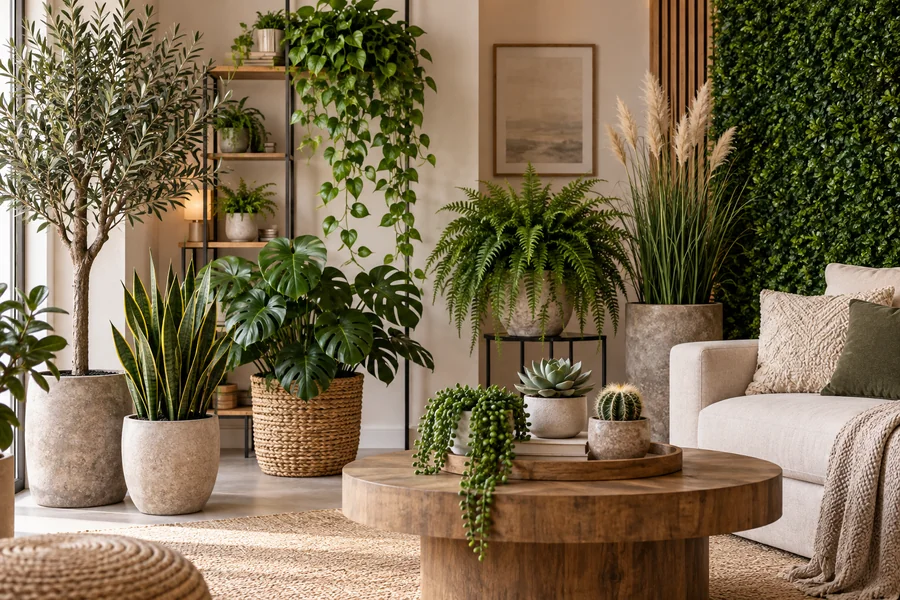
Artificial plants now range from tiny desk succulents to large olive trees, hanging vines, privacy hedges, green walls, and commercial installations, so choosing the right type starts with understanding its form.
Common types of artificial plants include potted foliage, artificial trees, palms, succulents, cacti, hanging vines, ferns, grasses, topiary, hedges, green walls, and outdoor UV-resistant greenery. Popular species include monstera, snake plant, pothos, olive tree, fiddle-leaf fig, eucalyptus, bird of paradise, agave, and artificial palms.
Artificial plants include trees, palms, succulents, cacti, vines, ferns, grasses, hedges, and green walls. Choose by size, shape, realism, placement, durability, and design purpose needs.
What Are the Most Common Types of Artificial Plants?
Artificial greenery can be classified by its physical form and how it functions in the room.
The most common artificial plant categories are potted plants, faux trees, palms, succulents, cacti, hanging plants, ferns, ornamental grasses, topiary, hedges, artificial green walls, and outdoor artificial greenery. Each type solves a different design problem, from filling a tabletop to creating a full commercial privacy screen.
1. Artificial Potted Plants
Potted faux plants are probably the most familiar category.
They range from tiny shelf plants to substantial floor plants.
Popular examples include:
- Monstera
- Snake plant
- ZZ plant
- Philodendron
- Calathea
- Dracaena
- Rubber plant
These work particularly well in:
- Living rooms
- Bedrooms
- Offices
- Reception areas
- Guest rooms
The advantage is simplicity.
The plant usually arrives already secured in a basic container, so it can either be displayed immediately or dropped into a larger decorative planter.
For the most convincing result, avoid leaving a large artificial plant in a tiny transport pot.
A substantial outer planter makes the scale feel more believable.
2. Artificial Trees
Artificial trees are designed to create vertical scale.
Popular types include:
- Olive tree
- Fiddle-leaf fig
- Ficus
- Eucalyptus
- Bamboo
- Artificial citrus trees
TidyPlant categorizes branching faux trees as vertical focal pieces that give a room height and an architectural anchor.
They work well:
- Beside sofas
- In empty corners
- Near entry consoles
- Behind desks
- In hotel lobbies
Artificial trees are often stronger visually than several tiny faux plants because one large canopy can anchor the entire room.
3. Artificial Palm Plants
Palms create a softer and more tropical silhouette.
Common artificial palms include:
- Areca palm
- Kentia palm
- Golden cane palm
- Fan palm
Architectural Digest’s current artificial-plant recommendations include a golden cane palm as a versatile faux greenery option.
Palms suit:
- Large living rooms
- Hospitality lounges
- Resort-style interiors
- Restaurants
- Covered patios where the product is suitable
Their long fronds require enough horizontal space.
A large artificial palm squeezed into a narrow corner often looks less natural because real palm fronds need room to spread.
4. Artificial Succulents
Artificial succulents are particularly common for small spaces.
Examples include:
- Echeveria
- Haworthia
- Aloe
- Sedum
- Aeonium
Their compact structure makes them useful for:
- Desks
- Coffee tables
- Bookshelves
- Bathrooms
- Reception counters
TidyPlant identifies rosette-shaped succulents as one of the major faux botanical forms, while Architectural Digest currently includes artificial succulents among its recommended fake plants.
Succulents can translate especially well into artificial materials because many real succulents already have:
- Thick leaves
- Waxy surfaces
- Structured shapes
That makes a good replica less visually surprising.
5. Artificial Cacti
Artificial cacti offer a strong sculptural form without requiring fine foliage.
Popular types mimic:
- Saguaro
- Prickly pear
- Column cactus
- Barrel cactus
Architectural Digest includes a large faux cactus among its current recommended artificial plants.
Cacti work especially well in:
- Southwestern interiors
- Minimalist rooms
- Modern offices
- Desert-inspired décor
Their simple shape means realism depends heavily on:
- Surface texture
- Spine detail
- Color variation
- Planter quality
A very glossy cactus can look obviously plastic.
6. Artificial Hanging Plants and Vines
Trailing greenery is designed to move downward rather than upward.
Common varieties include:
- Pothos
- Philodendron
- Ivy
- Tradescantia-style vines
- String plants
Architectural Digest currently recommends faux pothos specifically for high shelves and windowsills because of its draping form.
Artificial trailing plants are particularly useful for:
- High shelves
- Cabinets
- Hanging baskets
- Tall bookcases
- Difficult-to-water locations
This is one of the most practical faux categories because a real plant placed very high can be inconvenient to water and inspect.
7. Artificial Ferns
Common faux ferns include:
- Boston fern
- Maidenhair fern
- Sword fern
Architectural Digest’s current recommendations include an artificial Boston fern hanging basket.
Ferns create:
- Volume
- Fine texture
- Soft movement
They work well in:
- Hanging baskets
- Covered porches
- Plant stands
- Hospitality spaces
Their downside is maintenance.
Fine artificial fronds contain many surfaces where dust can settle.
For locations that are difficult to clean, broader-leaf faux plants may be easier.
8. Artificial Grasses
Artificial grasses provide fine vertical texture.
Examples include:
- Pampas-style grass
- Reed grass
- Fountain-grass styles
- Ornamental grass bunches
They work well in:
- Tall planters
- Entry areas
- Restaurants
- Modern commercial spaces
- Minimalist interiors
Artificial grass-style arrangements can help soften a room without creating the visual weight of a large tree.
They also work well where the décor needs vertical movement but not a heavy canopy.
9. Artificial Topiary
Topiary is deliberately shaped greenery.
Common forms include:
- Balls
- Cones
- Spirals
- Boxwood standards
These are particularly useful for:
- Entrances
- Hotels
- Restaurants
- Formal gardens
- Event spaces
Unlike faux olive or ficus trees, topiary does not need irregularity to look believable.
Its entire design language is controlled shaping.
However, overly glossy foliage can still make a faux topiary look inexpensive.
10. Artificial Hedges and Privacy Screens
Artificial hedges operate more like architectural greenery than individual plants.
They can be used for:
- Privacy screening
- Event partitions
- Restaurant terraces
- Balcony barriers
- Commercial zoning
Common styles mimic:
- Boxwood
- Ivy
- Mixed foliage
This category needs attention to:
- Panel joins
- Attachment systems
- Fire requirements where applicable
- Outdoor suitability
- UV exposure
A hedge used outdoors should not be assumed weather-resistant simply because it is made from plastic.
11. Artificial Green Walls
Green walls combine many artificial foliage pieces into a large vertical surface.
They can be used for:
- Offices
- Hotels
- Restaurants
- Retail stores
- Event backdrops
- Reception areas
Artificial green walls can include:
- Ferns
- Pothos
- Monstera
- Ivy
- Small flowers
- Mixed tropical leaves
They create a much stronger visual statement than one potted plant.
They also require more planning around:
- Dust cleaning
- Fire requirements
- Mounting
- Replacement modules
- Access
For commercial use, removable panels can make maintenance easier.
12. Outdoor UV-Resistant Artificial Plants
Outdoor artificial greenery is a functional category rather than one plant species.
It may include:
- Boxwood
- Ferns
- Palms
- Flowers
- Hedges
- Topiary
- Artificial trees
Outdoor products should be selected specifically for their intended exposure.
The term “UV-resistant” should not be interpreted as permanently fade-proof.
Outdoor lifespan depends on:
- Direct sunlight
- Heat
- Rain
- Wind
- Color
- Material
- Placement
Common Types at a Glance
| Type | Common Examples | Best Use |
|---|---|---|
| Potted plant | Monstera, snake plant | General interiors |
| Artificial tree | Olive, ficus | Large corners |
| Palm | Areca, Kentia | Hospitality/lounges |
| Succulent | Echeveria, aloe | Desks and shelves |
| Cactus | Saguaro-style | Sculptural décor |
| Hanging plant | Pothos, ivy | High shelves |
| Fern | Boston fern | Hanging/baskets |
| Grass | Reeds, pampas-style | Tall planters |
| Topiary | Boxwood | Formal entrances |
| Hedge | Boxwood, ivy | Privacy |
| Green wall | Mixed foliage | Feature walls |
| Outdoor greenery | Mixed | Exterior projects |
Which Artificial Plants Look the Most Realistic?
Some plant species are easier to reproduce convincingly because their natural leaves are already thick, structured, waxy, or geometrically simple.
Artificial snake plants, succulents, cacti, olive trees, rubber plants, monstera, agave, pothos, and high-quality palms can look especially realistic. Realism depends less on the plant name than on correct scale, irregular branching, leaf texture, color variation, matte surfaces, trunk quality, and how well the planter hides artificial construction.
Snake Plants
Snake plants are one of the easiest species to reproduce.
Their natural leaves are:
- Thick
- Upright
- Structured
- Slightly waxy
A high-quality molded artificial leaf can recreate those characteristics convincingly.
Snake plants work especially well:
- Beside desks
- In narrow corners
- In offices
- In bathrooms
ZZ Plants
ZZ leaves are naturally:
- Smooth
- Structured
- Slightly glossy
That means a limited amount of sheen does not automatically look artificial.
Choose leaves with several sizes and directions rather than identical symmetrical stems.
Succulents and Agave
Architectural Digest currently recommends both faux succulents and agave among convincing artificial categories.
These plants naturally have strong sculptural geometry.
High-quality molded versions can therefore work well even relatively close to the viewer.
Olive Trees
Olive trees have become a popular artificial statement plant.
Their success depends on:
- Sparse branching
- Small muted leaves
- Irregular silhouette
- Believable trunk
A faux olive tree looks less convincing when it has an excessively dense, perfectly round canopy.
Monstera
Monstera has large recognizable leaves.
Architectural Digest currently includes a faux monstera among its recommendations.
Look for:
- Different leaf sizes
- Natural fenestrations
- Varied directions
- Flexible stems
If every leaf is identical and facing forward, the plant will appear manufactured.
Pothos
Trailing pothos is effective because:
- Leaves overlap naturally
- Several greens can be combined
- The draping shape creates movement
Architectural Digest specifically notes the value of pothos color variation and trailing stems in faux styling.
What Makes Any Faux Plant Look Real?
TidyPlant’s current material and styling guidance emphasizes four broad qualities:
- Proportion
- Color variation
- Surface texture
- Convincing pot/base treatment
I would add three more:
- Irregular branching
- Believable scale
- Appropriate placement
Realistic vs Obviously Artificial
| More Realistic | More Artificial-Looking |
|---|---|
| Several green tones | One flat green |
| Matte texture | Plastic shine |
| Mixed leaf sizes | Identical leaves |
| Irregular canopy | Perfect sphere |
| Detailed veins | Smooth molded surface |
| Realistic planter | Tiny black pot |
| Hidden base | Visible foam |
| Natural trunk | Obvious plastic trunk |
| Negative space | Overfilled foliage |
What Are Artificial Plants Usually Made Of?
Artificial plants are mixed-material decorative products. The word “silk” is often a legacy trade term rather than a literal material description.
Modern artificial plants commonly use polyethylene or other molded plastics, polyester fabric, polyurethane or real-touch coatings, metal wire, foam, adhesive, and sometimes natural wood trunks. “Silk plant” does not guarantee real silk; many products sold under that name are actually polyester or polymer-based replicas.
Polyethylene and Molded Plastics
PE and related plastics are useful for:
- Leaves
- Succulents
- Cacti
- Structured foliage
TidyPlant notes that molded polyethylene can capture details such as leaf veins, curves, and surface irregularity.
This makes it useful for plants where leaf geometry is particularly visible.
Polyester Fabric
Polyester is common in:
- Flowers
- Softer leaves
- Fine botanical details
Fabric can create thin petals more easily than rigid plastic.
However, inexpensive polyester may show:
- Frayed edges
- Flat printing
- Artificial shine
Quality varies widely.
Polyurethane and Real-Touch Materials
Some higher-end faux greenery uses PU-style surfaces to create a softer, more tactile finish.
Current faux-plant material guides describe polyurethane and polyethylene compounds as common premium materials used to improve surface realism.
The phrase “real touch” should still be evaluated product by product.
It is not a guarantee that every stem will look realistic.
Metal Wire
Wire may be hidden inside:
- Stems
- Branches
- Leaves
This allows users to reshape the plant after shipping.
A good artificial tree should often be adjusted after unpacking because branches are compressed to fit inside cartons.
Foam
Foam can be used:
- Inside the nursery pot
- Around stem bases
- As structural filler
Visible foam should normally be hidden beneath:
- Moss
- Bark
- Stones
- Artificial soil
- Another suitable top dressing
Natural Wood Trunks
Some artificial trees use actual wood or bark-like trunk components with synthetic leaves attached above.
This can make:
- Olive trees
- Ficus
- Eucalyptus-style trees
more convincing at normal viewing distance.
Why Material Matters
Different materials affect:
- Realism
- Flexibility
- Cleaning
- UV resistance
- Weight
- Durability
- Price
Do not buy purely from the phrase:
Premium artificial plant.
Check what the product is actually made from.
Material Comparison
| Material | Typical Use | Main Strength |
|---|---|---|
| PE/plastic | Leaves, succulents | Molded detail |
| Polyester | Petals, soft foliage | Thin flexible surfaces |
| PU | Real-touch surfaces | Tactile realism |
| Wire | Stems/branches | Reshaping |
| Foam | Internal base | Structural support |
| Natural wood | Tree trunks | Visual realism |
Where Are Artificial Plants Best Used?
Artificial plants are particularly useful where greenery is visually desirable but watering, lighting, access, or consistent appearance makes living plants difficult.
Artificial plants work especially well in windowless offices, dark corners, high shelves, hotels, restaurants, retail stores, vacation homes, event spaces, and commercial interiors. Smaller succulents suit desks and shelves, trailing plants suit elevated areas, large trees anchor corners, and artificial hedges or green walls work for privacy and architectural impact.
Living Rooms
Use:
- Olive tree
- Ficus
- Bird of paradise
- Monstera
- Palm
A floor plant can soften hard furniture lines and provide vertical height.
Architectural Digest currently recommends several of these exact categories for interior styling.
Home Offices
Good choices include:
- Snake plant
- ZZ
- Dracaena
- Small succulent
- Pothos
The strongest locations are often:
- Behind the desk
- Beside filing cabinets
- On shelves
Avoid turning every desk surface into a faux-plant display.
Bathrooms
Use compact artificial greenery where:
- Natural light is poor
- A real plant would struggle
Good forms include:
- Snake plant
- Fern
- Succulent
Humidity and cleaning still matter even though watering does not.
High Shelves
Artificial trailing plants are particularly useful here.
Use:
- Pothos
- Ivy
- Philodendron-style vines
A real plant on a high shelf can be inconvenient to:
- Water
- Inspect
- Rotate
- Repot
Faux solves those maintenance problems.
Hotels
Artificial plants can be effective in:
- Reception areas
- Elevator lobbies
- Corridors
- Guest rooms
- Meeting spaces
Commercial buyers often need:
- Repeatable dimensions
- Stable color
- Easy cleaning
- Replacement availability
Restaurants
Good artificial options include:
- Compact table greenery
- Potted trees
- Hanging greenery
Choose plants that are easy to dust.
Extremely fine foliage can require much more cleaning.
Retail Stores
Artificial greenery can support:
- Window displays
- Fitting rooms
- Product displays
- Seasonal campaigns
A faux plant remains the same shape throughout the visual-merchandising period.
Outdoor Areas
Use only products appropriate for the expected exposure.
A plant described simply as “artificial” is not automatically suitable for:
- Full sun
- Rain
- Wind
- Heat
Outdoor performance should be a separate buying criterion.
Choose by Design Function
| Design Need | Artificial Plant Type |
|---|---|
| Add height | Tree or palm |
| Fill table | Succulent |
| Soften shelf | Trailing plant |
| Fill narrow corner | Snake plant |
| Create texture | Fern |
| Add architecture | Agave/cactus |
| Formal entrance | Topiary |
| Privacy | Hedge |
| Feature wall | Green wall |
| Outdoor display | Outdoor-rated greenery |
My Insights: What Are Some Common Types of Artificial Plants
Artificial plants are easier to choose when they are classified by what they do in a space rather than by an endless catalog of botanical names.
The most useful artificial plant types are potted foliage, statement trees, palms, succulents, cacti, trailing plants, ferns, grasses, topiary, hedges, green walls, and outdoor greenery. The best choice depends on scale, viewing distance, realism, location, maintenance access, and whether the plant needs to create height, softness, privacy, or architectural impact.
My First Insight: Artificial Plants Should Be Chosen by Form First
Before deciding:
Olive or ficus?
ask:
Do I need a tall branching tree?
Before asking:
Pothos or ivy?
ask:
Do I need a trailing form?
This simplifies the buying process.
My Second Insight: Trees Are the Strongest Choice for Empty Corners
A large empty corner usually needs scale.
One:
- Olive tree
- Ficus
- Palm
often works better than four small potted plants.
The larger silhouette looks intentional.
My Third Insight: Succulents Are Best for Small Surfaces
Use artificial succulents on:
- Desks
- Shelves
- Small tables
Their compact geometry suits confined spaces.
Do not expect a tiny succulent to solve an empty 2-meter corner.
My Fourth Insight: Hanging Plants Solve Difficult Access
Artificial trailing greenery has a real practical advantage.
A faux pothos can sit:
- Above cabinetry
- On a tall bookcase
- In a hanging basket
without creating a difficult watering routine.
That is one of the strongest use cases for artificial greenery.
My Fifth Insight: Structured Plants Often Look More Convincing
Snake plants, agave, succulents, rubber plants, and some cacti can translate particularly well into molded materials.
Their real counterparts already have:
- Firm surfaces
- Clear shapes
- Strong geometry
The artificial material therefore has less delicate biology to imitate.
My Sixth Insight: Trees Need Better Trunks Than Table Plants
A small faux succulent is mainly judged by its leaves.
A 7-foot artificial olive tree is judged by:
- Leaves
- Branches
- Trunk
- Canopy
- Planter
The larger the plant, the more construction details become visible.
My Seventh Insight: The Word “Silk” Tells You Less Than the Material Specification
Current material guides make this especially clear.
Modern “silk plants” are commonly made from polyester and plastics rather than genuine silk.
Ask for:
- Leaf material
- Stem material
- Trunk construction
- Outdoor rating
instead of buying from the category name alone.
My Eighth Insight: Green Walls Are a Different Product Category
A faux green wall should not be evaluated like one potted monstera.
It needs:
- Panel design
- Mounting
- Fire considerations where applicable
- Cleaning access
- Replacement planning
The larger the installation, the more artificial greenery becomes an architectural system rather than an accessory.
My Ninth Insight: Outdoor Is a Performance Category
An artificial monstera can be:
- Indoor-only
- Covered-outdoor
- Outdoor-rated
depending on construction.
Do not assume plant species tells you exposure performance.
Check the exact product.
My Tenth Insight: Buy for Viewing Distance
For a desk plant seen from 30 centimeters, prioritize:
- Leaf veins
- Edge quality
- Surface texture
For a tree across a lobby, prioritize:
- Silhouette
- Height
- Canopy
- Trunk
- Planter
For a high green wall, prioritize:
- Density
- Color balance
- Panel joins
Different viewing distances require different quality investments.
Best Type by Space
| Space | Recommended Starting Type |
|---|---|
| Living room | Artificial tree |
| Bedroom | Medium potted plant |
| Desk | Succulent |
| High shelf | Trailing pothos |
| Narrow corner | Snake plant |
| Large lobby | Tree or palm |
| Restaurant divider | Hedge |
| Reception wall | Green wall |
| Patio | Outdoor-rated greenery |
| Formal entrance | Topiary |
My Preferred Home Mix
For an average home, I would start with only three forms:
- One tall tree for scale
- One medium potted plant for structure
- One trailing or compact plant for a shelf or table
For example:
- Olive tree
- Snake plant
- Pothos
This creates variation without making artificial greenery the dominant decorating theme.
My Final Rule
Do not start by buying the artificial plant that looks prettiest in a product photo.
Start by asking:
What kind of greenery does this space actually need?
If the room needs height, buy a tree.
If it needs a tabletop accent, choose a succulent.
If it needs movement, choose a trailing vine.
If it needs privacy, use a hedge.
If it needs a dramatic botanical surface, use a green wall.
Once the function is clear, choosing the species becomes much easier.
Conclusion
Common artificial plants include trees, palms, potted foliage, succulents, cacti, vines, ferns, grasses, topiary, hedges, and green walls. Choose by scale, location, realism, and design purpose.