
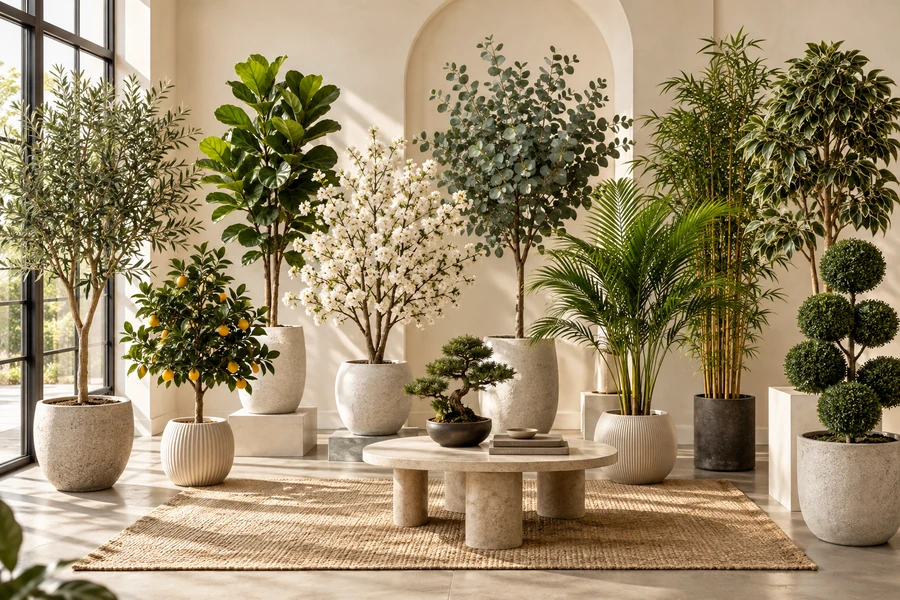
Fake trees now come in far more styles than the traditional artificial ficus. I can choose trees that look Mediterranean, tropical, flowering, formal, evergreen, or highly sculptural.
The main types of fake trees include olive, ficus, fiddle leaf fig, palm, bamboo, eucalyptus, citrus and other fruit trees, flowering trees, pine and cedar, maple and oak, bonsai, and artificial topiary trees. I can also divide them into indoor, UV-resistant outdoor, decorative, and commercial artificial trees according to where they will be used.
I find it more useful to classify artificial trees by both species and purpose. Two fake olive trees may look similar, but an indoor decorative tree and a UV-resistant outdoor version are designed for very different environments.
What Are the Most Popular Types of Artificial Trees?
The artificial tree market includes copies of many natural species, but several types appear much more often in homes, offices, hotels, shops, events, and commercial interiors.
Popular artificial trees include olive trees, ficus trees, fiddle leaf figs, palms, bamboo, dracaena, eucalyptus, citrus trees, flowering trees, cedar and pine trees, bonsai, and topiary trees. Olive and ficus trees are especially common indoors, while palms, topiaries, and UV-resistant evergreen trees are also widely used in exterior commercial spaces.
Artificial Olive Trees
The faux olive tree is one of the first types I consider for a modern interior.
It usually has:
- A slim trunk
- Fine branching
- Narrow gray-green leaves
- An open and airy canopy
- Sometimes artificial olives
I like this type when I want greenery without making the room feel visually heavy.
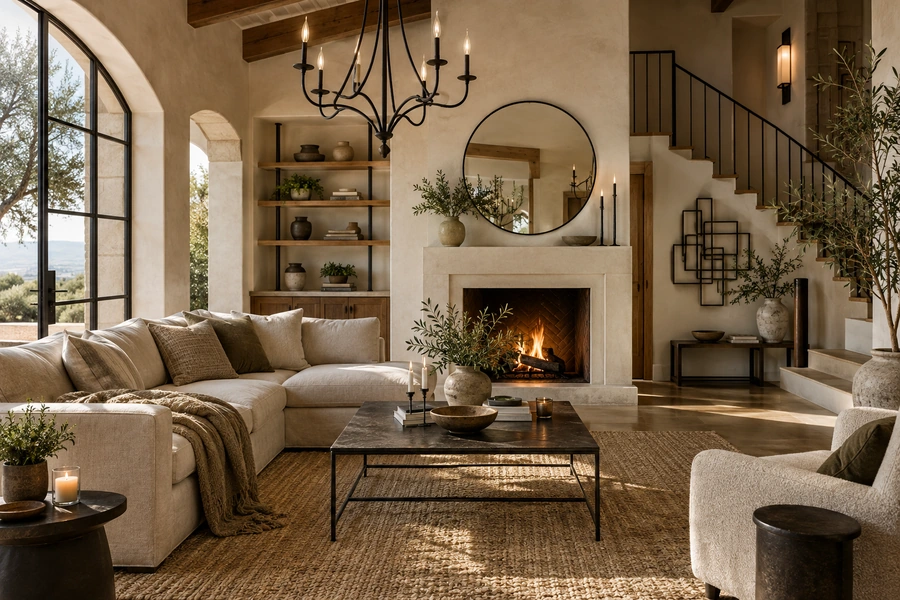
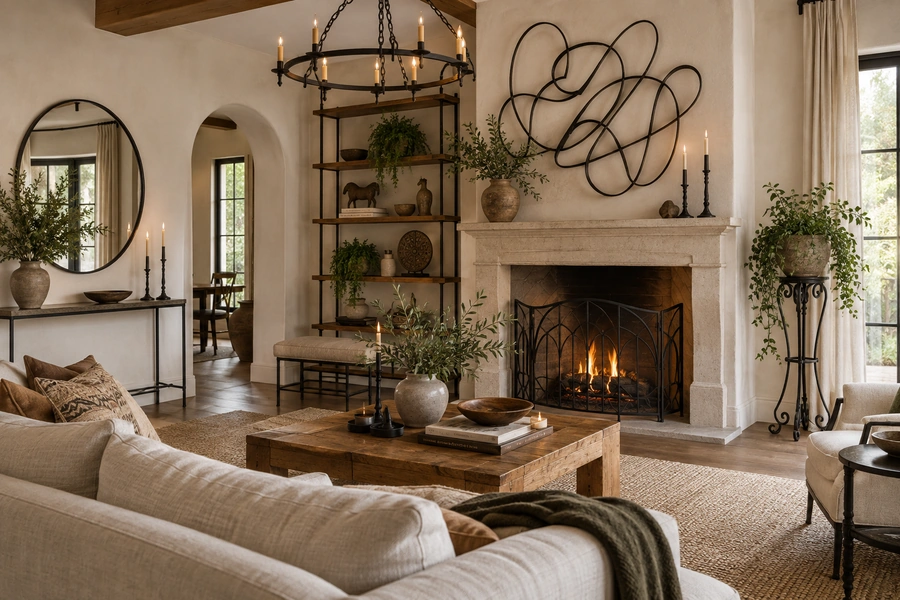
Olive trees work well with Mediterranean, minimalist, Scandinavian, coastal, and warm contemporary interiors. Current 2026 artificial-tree trend coverage continues to identify faux olive trees as a major indoor category because their slim shape adds height while keeping the room open.
Artificial olive trees are also available as topiaries and UV-resistant indoor/outdoor designs.
Artificial Ficus Trees
Ficus is a much broader category.
I may see:
- Weeping ficus
- Fiddle leaf fig
- Rubber-tree styles
- Ficus lyrata
- Ficus benjamina
- Other broad-leaf ficus designs
A traditional artificial ficus tends to look fuller than an olive tree.
That makes it useful when I want to soften an empty corner or create more visual volume.
The fiddle leaf fig gives me much larger leaves and a stronger sculptural shape.
A weeping ficus uses many smaller leaves, so it creates a softer and denser canopy.
Current indoor artificial-tree guidance still lists ficus trees among the major options for homes and offices.
Artificial Palm Trees
Artificial palm trees create a completely different mood.
Instead of fine branching, I get long fronds and a strong tropical silhouette.
Common faux palm styles include:
- Areca palm
- Kentia palm
- Coconut palm
- Phoenix palm
- Cycas palm
- Traveler’s palm
- Tropical decorative palms
I use smaller artificial palms indoors for relaxed tropical or resort-inspired interiors.
Large fake palms can also be used in hotels, restaurants, pool areas, shopping centers, entertainment venues, and rooftop spaces.
Commercial outdoor artificial palms are available with foliage specifically designed for UV and weather exposure.
Some commercial versions can also be built at very large scales. One current outdoor tropical palm line ranges from approximately 4 feet to 40 feet in height.
Artificial Bamboo Trees
Artificial bamboo trees give me a lighter vertical form.
They often use several narrow trunks with long, narrow leaves.
I like them in:
- Asian-inspired interiors
- Spa spaces
- Offices
- Modern bathrooms
- Restaurants
- Narrow corners
Bamboo has less visual mass than many broad-leaf trees.
This makes it useful where I want height without a very wide canopy.
Commercial artificial-tree suppliers currently include bamboo among both general and outdoor tree categories.
Artificial Dracaena Trees
Dracaena trees have a strong upright form.
They often feature long leaves clustered around one or more canes.
I use them when I want a narrow artificial tree for an entryway, office, or apartment.
Current 2026 indoor-tree trend coverage identifies faux dracaena or corn-stalk trees as useful vertical statement plants because they add height without taking up too much floor space.
Artificial Cedar, Cypress, and Pine Trees
Evergreen-style artificial trees create a more structured appearance.
This group can include:
- Cedar
- Cypress
- Pine
- Juniper
- Podocarpus
- Other conifer-inspired designs
I often associate these trees with entryways, traditional architecture, formal gardens, seasonal displays, and commercial spaces.
Artificial cedar and other evergreen forms also work well as topiaries because their foliage naturally supports dense geometric shapes.
Outdoor versions can be manufactured with UV-resistant materials. Current artificial outdoor collections include cedar, cypress, juniper, and pine styles.
Artificial Maple, Oak, and Birch Trees
Artificial deciduous trees imitate the broader branching structure of familiar landscape trees.
Examples include:
- Maple
- Oak
- Birch
- Aspen
These trees can be useful when I want something that feels less tropical and more like a natural temperate landscape.
Commercial artificial-tree catalogs currently include birch, oak, maple, and other deciduous species alongside tropical varieties.
The choice depends on the setting.
A maple-style artificial tree may make more visual sense in a traditional commercial lobby than a coconut palm.
A birch tree can work well in lighter Scandinavian or nature-inspired spaces.
What Are the Different Decorative Styles of Fake Trees?
Species are only one way I classify fake trees. I also look at the decorative form because the same foliage can be shaped into very different products.
Fake trees can be designed as natural-form trees, flowering trees, fruit trees, bonsai, topiary trees, spiral trees, ball topiaries, column trees, hedges, and custom sculptural trees. Some are made to imitate natural growth, while others are intentionally clipped or shaped into formal decorative forms.
Artificial Flowering Trees
Flowering trees add both height and color.
This category can include artificial versions of:
- Cherry blossom
- Magnolia
- Wisteria
- Dogwood
- Bougainvillea
- Jacaranda
- Azalea
I often use flowering fake trees differently from plain green trees.
A green tree can become a quiet background object.
A flowering tree is usually more of a focal point.
That makes it useful for:
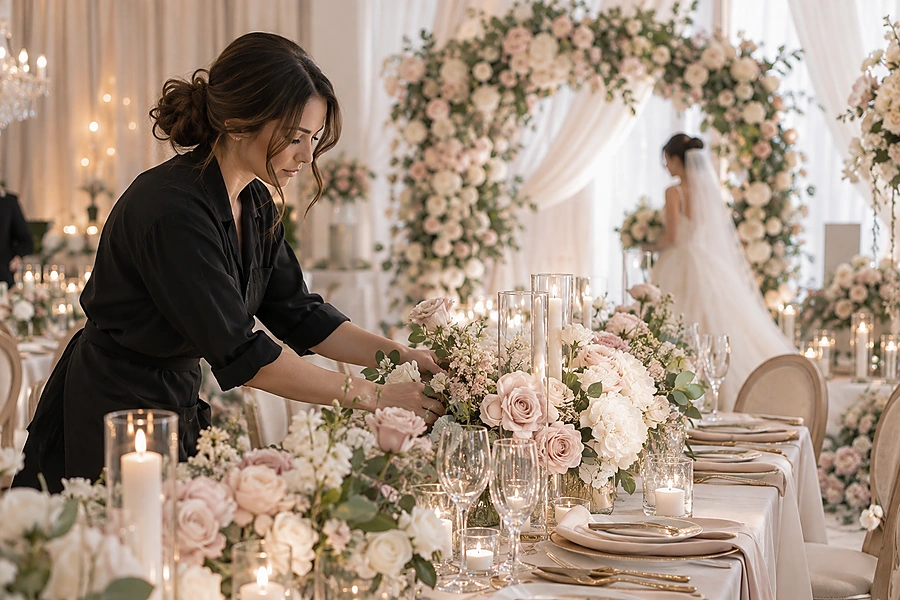
- Weddings
- Restaurants
- Hotel lobbies
- Event entrances
- Retail displays
- Photo areas
- Seasonal décor
With flowering trees, I pay more attention to petal quality.
A realistic trunk cannot compensate for very shiny or flat-looking flowers.
I also prefer variation in bloom size and position because real flowering trees do not produce identical flowers in perfect rows.
Artificial Fruit Trees
Artificial fruit trees combine foliage with imitation fruit.
Common examples include:
- Olive
- Lemon
- Orange
- Apple
- Fig
I often use these when I want a Mediterranean, farmhouse, kitchen, restaurant, or garden-inspired look.
Commercial artificial-tree suppliers classify fruit trees as a distinct tree category.
A faux lemon tree creates a much brighter visual effect than a plain ficus.
An olive tree is more subtle because the fruit is smaller and the leaf color is muted.
I choose based on the style of the room rather than simply asking which fruit tree looks most realistic.
Artificial Bonsai Trees
Artificial bonsai trees reproduce the compact, sculptural form associated with trained living bonsai.
They may imitate:
- Ficus
- Pine
- Juniper
- Cedar
- Flowering varieties
I use these mainly as tabletop or shelf décor rather than as large floor trees.
Because bonsai trees are viewed closely, small details matter.
I inspect:
- Trunk texture
- Branch structure
- Root appearance
- Leaf scale
- Pot quality
- Moss or soil surface
Commercial artificial-tree categories also include bonsai as a distinct tree style.
Artificial Topiary Trees
Topiary trees are intentionally formal.
Instead of copying unrestricted natural growth, they imitate plants that have been clipped into controlled shapes.
Common artificial topiary forms include:
- Ball
- Double ball
- Triple ball
- Cone
- Pyramid
- Spiral
- Column
- Rectangular form
- Custom sculptural shapes
Commercial suppliers currently offer artificial topiaries in boxwood, cedar, olive, podocarpus, azalea, ivy, and other foliage types.
I use them particularly around:
- Doorways
- Hotel entrances
- Formal patios
- Restaurants
- Retail stores
- Event entrances
- Traditional interiors
A pair of matching topiaries can create a strong symmetrical entrance.
That is very different from the relaxed, asymmetrical effect of a faux olive tree.
Custom Artificial Trees
At the commercial end of the market, fake trees do not always copy a standard retail plant.
They can be custom built.
Designers may specify:
- Height
- Canopy width
- Trunk shape
- Foliage type
- Number of branches
- Indoor or outdoor construction
- Fire-resistant foliage
- UV-resistant foliage
Artificial topiary suppliers also create custom shapes that range from simple geometry to animal and sculptural forms.
This means the category can move beyond home decoration and into architectural installations.
What Kind of Fake Tree Looks the Most Realistic?
A realistic species does not automatically make a realistic artificial tree. Construction quality matters much more than the name on the label.
The most realistic fake trees usually have natural branching, several leaf sizes or color tones, matte foliage, believable trunks, and slight irregularity. I often find olive, ficus, fiddle leaf fig, palm, and high-quality evergreen trees convincing because their shapes are easy to recognize. However, realism depends more on material and construction than species alone.
I Inspect the Trunk First
The trunk is one of the most important parts of a large artificial tree.
Some premium faux trees use natural wood trunks or carefully molded bark.
Cheaper products may have smooth plastic trunks with obvious seams.
I look for:
- Irregular bark
- Natural taper
- Different branch thicknesses
- Convincing joints
- No obvious repeating pattern
A beautiful canopy attached to an unrealistic trunk can weaken the whole effect.
I Look for Natural Leaf Variation
I rarely choose a tree where every leaf is exactly the same green.
Real trees contain variation.
Leaves may be:
- Darker near the interior
- Lighter on new growth
- Slightly different sizes
- Pointing in different directions
- Partially hidden behind other leaves
Current faux-tree design has moved toward reproducing that variation. Current 2026 indoor-tree coverage emphasizes the importance of scale and texture in realistic artificial tree styling.
I Avoid Excessive Shine
Strong plastic shine is one of the quickest clues that a tree is artificial.
Many natural leaves have some sheen, but they do not usually look like polished plastic from every angle.
I prefer matte or controlled low-sheen foliage.
That is especially important for broad-leaf trees such as fiddle leaf figs and rubber-tree styles.
I Reshape the Tree After Delivery
Even a good artificial tree can look poor straight from the box.
Branches are often compressed for shipping.
I bend them into different positions.
I spread the canopy.
I rotate leaves.
I make one side slightly fuller than the other.
I try to reproduce natural growth instead of making the tree perfectly symmetrical.
The Planter Also Changes Realism
Many fake trees arrive in a small nursery pot.
I rarely use that as the finished planter.
I place the tree inside a larger:
- Ceramic planter
- Terracotta pot
- Stone-effect container
- Basket
- Concrete-style planter
Then I hide the base with moss, bark, pebbles, or another natural-looking top dressing.
This helps the whole tree look intentional rather than like an artificial product placed temporarily in the room.
Can Fake Trees Be Used Outside?
Outdoor use changes the way I classify artificial trees because ordinary indoor foliage may fade or become brittle when it is exposed to strong sunlight and weather.
Yes, some fake trees can be used outside, but I choose products specifically marked for exterior use. Outdoor artificial trees may use UV-resistant foliage, weather-resistant pigments, stronger internal frames, and materials intended for sun, wind, and rain. I do not assume that a standard indoor artificial tree can remain outside simply because its leaves are plastic.
Outdoor Artificial Palm Trees
Palms are one of the most common large outdoor artificial tree types.
They work especially well in:
- Pool areas
- Rooftops
- Resorts
- Restaurants
- Theme environments
- Commercial patios
Current commercial artificial palm systems use UV-resistant foliage for constant exterior exposure.
I still check the installation requirements because a tall fake palm needs more than weather-resistant leaves.
The trunk and base must also handle wind and physical loads.
Outdoor Artificial Topiary Trees
Topiary is another strong exterior category.
I may choose:
- Boxwood
- Cypress
- Olive
- Bay leaf
- Cedar
Current outdoor topiary collections include UV-resistant cypress, boxwood, olive, and bay-leaf designs.
These work well around entrances because they maintain the same clipped shape without pruning.
Outdoor Evergreen and Landscape Trees
Commercial fake-tree collections now include UV-rated:
- Ficus
- Acacia
- Bamboo
- Pine
- Cedar
- Aspen
- Cypress
- Juniper
These products are intended for applications where ordinary interior faux foliage would not be suitable.
For outdoor projects, I therefore classify a tree by environmental performance first and species second.
A beautiful indoor ficus is not a good exterior ficus if the leaves fade after one season.
How Do I Choose the Right Type of Fake Tree?
The number of artificial tree styles can make shopping confusing. I simplify the decision by starting with the space rather than the species.
I choose a fake tree by considering location, available height and width, interior style, viewing distance, foliage density, planter size, and whether the tree needs indoor or outdoor protection. I use slim olive or dracaena trees in tighter areas, fuller ficus trees in larger corners, palms for tropical spaces, and topiaries where I want formal structure.
I Match the Tree to the Amount of Space
A narrow tree works better in a small apartment.
A wide ficus may need more room.
I use a simple guide:
| Space or goal | Fake tree type I might choose |
|---|---|
| Narrow corner | Olive or dracaena |
| Large living room | Ficus or fiddle leaf fig |
| Mediterranean room | Olive or citrus |
| Tropical interior | Palm |
| Spa or Asian-inspired room | Bamboo |
| Formal entrance | Topiary |
| Traditional exterior | Cypress or cedar |
| Minimal interior | Olive or simple evergreen |
| Tabletop display | Bonsai |
| Wedding or event | Flowering tree |
| Restaurant | Olive, citrus, ficus, or flowering tree |
| Outdoor commercial area | UV-resistant palm, topiary, or landscape tree |
I do not treat this as a rigid rule.
The table simply helps me connect form to function.
I Measure Before Buying
I check:
- Ceiling height
- Available floor width
- Furniture height
- Distance from walls
- Door clearance
- Planter dimensions
A seven-foot tree in an eight-foot room can feel crowded if the canopy touches the ceiling.
A four-foot tree beside a tall sofa may look undersized.
Current faux-tree styling trends favor taller artificial trees because they can act as visual anchors, but scale still needs to match the room.
I Consider Viewing Distance
A tree beside a dining table will be viewed closely.
I invest more in detailed leaves and a realistic trunk.
A fake tree used at the back of a large commercial space may be viewed from several meters away.
Overall silhouette becomes more important there.
This helps me decide where quality matters most.
My insights: What Are the Different Types of Fake Trees
The most useful way I have found to understand artificial trees is not to treat them as one category. I divide them by botanical look, decorative shape, and intended environment.
The different types of fake trees include natural-form artificial trees such as olive, ficus, palm, bamboo, maple, oak, cedar, and pine; decorative types such as flowering, fruit, bonsai, and topiary trees; and performance-based categories such as indoor, UV-resistant outdoor, fire-resistant commercial, and custom architectural trees. I choose among them according to the space rather than simply choosing the most popular species.
My First Insight: Species Is Only the First Layer
When someone tells me they want a fake tree, I do not immediately recommend an olive tree or ficus.
I first ask what they want the tree to do.
Do they need height?
Do they want dense privacy?
Do they need a formal entrance?
Do they want a tropical atmosphere?
Will people touch the tree?
Will it be outdoors?
The answer changes the category I choose.
An artificial palm and an artificial topiary are both fake trees, but they solve completely different design problems.
My Second Insight: I Separate Natural-Form Trees From Formal Trees
This distinction makes artificial-tree selection much easier.
Natural-form trees try to reproduce unrestricted plant growth.
Examples include:
- Olive
- Ficus
- Palm
- Maple
- Oak
- Bamboo
Formal artificial trees intentionally reproduce clipped or shaped plants.
Examples include:
- Spiral topiary
- Ball topiary
- Cone
- Double ball
- Triple ball
- Column
Commercial suppliers now offer both categories, including custom topiary forms and many different species.
I use natural forms when I want softness.
I use topiary when I want order.
My Third Insight: Outdoor Is a Technical Category, Not Just a Style
This is one of the most important points.
An artificial olive tree may be sold for indoor styling.
Another artificial olive tree may be UV-resistant and approved for outdoor use.
They may look almost identical in a photograph.
Their intended performance is different.
Current commercial outdoor artificial-tree systems use UV-resistant foliage and more robust construction specifically for weather exposure.
So I always check the specification.
I never use the word “plastic” as proof that a tree is outdoor-safe.
My Fourth Insight: The Most Realistic Tree Is the One That Fits Its Location
I can buy an extremely realistic tropical palm and still make it look strange in the wrong room.
Context contributes to realism.
An olive tree near warm wood, linen, stone, and neutral colors feels natural.
A palm works better in a relaxed or tropical setting.
A formal topiary belongs naturally near a doorway.
A flowering cherry tree can make sense in an event or statement installation.
This means botanical realism is only one part of the result.
Design realism matters too.
My Fifth Insight: Large Artificial Trees Are Becoming More Architectural
Artificial trees are no longer limited to small home décor products.
Current commercial suppliers offer large palms, landscape trees, topiaries, UV-resistant exterior trees, and custom installations.
That changes the way I think about the category.
A small faux ficus is an accessory.
A 15-foot artificial tree in a hotel lobby is closer to an architectural feature.
A large custom topiary becomes part of the identity of the space.
For those projects, I also need to think about:
- Structural support
- Fire requirements
- UV exposure
- Anchoring
- Maintenance access
- Transportation
- Installation
The species name alone tells me very little.
My Simple Fake Tree Classification
When I need a quick overview, I use this structure:
| Category | Typical examples |
|---|---|
| Mediterranean trees | Olive, citrus |
| Tropical trees | Palm, banana-style, traveler’s palm |
| Broad-leaf trees | Ficus, fiddle leaf fig |
| Vertical trees | Bamboo, dracaena |
| Evergreen trees | Cedar, pine, cypress, juniper |
| Deciduous trees | Maple, oak, birch, aspen |
| Fruit trees | Olive, lemon, orange, fig |
| Flowering trees | Cherry blossom, magnolia, wisteria |
| Miniature trees | Bonsai |
| Formal trees | Topiary |
| Exterior trees | UV-resistant outdoor varieties |
| Commercial trees | Fire-rated, custom, oversized installations |
This classification helps me compare products that otherwise appear very different.
My Final View
When someone asks me “What are the different types of fake trees?”, I do not think there is one short list that covers the entire market.
I can choose artificial trees by species.
I can choose them by shape.
I can choose them by environment.
I can choose them by scale.
For home interiors, I often begin with olive, ficus, fiddle leaf fig, palm, bamboo, or dracaena.
For formal entrances, I look at topiary.
For weddings and events, I may choose flowering trees.
For outdoor areas, I start with UV-resistant products before deciding whether I want palm, olive, cypress, or another species.
For commercial interiors, I also consider fire performance and custom construction.
That approach gives me a much more useful answer than simply asking which fake tree is the most popular.
The best artificial tree is the one whose species, silhouette, scale, materials, and performance match the place where I actually plan to use it.
Conclusion
Fake trees include olive, ficus, palm, bamboo, evergreen, fruit, flowering, bonsai, and topiary styles, plus indoor, outdoor, and commercial versions designed for different environments.