
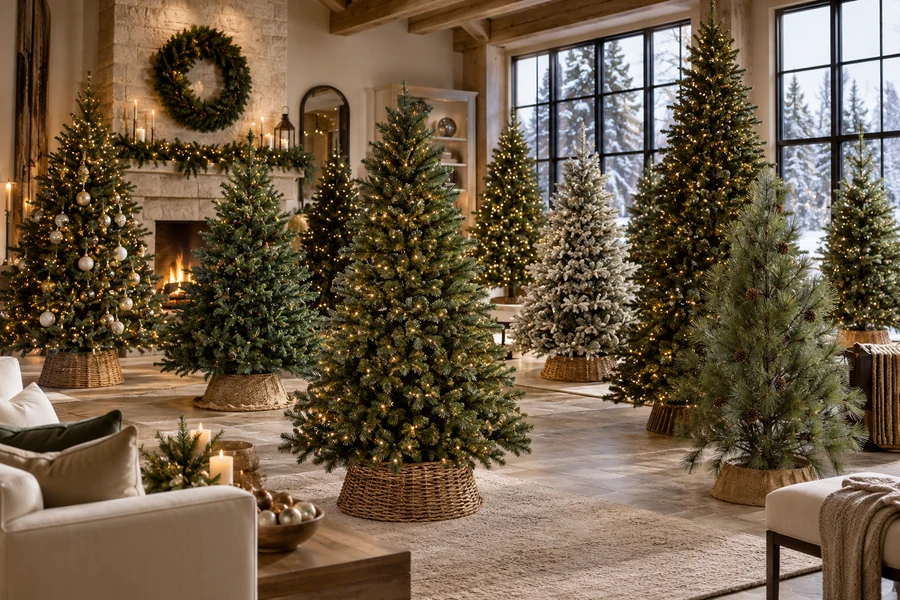
Artificial Christmas trees can look almost indistinguishable from fresh-cut firs now, but realism varies dramatically between molded PE branches, traditional PVC needles, tree shape, color, and construction.
The most realistic artificial Christmas trees in 2026 include the Balsam Hill BH Fraser Fir, Vermont White Spruce, King of Christmas King Fraser Fir, National Tree Company Downswept Douglas Fir, BH Balsam Fir, King Noble Fir, BH Norway Spruce, King Douglas Fir, Puleo Balsam Fir, and National Tree Company Carolina Pine. I rank them mainly by foliage realism, natural silhouette, branch variation, and independent testing.
I do not think the tree with the greatest number of tips is automatically the most realistic. A convincing artificial Christmas tree needs natural gaps, believable needles, varied branch shapes, appropriate color, and proportions that resemble an actual fir, spruce, or pine.
What Makes an Artificial Christmas Tree Look Real?
A realistic artificial Christmas tree needs more than dense green branches. I look closely at the needles, branch structure, color variation, trunk visibility, silhouette, and how naturally the tree responds after shaping.
The most realistic artificial Christmas trees usually use molded polyethylene, or PE, tips based on real evergreen branches. They also reproduce natural color changes, irregular branch lengths, realistic spacing, and species-specific silhouettes. PVC can add useful interior fullness, but molded PE foliage generally produces more convincing close-up texture than flat traditional PVC needles.
PE Needles Make a Major Difference
When I compare premium artificial trees with budget versions, I first look at the outer branch tips.
Traditional PVC Christmas-tree needles are usually cut from flat plastic film. They can create fullness economically, but close inspection often makes the artificial construction obvious.
Molded PE foliage is different.
Manufacturers can make molds from natural tree branches and reproduce the three-dimensional shape of the needles and twigs. Balsam Hill, for example, says its BH Fraser Fir uses branch tips molded from actual Fraser fir cuttings and includes more than 40 tip variations. National Tree Company’s Downswept Douglas Fir uses its molded Feel Real PE tips together with PVC foliage.
For me, this produces the strongest improvement in close-up realism.
Shape Matters as Much as Material
A real Christmas tree is rarely a perfect green triangle.
Some Fraser firs are full but still contain visible spaces between branch layers.
Noble firs often have more open silhouettes.
Norway spruces can have irregular, slightly drooping growth.
Real Simple recently highlighted the same basic principle: artificially dense, perfectly triangular trees can look less natural than trees with flatter branches and visible spacing similar to real evergreens.
That is why I do not automatically choose the fullest tree.
| Realism feature | What I look for |
|---|---|
| Outer foliage | Molded PE or similar 3D needles |
| Branch structure | Uneven, species-appropriate growth |
| Color | Several natural green tones |
| Stems | Brown or realistic woody coloration |
| Needle direction | Variation rather than perfect repetition |
| Silhouette | Natural gaps and irregularity |
| Tree top | Organic rather than perfectly pointed |
| Interior foliage | Enough fullness to hide the center pole |
| Trunk | Textured or well concealed |
| Finish | Low plastic shine |
This is the framework I used for the following top 10.
What Are the Top 10 Most Realistic Artificial Christmas Trees?
I would not claim that one ranking can be scientifically definitive because realism is partly visual and personal. My 2026 shortlist combines current product construction with recent independent testing from sources including Forbes, Good Housekeeping, WIRED, and Bob Vila.
My top 10 most realistic artificial Christmas trees for 2026 are led by the Balsam Hill BH Fraser Fir and Vermont White Spruce, followed closely by the King of Christmas King Fraser Fir and National Tree Company Downswept Douglas Fir. The strongest models use molded foliage, species-specific colors, and less mechanically perfect branch structures.
| Rank | Artificial Christmas tree | Why I include it |
|---|---|---|
| 1 | Balsam Hill BH Fraser Fir | Exceptional PE tip variation and species accuracy |
| 2 | Balsam Hill Vermont White Spruce | Very full, lush and independently praised for realism |
| 3 | King of Christmas King Fraser Fir | Natural-looking needles, full shape and strong independent test results |
| 4 | National Tree Company Downswept Douglas Fir | Molded Feel Real PE tips and natural Douglas fir profile |
| 5 | Balsam Hill BH Balsam Fir | Realistic semi-flat needles and classic natural silhouette |
| 6 | King of Christmas King Noble Fir | Sparse, natural Noble fir shape with excellent ornament spacing |
| 7 | Balsam Hill BH Norway Spruce | Organic spruce structure and realistic faux trunk |
| 8 | King of Christmas King Douglas Fir | Lifelike needles with a more slender natural silhouette |
| 9 | Puleo International Balsam Fir | Dense PE/PVC foliage and strong fullness |
| 10 | National Tree Company Carolina Pine | Convincing pine shape, pinecones and tested construction |
1. Balsam Hill BH Fraser Fir
If realism is my main priority, the BH Fraser Fir is the tree I would examine first.
Balsam Hill says it created the foliage from molds of actual Fraser fir branch cuttings. More importantly, it uses more than 40 variations of forked branch tips rather than repeating one molded component across the entire tree. The foliage also reproduces the rich green upper surface and lighter silvery underside associated with Fraser fir needles.
That detail matters at close range.
The tree does not depend only on fullness to create realism. The branches themselves are intended to reproduce the species.
Bob Vila’s comparison of the BH Fraser Fir with the King of Christmas Fraser Fir also found Balsam Hill’s branch details highly realistic, including the lighter needle undersides and brown branch coloring.
I especially like this model for a living room where guests will walk close to the tree.
2. Balsam Hill Vermont White Spruce
The Vermont White Spruce gives me a fuller and more luxurious appearance.
WIRED conducted a blind comparison judged by interior designers and placed the Vermont White Spruce at the top of its group. The judges highlighted its thickness, realistic texture, and natural upward-sloping branches.
Good Housekeeping also identifies it as its luxury artificial-tree choice and describes the boughs as full and realistic.
Compared with the BH Fraser Fir, I see this as the stronger choice when I want a very full traditional Christmas-tree silhouette.
The Fraser Fir is particularly convincing in the branch details.
The Vermont White Spruce creates a grander overall mass.
3. King of Christmas King Fraser Fir
The King Fraser Fir is one of the strongest alternatives to Balsam Hill.
Good Housekeeping currently names it its best overall artificial Christmas tree. Testers found the tree natural looking, stable, and full, with more than 2,000 branch tips on the tested 6.5-foot version.
Bob Vila directly compared a King Fraser Fir with a Balsam Hill Fraser Fir and found both convincingly realistic, although their needle structures differ. The King version uses narrower needles distributed around its branch tips and creates a very full visual effect.
I would choose this tree when I want a premium Fraser-fir appearance but also want to compare alternatives to Balsam Hill.
4. National Tree Company Downswept Douglas Fir
The Downswept Douglas Fir is one of my strongest choices outside the two premium brands above.
Forbes Vetted named National Tree Company’s Downswept Douglas Fir its best overall artificial Christmas tree in September 2026, emphasizing its full-bodied branches and high tip count.
National Tree Company says its current Feel Real version uses molded PE tips together with quality PVC foliage. A 10-foot model, for example, has 3,933 PE and PVC branch tips molded to create natural texture and depth.
I think it is particularly attractive for someone who wants substantial fullness without moving into the highest premium price tier.
5. Balsam Hill BH Balsam Fir
The BH Balsam Fir reproduces a different type of natural Christmas tree.
Its semi-flat light-green needles and upward-sloping branches are modeled after real balsam firs. Balsam Hill places the model among its most realistic trees and specifically highlights its traditional teardrop shape.
Good Housekeeping has also tested this model and praised its branches, needles, ease of assembly, and overall appearance.
I like it when I want an old-fashioned full Christmas-tree silhouette rather than the slightly more sculptural appearance of a Fraser or Noble fir.
6. King of Christmas King Noble Fir
The King Noble Fir is interesting because it does not try to hide its center behind extreme density.
Its more open shape is part of the realism.
King of Christmas describes it as a recreation of the sparse silhouette of a natural Noble fir. Its branches leave deliberate space for ornaments instead of forming one continuous wall of foliage.
Good Housekeeping also highlighted the King Noble Fir in its 2026 shopping coverage as a strong option for shoppers who like a minimalist, sparse Christmas-tree aesthetic.
I think this is an important trend in realistic artificial trees.
For years, manufacturers competed to produce the densest possible tree.
Natural trees are often more open.
If I decorate with larger ornaments, ribbons, hanging candles, or vintage decorations, that extra branch spacing can actually make the finished tree look more authentic.
7. Balsam Hill BH Norway Spruce
I include the BH Norway Spruce because its realism comes from shape rather than simple density.
Balsam Hill describes it as having a slender profile, textured faux trunk, and an organically shaped treetop modeled after natural Norway spruce trees. Its branches are intended to reproduce the more irregular structure of Picea abies.
This is the kind of tree I would choose if I dislike overly manicured artificial Christmas trees.
It works especially well for Scandinavian, traditional European, rustic, or restrained holiday decorating.
The visible trunk and less-perfect silhouette can make it feel closer to a tree that was actually grown rather than manufactured.
8. King of Christmas King Douglas Fir
The King Douglas Fir gives me another natural-looking alternative with a somewhat slimmer profile.
King of Christmas describes it as having lifelike needles and a graceful silhouette inspired by a real Douglas fir. The current 7.5-foot pre-lit version is positioned as one of the brand’s realistic models.
I would consider this tree when I want the visual height of a traditional Christmas tree without the broad footprint of the fullest Fraser or spruce models.
The slimmer form can also appear more natural in a smaller room because it does not look artificially compressed against furniture.
9. Puleo International Balsam Fir
The Puleo International Balsam Fir is a strong choice when I care about foliage density.
Current 9-foot versions use a combination of PE and PVC and can contain thousands of branch tips. One current model lists 7,477 tips, including 5,782 PE tips and 1,749 PVC tips.
That is a useful construction strategy.
The PE foliage creates more realistic outer branches where I can see and touch the tree.
The PVC helps fill the center and prevents the pole from becoming visible.
I would not judge it by tip count alone, but the high proportion of PE foliage makes this one of the more interesting options in Puleo’s range when realism is the priority.
10. National Tree Company Carolina Pine
The National Tree Company Carolina Pine finishes my top 10.
Good Housekeeping’s long-term artificial-tree testing found the completed tree realistic enough to look as though it had come from a tree farm after proper fluffing. Testers also praised its construction and straightforward assembly.
This tree takes a slightly different approach.
Pinecones, varied branch forms, and a rustic pine appearance add natural detail.
I like it for a traditional or woodland-style Christmas display where a perfectly formal fir would feel too polished.
Is PE or PVC Better for a Realistic Artificial Christmas Tree?
Material terminology can make artificial Christmas-tree shopping unnecessarily confusing. I think the easiest approach is to understand what each material contributes.
PE is generally better for close-up realism because it can be molded into three-dimensional evergreen needles and branch tips. PVC is useful for creating inexpensive interior fullness but usually looks flatter when viewed closely. Many of the best artificial Christmas trees combine molded PE on visible outer branches with PVC deeper inside the tree.
I Prefer PE Where People Can See It
If a tree will stand in a living room, guests may be only a few feet away.
That makes outer foliage important.
I want the visible branch tips to have dimension.
I also want different needle directions and realistic branch stems.
PE is well suited to that job.
The BH Fraser Fir demonstrates the premium version of this approach by using molded tips modeled from actual Fraser fir cuttings.
National Tree Company’s Feel Real system uses molded PE tips for a similar reason.
PVC Can Still Be Useful
I do not reject a tree simply because it contains PVC.
PVC can create dense interior foliage at lower cost.
When it sits deep inside the canopy, I may barely notice that the individual needles are flatter.
This is why mixed PE/PVC construction is common.
The important question for me is where the PE is used and how much of the visible tree consists of realistic molded foliage.
A tree can advertise PE construction while still having a relatively small amount of molded foliage.
That is why I also look at close-up branch photographs before buying.
Which Brand Makes the Most Realistic Artificial Christmas Trees?
Balsam Hill, King of Christmas, National Tree Company, and Puleo International all have realistic models, but they target somewhat different parts of the market.
Balsam Hill currently offers some of the most detailed species-specific artificial trees, while King of Christmas provides strong premium alternatives with natural silhouettes. National Tree Company offers realistic molded-tip trees across broader price points, and Puleo International has several convincing PE/PVC models. I compare individual trees rather than assuming every model from one brand has the same realism.
Balsam Hill Leads in Species-Specific Detail
Balsam Hill has put considerable effort into replicating individual evergreen species.
Its BH Fraser Fir uses more than 40 tip variations.
Its BH Nordmann Fir reproduces curved dark-green needles with silvery undersides.
Its Norway Spruce includes an organic treetop and visible faux trunk.
Its Noble Fir uses blue-green molded needles based on natural Noble fir cuttings.
For me, that species-level attention is the brand’s biggest strength.
King of Christmas Is Especially Strong in Silhouette
King of Christmas performs particularly well when I want a specific tree shape.
The King Fraser Fir gives me a full traditional appearance.
The King Noble creates the more fashionable open, sparse silhouette.
The King Douglas Fir gives me a slimmer alternative.
The company’s current realistic collection also covers full, slim, sparse, green, and flocked formats.
National Tree Company Can Offer Strong Realism for Less
National Tree Company is important because realistic artificial trees do not have to cost at the very top of the market.
Forbes currently recommends its Downswept Douglas Fir as its overall pick, while Good Housekeeping has praised several National Tree models after physical testing.
I would look closely at models using the company’s Feel Real molded PE technology rather than choosing only by brand name.
How Do I Choose the Most Realistic Artificial Christmas Tree?
Even the most lifelike tree on a reviewer’s list can look wrong in my house if its proportions do not fit the room.
I choose a realistic artificial Christmas tree by measuring ceiling height and floor width first, then comparing foliage material, branch spacing, natural color, tree profile, lighting, and ornament capacity. I also consider viewing distance. A tree seen closely needs excellent PE foliage, while a large tree viewed from across a room depends more heavily on silhouette and fullness.
I Match the Tree to the Natural Species I Prefer
If I normally buy a real Fraser fir, I would begin with an artificial Fraser fir.
The familiar branch direction and needle color will probably feel more authentic to me.
If I grew up with fuller spruce trees, a Vermont White Spruce may feel more natural.
If I like trees with open branches and visible space, a Noble Fir or Norway Spruce may be more convincing.
Realism is partly about expectation.
A tree can be technically excellent but still feel wrong if it does not resemble the kind of Christmas tree I naturally associate with the holiday.
I Leave Enough Space Around the Tree
Artificial trees often look less convincing when they are too large for the room.
A broad tree pushed against a wall loses its natural silhouette.
Branches become compressed.
The lower shape disappears behind furniture.
I measure both height and diameter.
For a standard ceiling, I also leave room for the stand and tree topper rather than buying a tree that nearly touches the ceiling before decorating.
I Judge Unlit Photos When Possible
Lights can make almost any tree look attractive.
When I judge realism, I want to see the tree unlit and undecorated.
That lets me inspect:
- Branch density
- Needle texture
- Interior gaps
- Tree-top shape
- Color
- Center-pole visibility
If the undecorated tree already looks convincing, ornaments and lights usually improve it further.
My insights: What Are the Top 10 Most Realistic Artificial Christmas Trees
After comparing current manufacturer specifications with recent independent testing, I think the best artificial Christmas tree is not simply the fullest or most expensive model. The strongest trees reproduce the biological irregularity of real evergreens.
My top 10 most realistic artificial Christmas trees are the Balsam Hill BH Fraser Fir, Vermont White Spruce, King Fraser Fir, National Tree Company Downswept Douglas Fir, BH Balsam Fir, King Noble Fir, BH Norway Spruce, King Douglas Fir, Puleo Balsam Fir, and National Tree Company Carolina Pine. I give the greatest weight to molded foliage, realistic branch structure, species-accurate color, and natural silhouette.
My First Insight: More Tips Do Not Automatically Mean More Realism
Tip count is easy to advertise.
It is also easy to compare.
That makes it attractive as a shopping metric.
But I do not think it tells the full story.
A tree with thousands of flat PVC tips may look extremely full while still appearing artificial up close.
A tree with fewer molded PE branches and realistic gaps may resemble a natural evergreen more closely.
I therefore treat tip count as a measure of fullness rather than a complete measure of realism.
My Second Insight: Natural Imperfection Is Becoming More Important
I think realistic artificial Christmas trees are moving away from the perfect triangle.
Current styling guidance emphasizes flatter, more natural branch positions and visible spacing because real trees do not grow as uniform green cones.
That is also why I rate the King Noble Fir and BH Norway Spruce highly.
Their less uniform shapes can look more authentic than an extremely dense tree.
My Third Insight: Close-Up Realism and Whole-Tree Realism Are Different
I divide realism into two levels.
Close-up realism comes from needle shape, branch color, texture, and molded foliage.
Whole-tree realism comes from silhouette, spacing, taper, branch direction, and proportion.
The BH Fraser Fir performs especially well at the first level because of its extensive molded-tip variation.
The Vermont White Spruce performs extremely well at the second level because its full shape and branch structure create a convincing overall tree. WIRED’s blind judges responded particularly strongly to that complete visual effect.
The best artificial trees combine both.
My Fourth Insight: I Would Spend More on the Tree Before Spending More on Decorations
If realism matters, I prefer to invest in better foliage rather than trying to hide a weak tree under hundreds of ornaments.
Good ornaments can add beauty.
They cannot completely disguise flat plastic needles, an exposed center pole, or an unnatural silhouette.
A premium realistic tree can also look attractive with simpler decoration.
That gives me more flexibility from year to year.
My Fifth Insight: My Best Choice Depends on the Look I Want
I would choose BH Fraser Fir when my top priority is detailed botanical realism.
I would choose Vermont White Spruce when I want a luxurious, full traditional tree.
I would choose King Fraser Fir when I want a premium alternative with strong independent test results.
I would choose Downswept Douglas Fir when I want a strong combination of realism and broader value.
I would choose King Noble Fir when I want an airy, natural tree with visible ornament space.
That is why I do not think “most realistic” should mean one identical tree for everyone.
A real Fraser fir does not look like a real Noble fir.
A real spruce does not look like a Douglas fir.
A convincing artificial tree should reproduce the characteristics of the species it is supposed to imitate rather than conform to one idealized Christmas-tree shape.
For me, that is the clearest sign that artificial Christmas trees have become more realistic: the best models no longer simply look like generic green cones. They look like specific trees.
Conclusion
For the most realistic artificial Christmas tree, I would start with the BH Fraser Fir, Vermont White Spruce, King Fraser Fir, or Downswept Douglas Fir, then choose the species and silhouette that feel most natural in my room.