

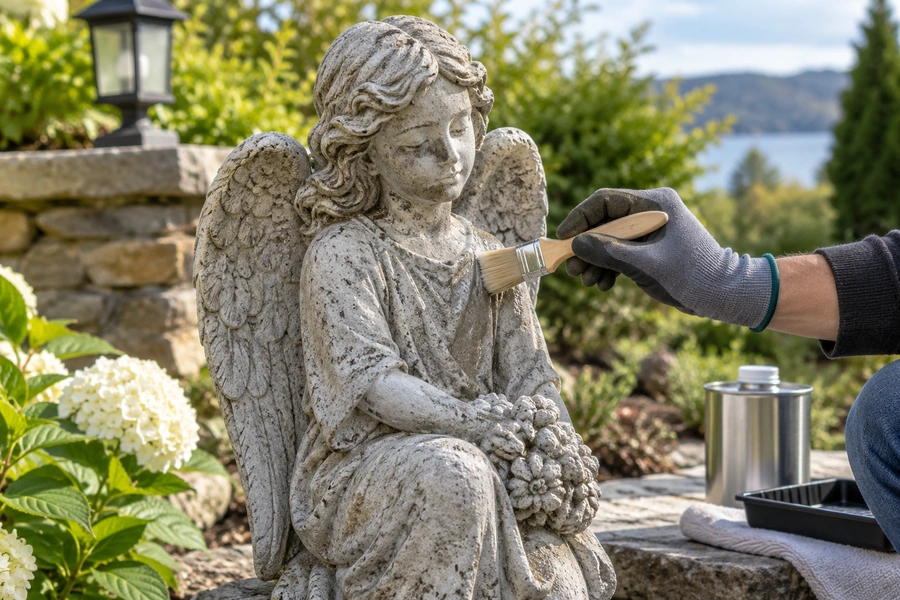
Outdoor concrete statues face rain, sun, frost, and moisture every day. The wrong sealer can protect poorly or even trap moisture inside the concrete.
For most unpainted outdoor concrete statues, I recommend a breathable penetrating silane or siloxane sealer. It reduces water absorption without creating a thick surface film or changing the natural concrete look. For painted statues, a compatible exterior-grade UV-resistant acrylic sealer is often a better choice because it can also protect the decorative finish.
The best concrete statue sealer depends on the surface, climate, finish, and desired appearance. Before choosing one, I separate natural concrete, painted concrete, and decorative finishes because they need different protection.
Should Concrete Statues Be Sealed?
Concrete looks solid, but it contains small pores that can absorb water. This becomes especially important when a statue stays outdoors through rain, irrigation, snow, and changing temperatures.
Yes, many outdoor concrete statues benefit from sealing because a suitable sealer reduces water absorption and weather-related deterioration. Sealing is especially useful in wet or freeze-thaw climates. However, not every statue must be sealed, and some cast-stone pieces are intentionally left untreated so they can develop a natural aged appearance or patina.
Why Water Matters More Than It Seems
I consider moisture the main reason to seal an outdoor concrete statue.
Concrete contains a network of pores. When rain or irrigation reaches the statue, some water can enter these pores. When temperatures remain mild, this may mainly contribute to staining, algae, moss, or efflorescence.
Cold climates create a greater concern.
Water inside porous concrete can freeze and expand. Repeated freezing and thawing can place stress on the surface. Over time, vulnerable concrete may develop scaling, cracking, or spalling. Penetrating concrete sealers are widely used on exterior concrete because they can reduce moisture penetration while allowing the material to remain breathable.
A sealer is still only one part of protection.
| Problem | Can sealer help? | What else matters? |
|---|---|---|
| Rain absorption | Yes | Drainage and placement |
| Freeze-thaw exposure | Yes | Keeping standing water away |
| Surface staining | Often | Regular cleaning |
| Moss and algae | Partly | Shade, moisture, cleaning |
| Existing cracks | No | Repair cracks first |
| Structural damage | No | Repair or professional assessment |
| Standing water | Limited | Improve drainage |
| Fading paint | Depends on sealer | UV-resistant coating |
Breathability Is Important
I would not automatically choose the thickest or most waterproof-looking coating.
Concrete may already contain moisture. A coating that prevents that moisture from escaping can create new problems.
The National Park Service documented a reinforced-concrete monument where impermeable coatings contributed to deterioration because they trapped moisture inside saturated concrete. Another concrete conservation project found that a thick acrylic coating had trapped moisture beneath the surface.
For ordinary unpainted garden statues, this is one reason I generally prefer a breathable penetrating product rather than a thick epoxy-like film.
However, some statues are intentionally designed to age naturally. A cast-stone manufacturer may recommend allowing a piece to develop patina rather than sealing it.
So I always check the manufacturer’s instructions before applying a permanent treatment.
What Kind of Sealer Should I Use on Concrete Statues?
The word “concrete sealer” covers several very different products. I do not choose one based only on the claim that it is waterproof.
For natural, unpainted concrete statues, a breathable penetrating silane, siloxane, or silane-siloxane sealer is usually my first choice. For painted or color-enhanced statues, I look for a compatible exterior acrylic or decorative coating with UV resistance. The correct product should protect the surface without creating an unwanted gloss or trapping moisture.
Penetrating Silane and Siloxane Sealers
For a natural gray concrete statue, this is usually the category I would consider first.
Silane and siloxane sealers enter the pores of concrete and create water-repellent protection below the surface. Unlike thick topical coatings, they normally do not form a visible film.
Concrete Network identifies penetrating sealers, including silanes and siloxanes, as useful for exterior concrete exposed to harsh weather and freeze-thaw conditions. These products normally provide a natural matte appearance and allow water vapor to escape.
Sika also describes its silane-siloxane penetrating system as non-film-forming and designed to reduce water absorption and freeze-thaw damage without enhancing the surface color.
That combination works well for many statues because I usually want the concrete to continue looking like stone rather than coated plastic.
Acrylic Sealers
Acrylic sealers work differently.
They usually create a thin protective film over the surface. They are available in water-based and solvent-based versions and can produce finishes ranging from relatively natural to glossy or “wet look.”
I would consider acrylic when appearance is part of the goal.
For example, a painted statue may need a protective clear finish over the paint. A colored concrete ornament may also benefit from a product that enhances its color.
Acrylic sealers can provide UV and moisture protection, but they normally require more maintenance than penetrating products because the film remains exposed at the surface.
What About Polyurethane or Epoxy?
Polyurethane and epoxy coatings can produce very durable films, but durability alone does not make them my first choice for a porous outdoor statue.
A thick film can strongly change the appearance. It may create gloss and can make an old stone-style statue look artificial.
More importantly, I want an outdoor concrete system to manage moisture correctly.
For valuable, historic, heavily cracked, or deteriorating concrete statues, I would not experiment with a thick coating. Conservation guidance shows that inappropriate impermeable coatings can contribute to moisture-related deterioration.
Quick Sealer Comparison
| Sealer type | Best use | Appearance | Breathability | My general view |
|---|---|---|---|---|
| Silane | Exterior unpainted concrete | Natural | High | Strong choice |
| Siloxane | Porous outdoor concrete | Natural | High | Strong choice |
| Silane-siloxane | Outdoor statuary | Natural | High | Often my first choice |
| Siliconate | Unpainted concrete | Natural | Good | Useful option |
| Acrylic | Painted or decorative concrete | Matte to gloss | Product-dependent | Good when finish matters |
| Polyurethane | Special decorative surfaces | Film-forming | Product-dependent | Check compatibility carefully |
| Epoxy | Specialized applications | Usually thicker/glossier | Lower | Usually not my first choice outdoors |
The most useful rule is simple: natural unpainted concrete usually benefits from penetrating protection, while painted decorative concrete often needs a coating compatible with its existing finish.
How Do You Seal a Concrete Statue?
Even a good sealer can fail when it is applied over dirt, moisture, algae, old loose coatings, or damaged concrete. Surface preparation matters as much as product choice.
To seal a concrete statue, I first clean it gently and repair significant damage. I then let the concrete dry completely, test the sealer in a hidden area, and apply the recommended amount in thin, even coverage. I follow the manufacturer’s temperature, coat, drying, and curing instructions rather than adding extra sealer for more protection.
Step 1: Inspect the Statue
Before sealing, I check the statue carefully.
I look for:
- Cracks
- Loose concrete
- Flaking paint
- Moss
- Algae
- Efflorescence
- Previous coatings
- Water collecting around the base
Sealer does not repair structural damage.
If a crack is actively growing or pieces of concrete are separating, I address that problem first.
Step 2: Clean the Surface
The surface should be free from loose dirt and biological growth.
For ordinary garden décor, gentle cleaning is normally better than aggressive cleaning. Concrete details can be damaged by excessive pressure, hard wire brushes, or harsh chemicals.
I remove loose debris and allow the cleaned statue to dry.
The goal is not only a cleaner appearance. A clean surface also gives the sealer better access to the concrete.
Step 3: Let the Concrete Dry
This step is easy to underestimate.
I would not apply a water-repellent product to a statue that is still saturated from rain or washing unless the manufacturer specifically permits it.
Preservation guidance warns that applying water-repellent treatment to damp masonry can contribute to trapped moisture problems.
I therefore choose a dry weather window and follow the sealer manufacturer’s moisture requirements.
Step 4: Test Before Sealing the Whole Statue
I test an inconspicuous area first.
Even a product described as “clear” may slightly change the concrete.
I check for changes in:
- Color
- Sheen
- Texture
- Surface depth
- Painted finish
This is particularly important with light concrete, aged finishes, colored statues, and pieces designed to look like natural stone.
Step 5: Apply Only the Recommended Amount
More sealer does not automatically mean better protection.
Penetrating sealers work by entering porous concrete. Once the concrete stops absorbing the product, additional material may simply remain on the surface and create residue or uneven areas. Concrete Network specifically warns that overapplication can cause white residue or streaking.
I follow the label for application method, coverage, number of passes, drying time, and curing time.
A small statue with deep texture may be easier to cover with a suitable sprayer or brush than with a roller. The exact tool should match the sealer instructions.
How Often Should You Reseal Concrete Statues?
Resealing too often wastes material and may cause buildup. Waiting too long can also leave the concrete without useful water repellency.
There is no universal resealing schedule for concrete statues. I inspect outdoor pieces every year and follow the specific sealer manufacturer’s interval. Exposure, rainfall, sunlight, freeze-thaw cycles, surface porosity, and sealer chemistry all affect service life. General exterior-concrete guidance often falls within a multi-year maintenance cycle rather than automatic annual recoating.
I Inspect Instead of Following One Fixed Number
Consider two identical statues.
The first statue sits beneath a covered porch in a mild climate.
The second statue sits beside a garden path where it receives full rain, direct sun, irrigation, winter freezing, and snow.
It would not make sense to reseal both on exactly the same schedule.
The second statue experiences far more environmental stress.
I therefore check the condition of the surface instead of relying only on a calendar.
Signs That Protection May Need Attention
I look for changes such as:
| Sign | What it may suggest |
|---|---|
| Concrete darkens quickly in rain | Water is entering the surface more easily |
| Water no longer beads as expected | Repellency may be declining |
| New staining appears easily | Protection may be weaker |
| Surface becomes chalky | Concrete or coating needs inspection |
| Topical coating peels | Existing coating may be failing |
| White deposits appear | Moisture movement needs investigation |
| New cracks appear | Repair problem before resealing |
A failed topical coating needs different treatment from an aging penetrating sealer.
I do not simply coat over peeling layers. I first determine what is already on the statue and whether the new product is compatible.
Climate Changes the Maintenance Plan
Cold, wet climates deserve special attention because water penetration and freeze-thaw exposure can work together.
Hot climates present a different problem. Strong sunlight and UV exposure can age some surface films.
Humid or shaded locations can encourage biological growth.
A statue located beneath trees may also collect organic stains from leaves, fruit, pollen, or bird activity.
Because these conditions vary, the label on the actual sealer remains more useful than a universal rule such as “seal every year.”
For valuable artwork or historic concrete, I would use an even more cautious approach. The National Park Service notes that penetrating treatments can be difficult or impossible to reverse and recommends careful evaluation before they are used on historic concrete.
My insights: What Is the Best Sealer for Concrete Statues?
The best choice becomes much clearer when I stop looking for one universal product and instead match the sealer to the statue’s surface and environment.
For most unpainted outdoor concrete statues, my best starting choice is a clear, breathable, non-film-forming silane-siloxane penetrating sealer rated for exterior concrete. It reduces water absorption while keeping the natural matte appearance. For painted statues, I would instead choose an exterior UV-resistant clear sealer specifically confirmed to be compatible with the existing paint.
My First Priority Is Water Management
The main purpose of sealing most outdoor concrete statues is not making them shiny.
It is controlling water.
Water can enter concrete through rain, irrigation, snow, contact with wet soil, or standing water around the base.
That moisture may contribute to staining and biological growth. In freezing climates, it can also increase the stresses caused by repeated freezing and thawing.
For this reason, a penetrating water repellent makes sense for many natural concrete statues.
Silane and siloxane systems are especially useful because they can reduce liquid-water absorption while retaining vapor permeability. Conservation guidance for porous masonry has also identified silane and siloxane treatments as successful breathable options in appropriate situations.
My Second Priority Is Breathability
I would not choose a sealer only because the packaging promises a strong waterproof barrier.
Concrete needs to be considered as a porous material.
A coating that traps moisture may create a worse condition beneath the surface.
A useful real-world example comes from concrete sculpture conservation. The National Park Service documented serious deterioration in a reinforced concrete monument where impermeable coatings prevented moisture from escaping.
That does not mean every surface coating is bad.
It means compatibility and vapor transmission matter.
A modern breathable acrylic product can be appropriate for some decorative surfaces. A thick impermeable coating applied without understanding the moisture conditions can be risky.
My Third Priority Is Appearance
Garden statues are decorative objects.
The sealer should not protect the statue while ruining the look I wanted to preserve.
For stone-effect statuary, I usually prefer:
clear + matte + breathable
A penetrating sealer is useful here because it generally does not create the heavy glossy appearance associated with some topical coatings.
If the statue has intentionally rich color, a decorative acrylic may be a better fit because acrylic sealers can enhance color and offer different sheen levels.
This is why I always test a hidden section first.
Painted Statues Need Their Own Decision
A painted concrete statue has two materials that need protection:
- The concrete underneath.
- The decorative paint on top.
I do not assume that a penetrating sealer designed for bare driveways is automatically suitable for a painted statue.
The product must be compatible with the paint.
For painted outdoor concrete, I look for a clear exterior coating that provides UV and moisture resistance without reacting with, lifting, clouding, or discoloring the existing paint.
Acrylic products are often a practical starting point for decorative concrete because they form a protective surface film and are available in different sheen levels.
However, I still check the paint manufacturer’s requirements.
My Sealer Selection Guide
| Statue condition | My preferred starting point |
|---|---|
| Natural gray concrete | Breathable silane-siloxane penetrating sealer |
| Natural stone-look concrete | Clear matte penetrating sealer |
| Freeze-thaw climate | Exterior penetrating sealer with freeze-thaw protection |
| Very rainy environment | Breathable water-repellent penetrating sealer |
| Painted concrete statue | Compatible exterior UV-resistant clear acrylic |
| Colored decorative concrete | Compatible penetrating or decorative acrylic sealer |
| Glossy decorative statue | Compatible topical sealer |
| Previously sealed statue | Identify existing coating before applying another |
| Cracked statue | Repair first, then consider sealing |
| Historic or valuable sculpture | Consult a conservator before irreversible treatment |
I Would Not Use the Same Product for Every Statue
This is the main insight I take from comparing different sealer systems.
A product can be excellent and still be wrong for a specific statue.
A high-gloss acrylic may work well when someone wants stronger color and a decorative finish. The same product may look completely wrong on an aged classical statue.
A penetrating silane-siloxane sealer may be excellent for bare outdoor concrete. It may not be the right topcoat for an already painted surface.
An industrial epoxy may sound stronger, but strength does not automatically equal suitability for breathable exterior concrete.
The better question is not:
“What is the strongest concrete sealer?”
It is:
“What sealer provides the protection this statue needs while remaining compatible with the concrete and the finish?”
For most ordinary, unpainted outdoor garden statues, that leads me back to a breathable silane-siloxane penetrating concrete sealer.
It protects without creating a heavy film. It maintains a natural appearance. It reduces water penetration. It is also well suited to the main environmental problem faced by outdoor porous concrete: moisture.
For painted concrete statues, I make a different choice. I look for an exterior UV-resistant clear coating that is compatible with the exact paint system.
That distinction is more useful than naming one universal sealer for every statue.
Conclusion
For most unpainted concrete statues, I choose a breathable silane-siloxane penetrating sealer; for painted statues, I use a compatible exterior UV-resistant clear coating.